
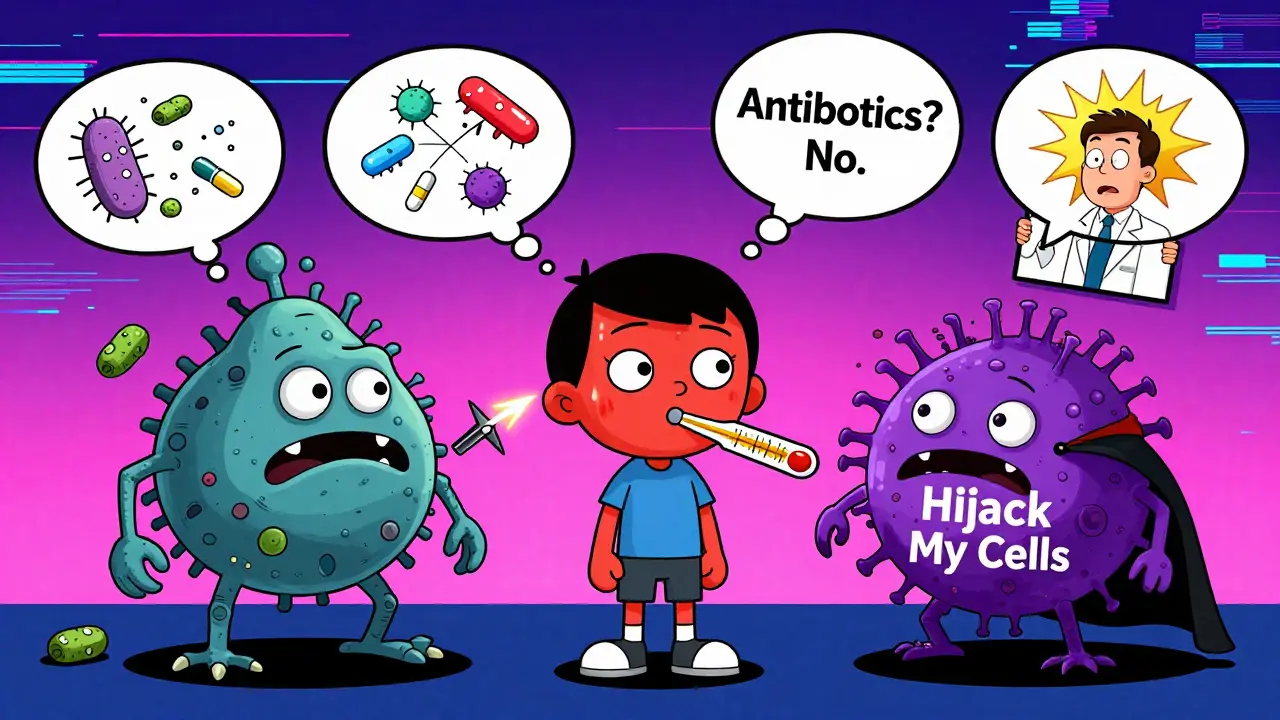
When you have a fever, sore throat, or cough, it’s easy to assume you need antibiotics. But that’s not always true-and in fact, taking them when you don’t need them can make things worse. The difference between a bacterial infection and a viral infection isn’t just scientific jargon. It’s the difference between getting better quickly and risking long-term health problems like antibiotic resistance. And no, you can’t tell just by how you feel.
What Exactly Is a Bacterial Infection?
Bacteria are single-celled living organisms. They can survive on doorknobs, in water, on your skin, and inside your body. Some are helpful-like the ones in your gut that help digest food-but others cause disease. Common bacterial infections include strep throat, urinary tract infections (UTIs), tuberculosis, and some types of pneumonia.
What makes bacteria unique is that they reproduce on their own. Under the right conditions, a single bacterium can split into two every 20 minutes. That’s why infections like strep throat can escalate fast. Bacteria have their own cell walls, DNA, and machinery to build proteins and generate energy. That’s also why antibiotics work: they attack these structures. Penicillin, for example, breaks down bacterial cell walls. Macrolides like azithromycin shut down their protein factories.
According to the World Health Organization, tuberculosis alone caused 10.6 million new cases and 1.3 million deaths in 2022. UTIs lead to over 8 million doctor visits in the U.S. each year. These aren’t rare. But here’s the catch: not every sore throat or cough is bacterial. And that’s where things get dangerous.
What Exactly Is a Viral Infection?
Viruses aren’t alive in the way bacteria are. Think of them as tiny genetic packages wrapped in protein. They can’t reproduce by themselves. They need to invade your cells, hijack their machinery, and force them to make more viruses. That’s why you can’t cure a cold with antibiotics-there’s nothing for them to attack.
The biggest viral infections you’ve likely experienced are the common cold (usually from rhinoviruses), the flu (influenza), chickenpox (varicella-zoster), and COVID-19 (SARS-CoV-2). Before vaccines, chickenpox affected about 4 million people globally each year. Seasonal flu hits 9 to 41 million Americans annually. And as of May 2024, the COVID-19 pandemic had caused over 7 million documented deaths worldwide.
Viruses are much smaller than bacteria. The largest viruses are about 300 nanometers wide. The smallest bacteria are around 200 nanometers. That means you can’t see viruses with a regular microscope. You need an electron microscope. This also means your body’s immune system has to respond differently. Viruses often trigger widespread inflammation-hence the body aches, fatigue, and runny nose that come with the flu.
How Do Symptoms Differ?
Here’s the problem: bacterial and viral infections often feel the same. Both can cause fever, fatigue, sore throat, and cough. But there are patterns that doctors use to guess what’s going on.
Bacterial infections tend to:
- Have higher fevers-often above 101°F (38.3°C)
- Last longer than 10 to 14 days
- Start to improve, then suddenly get worse (like a cold turning into sinusitis)
- Have localized symptoms-like pus on tonsils in strep throat or burning during urination in a UTI
Viral infections usually:
- Start with lower fevers-often under 100.4°F (38°C)
- Come with runny nose, watery eyes, and generalized aches
- Get better within 7 to 10 days
- Are more likely to spread quickly through households or workplaces
But here’s the twist: viral infections can lead to secondary bacterial infections. About half of hospitalized patients with severe viral pneumonia, including from COVID-19, end up with a bacterial infection on top of it. That’s why doctors sometimes prescribe antibiotics in hospitals-even when the original illness was viral.
Why Antibiotics Don’t Work on Viruses
This is the biggest public health mistake in modern medicine. About 68% of people think antibiotics can treat the flu or a cold. A 2023 CDC survey found that 47 million unnecessary antibiotic prescriptions are given every year in U.S. outpatient clinics alone.
Antibiotics work by targeting structures bacteria have but viruses don’t. Penicillin attacks cell walls. Tetracycline blocks protein production. Viruses don’t have cell walls or their own protein factories-they use yours. So antibiotics are like trying to break into a house by picking the lock… when the house is empty.
What happens when you take antibiotics for a virus? You kill off good bacteria in your gut, which can cause diarrhea or even a dangerous infection called Clostridioides difficile (C. diff). In the U.S., C. diff causes 223,900 cases and 12,800 deaths every year. And you’re not helping your body fight the virus-you’re just making it harder for your immune system to bounce back.
When Do You Actually Need Antibiotics?
You need antibiotics when a test confirms a bacterial infection. For strep throat, a rapid antigen test gives results in 10 minutes and is 95% accurate. A throat culture is even more precise-98% accurate-but takes a couple of days.
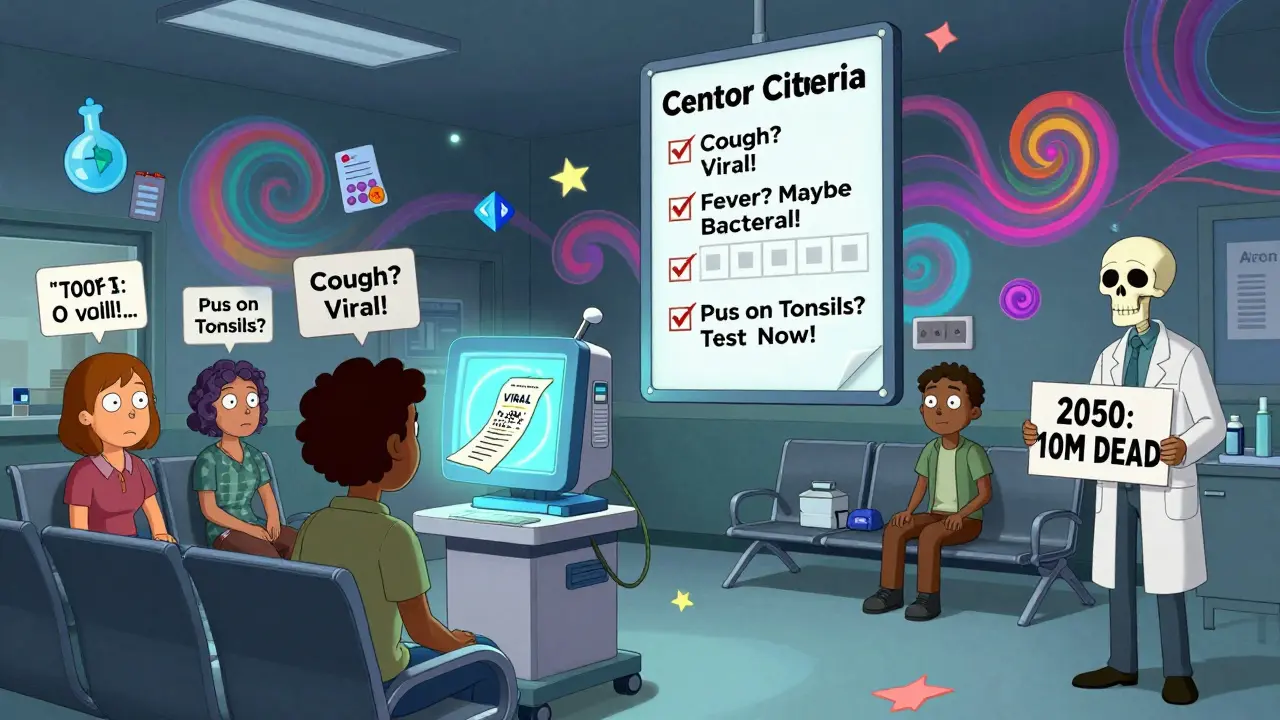
Doctors use the Centor Criteria to help decide if testing is needed:
- Tonsil exudate (white patches) = 1 point
- Tender neck lymph nodes = 1 point
- History of fever over 100.4°F = 1 point
- No cough = 1 point
If you score 3 or more points, there’s a 50-55% chance it’s strep. That’s when testing makes sense. If you score 0-1, it’s almost certainly viral.
For other infections like sinusitis or bronchitis, antibiotics are only recommended if symptoms last longer than 10 days or get worse after improving. About 85% of acute bronchitis cases and 70% of sinus infections are viral. But if you’ve been sick for two weeks with thick yellow mucus and facial pain? That’s when bacteria might be involved.
What Treatments Work for Viral Infections?
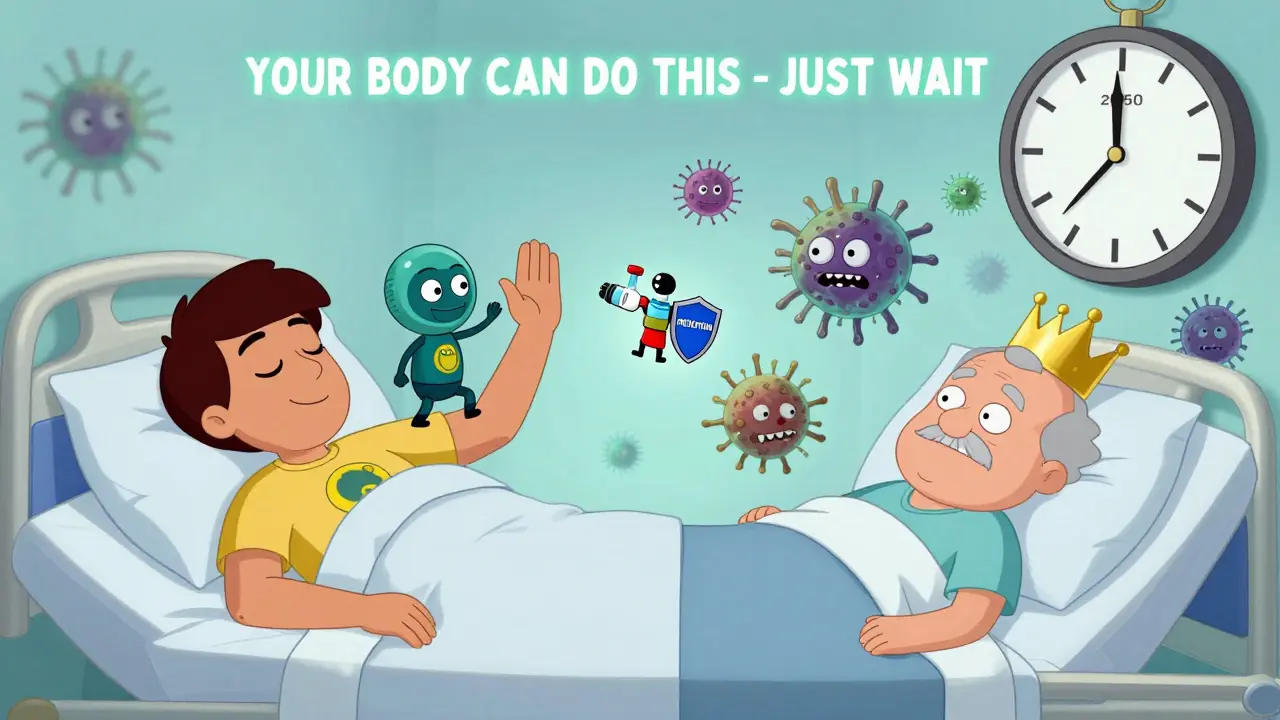
For most viruses, there’s no magic pill. Your body fights them off. But there are tools to help.
- Antivirals: These are rare but powerful. Oseltamivir (Tamiflu) for flu can shorten illness by 1-2 days if taken within 48 hours of symptoms. Remdesivir helps hospitalized COVID-19 patients. Acyclovir treats chickenpox and shingles.
- Supportive care: Rest, fluids, and fever reducers like acetaminophen or ibuprofen. No antibiotics needed.
- Vaccines: The best defense. Flu shots, MMR, varicella, and COVID-19 vaccines have dramatically cut infection rates. A universal coronavirus vaccine is in Phase III trials as of late 2024.
Children get 6 to 8 viral respiratory infections a year. That’s why they miss 22 million school days and parents lose 20 million workdays annually in the U.S. alone. It’s not glamorous-but it’s normal.
The Bigger Picture: Antibiotic Resistance
Every time you take an antibiotic unnecessarily, you’re helping bacteria evolve. They’re not dumb. They learn. And now, we’re running out of options.
In 2019, drug-resistant bacterial infections killed 1.27 million people worldwide. By 2050, that number could hit 10 million-more than cancer. In the U.S., antibiotic-resistant bugs cause 35,900 deaths each year. Resistance to first-line antibiotics like amoxicillin and azithromycin has jumped from 5.8% in 2017 to 17.3% in 2023.
That’s why doctors are now using faster tests like FebriDx, approved by the FDA in 2020. It checks two biomarkers-CRP (a sign of inflammation) and MxA (a sign of viral infection)-and tells you within 10 minutes whether it’s likely bacterial or viral. One study showed it cut unnecessary antibiotic prescriptions by 50%.
Scientists are also testing phage therapy-using viruses that kill bacteria. In European trials, it’s worked in 85% of cases where antibiotics failed. And new narrow-spectrum antibiotics are being designed to target just one type of bacteria, sparing your good gut bugs.
What Should You Do When You’re Sick?
Here’s a simple rule:
- If you feel okay after 7 days, rest and hydrate. You probably have a virus.
- If you feel worse after 5-7 days, or you have a high fever, pus, or symptoms lasting over 10 days, see a doctor.
- Never demand antibiotics. Ask: “Is this bacterial? Can we test for it?”
- Get vaccinated. Flu, COVID-19, and pneumococcal vaccines save lives.
- Don’t share antibiotics. Never use leftover pills.
Most of the time, your body is more than capable of handling an infection. You don’t need a pill. You need time, rest, and patience.
Can you have both a bacterial and viral infection at the same time?
Yes. It’s common, especially in serious cases. For example, someone with the flu (viral) might develop bacterial pneumonia on top of it. That’s why hospitalized patients often get antibiotics-even if the original illness was viral. The body’s defenses are weakened, making room for bacteria to move in.
Why do some people get better faster than others with the same infection?
It depends on age, overall health, immune system strength, and whether they’re vaccinated. A healthy 25-year-old with the flu will usually recover in 5-7 days. An 80-year-old with diabetes and no flu shot might take 3 weeks and need hospitalization. Your body’s ability to fight infection isn’t the same for everyone.
Are natural remedies like garlic, honey, or vitamin C effective against infections?
Some may help with symptoms. Honey can soothe a cough. Zinc lozenges might shorten a cold by a day. But they don’t kill bacteria or viruses. Don’t rely on them instead of medical care. If you have a high fever, trouble breathing, or symptoms lasting over 10 days, you need a doctor-not just honey.
Can you prevent bacterial infections?
Yes. Handwashing, safe food handling, and vaccines (like pneumococcal and meningococcal) reduce risk. Avoiding close contact with sick people helps too. For UTIs, drinking water, peeing after sex, and not holding it in lowers chances. Prevention is always better than antibiotics.
What happens if you take antibiotics when you don’t need them?
You don’t get better faster. Instead, you risk side effects like diarrhea, yeast infections, or C. diff. More importantly, you contribute to antibiotic resistance. Bacteria that survive become stronger. Eventually, common infections could become untreatable. This isn’t science fiction-it’s happening right now.
Reggie McIntyre
February 14, 2026 AT 04:08Man, I wish more people knew this. I used to beg my doctor for antibiotics every time I got a cold-felt like I was being weak if I didn’t get a prescription. Then one time I got C. diff from a needless course of amoxicillin. Lost 15 pounds in two weeks. Learned the hard way: your gut’s got your back if you let it. Rest. Hydrate. Stop panicking. Your body’s a damn warrior.
Jim Johnson
February 15, 2026 AT 17:32sooo true. i had a sinus thing last winter and just rode it out. no antibotics. 8 days later? back to normal. no drama. no diarrhea. no panic. just tea, sleep, and memes. doctors arent magic. your immune system is. trust it. also-vaccines r life. get em.
Vamsi Krishna
February 16, 2026 AT 20:57You people are naive. The pharmaceutical industry doesn’t want you to know this because antibiotics are a $40 BILLION market. They’ve been pushing this ‘antibiotics for everything’ myth since the 1980s. Even WHO is compromised. Look at how fast they approved new drugs after COVID-no long-term studies. They’re gambling with your microbiome. And don’t even get me started on how vaccines are used as control tools. You think this is science? It’s capitalism in a lab coat.
Brad Ralph
February 17, 2026 AT 03:40Antibiotics are the crypto of medicine. Everyone thinks they’re the future. They’re not. They’re just a broken promise with a prescription pad. 🤡
Pat Mun
February 17, 2026 AT 17:57This post literally made me cry. I’m a nurse, and I’ve seen so many patients come in demanding antibiotics for viral infections, then get sicker because their gut flora got wiped out. One woman came in with a UTI after her third round of amoxicillin for a cold. She had to be hospitalized. We had to use last-resort drugs. It breaks my heart. I wish everyone knew how powerful their own immune system is. Rest isn’t laziness-it’s medicine. And yes, honey does help a cough. Not cure it. But soothe it. And that’s worth something. Please, if you’re reading this, stop being afraid of being sick. Your body is not your enemy. Let it work.
Sophia Nelson
February 19, 2026 AT 05:31Wow. So this is what happens when a textbook gets a TED Talk. Congrats. You just turned a simple medical fact into a 2000-word sermon. Can we please just have a pill? I have work. I have kids. I don’t have time to meditate on my immune system. Sometimes I just want to feel better. Not philosophize about it.
steve sunio
February 20, 2026 AT 17:54lol this is why africa is behind. people here think rest and honey fixes everything. you get sick? drink water? bro. i went to hospital with fever, got antibiotic, got better in 2 days. you think your body is a god? no. science is. antibiotics saved my life. stop being woke.
Neha Motiwala
February 21, 2026 AT 08:20Have you considered that this entire article is a government psyop? The CDC, WHO, Big Pharma-they’re all connected. They want you to think you can't tell the difference between viral and bacterial because then you'll keep going to them for tests, for vaccines, for antibiotics... and they'll keep getting rich. I've been researching this for 17 months. The truth is: viruses are man-made. And antibiotics? They're a trap. Don't trust the system. Your body knows what to do. Trust your gut. Literally.
athmaja biju
February 22, 2026 AT 01:19As an Indian, I must say this article is very Western-centric. In our country, we have been using turmeric, neem, and ginger for thousands of years to treat infections. We don’t need your Western pills. Our ancestors knew. You modern people are too dependent on chemicals. Your body is weak because you eat processed food. Go back to roots. Eat real food. Drink warm water. Stop taking antibiotics. Your body is strong. You just forgot how to listen.
Robert Petersen
February 22, 2026 AT 10:08Hey, I just want to say-this post was a game-changer for me. I used to be the guy who demanded antibiotics at every sniffle. Then I got really sick last year and didn’t take any. I slept. I drank broth. I watched dumb Netflix. And you know what? I got better. Not because of magic. Because my body did its job. And now I’m actually *proud* of how resilient I am. If you’re reading this and you’re sick right now-breathe. You’ve got this. You’re not broken. You’re healing. And that’s kind of beautiful.