
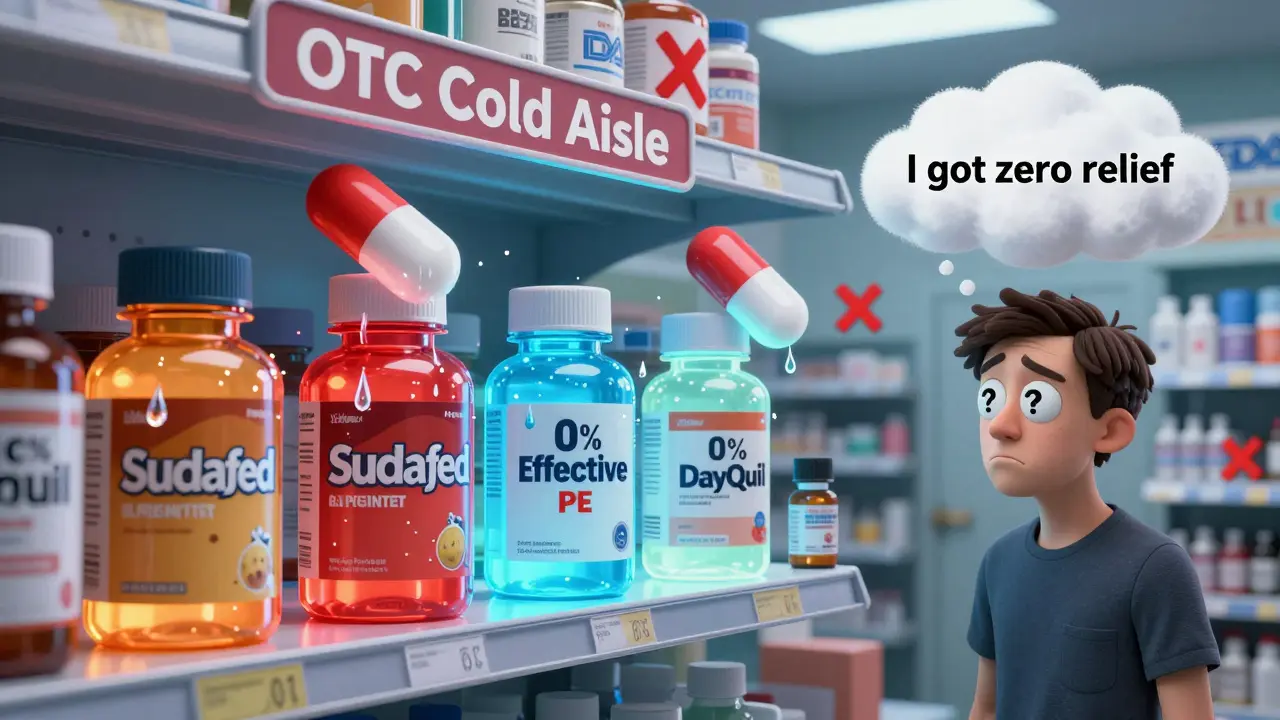
Every winter, millions of people reach for OTC cough and cold medicines hoping for quick relief. But what if the bottle in your cabinet doesn’t actually work - and might even be risky? The truth is, many of the most common over-the-counter remedies for coughs and colds have been called into question by science, regulators, and even pharmacists. If you’re wondering whether those pills, syrups, and drops are worth the money, you’re not alone.
Why Your OTC Cold Medicine Might Be Wasting Your Money
The most widely used decongestant in OTC products today is phenylephrine. You’ll find it in brands like Sudafed PE, DayQuil, and Robitussin Cold. It’s labeled as a nasal decongestant, promising to unclog your sinuses. But here’s the problem: a 2007 meta-analysis by Hatton et al. found that 10mg of oral phenylephrine - the exact dose in every bottle - showed no significant difference compared to a sugar pill. Even at 25mg, which isn’t sold in stores, the improvement was minimal and didn’t match how people actually felt.
In September 2023, the FDA’s Non-prescription Drug Advisory Committee concluded that oral phenylephrine is not effective as a nasal decongestant at any approved dose. This isn’t a new suspicion - pharmacists have been saying this for years. Reddit threads from r/Pharmacy are full of users who’ve tried it and got zero relief. One user wrote: “I’ve recommended nasal sprays over oral phenylephrine for years because the evidence shows it simply doesn’t work.”
And yet, phenylephrine is still everywhere. Why? Because it’s cheap to make and doesn’t require ID to buy - unlike pseudoephedrine, which actually works. Pseudoephedrine (found in Sudafed) reduces nasal congestion by 30-40%, but it’s kept behind the counter because it can be used to make methamphetamine. So, you get the ineffective ingredient in plain sight, and the real solution is hidden.
What About Cough Suppressants and Expectorants?
Two other common ingredients are dextromethorphan (for cough suppression) and guaifenesin (to loosen mucus). Both are in nearly every cough syrup on the shelf. But the evidence? Weak.
A 2014 review of 29 clinical trials found conflicting results for both. For dextromethorphan, some studies showed slight benefit in adults, but others showed nothing. For guaifenesin, there’s almost no proof it helps thin mucus in real-world conditions. Dr. Libby Wirth from the University of Minnesota Pharmacy put it bluntly: “Evidence for OTC cough medications is poor, not supporting the use of guaifenesin or dextromethorphan.”
And here’s the kicker: these ingredients aren’t harmless. Dextromethorphan can cause dizziness, nausea, and, in high doses, hallucinations. Guaifenesin can interact with other medications and cause dehydration if you don’t drink enough water. Taking multiple products at once - like a cold tablet, a cough syrup, and a nighttime formula - means you’re likely doubling up on these ingredients. The FDA warns this can lead to accidental overdose. Between 2000 and 2007, 20 child deaths in the U.S. were linked to OTC cold medicine ingestion, mostly in kids under two.
Children and OTC Medicines: A Dangerous Mix
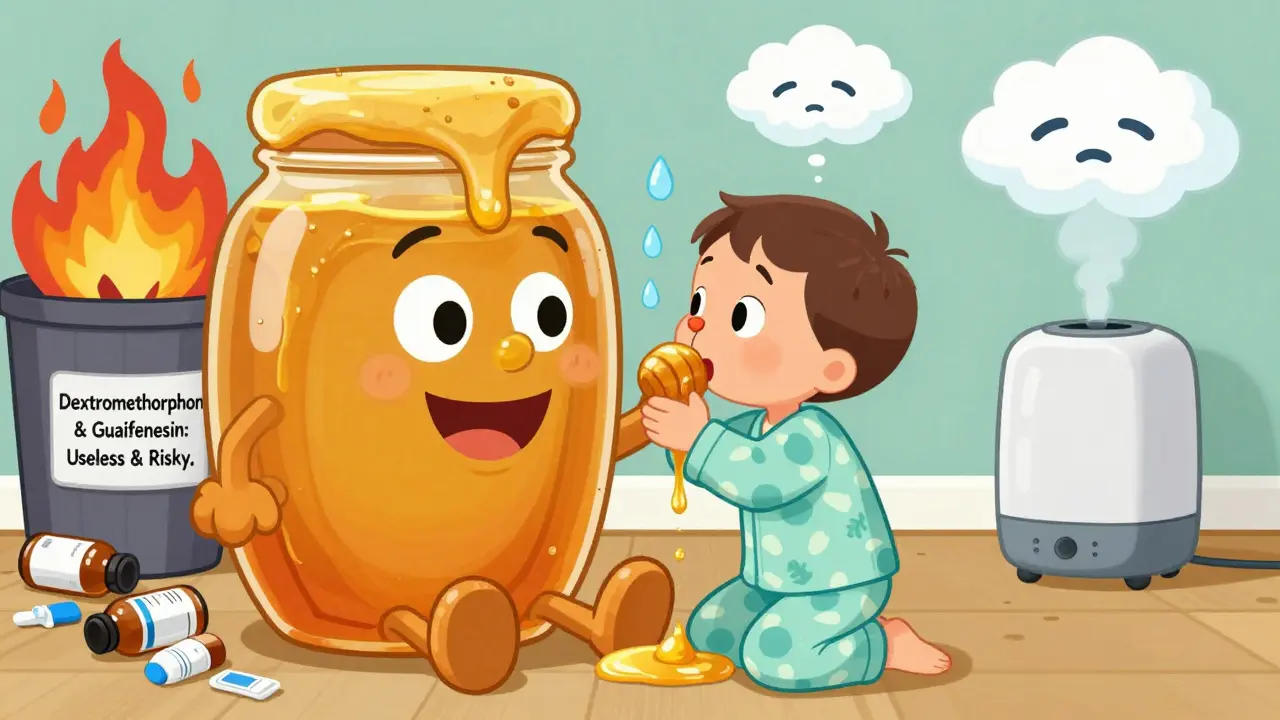
If you have young kids, this is critical: don’t give OTC cough and cold medicine to children under six. The American Academy of Pediatrics, the FDA, and the Mayo Clinic all agree: there’s no evidence these medicines help kids get better faster. And the risks? Real.
Children’s metabolisms process drugs differently. A dose that’s safe for an adult can be toxic for a toddler. Accidental overdoses happen often - parents think they’re being careful by giving half a dose, but the liquid formulations are hard to measure accurately. A 2023 survey by What to Expect found that 73% of parents have stopped giving OTC cold medicine to children under six after seeing FDA warnings.
So what works instead? Simple, safe, and free:
- Honey - for kids over 12 months. A 2023 study in the Journal of the American Medical Association found that 2.5mL (half a teaspoon) of honey before bed reduced nighttime coughing as well as, or better than, dextromethorphan. It’s natural, cheap, and has no side effects.
- Saline nose drops - use them before feeding or bedtime. They clear mucus without chemicals.
- Bulb suction - for babies who can’t blow their noses.
- Humidified air - a cool-mist humidifier in the room helps thin mucus and soothe irritated airways.
- Extra fluids - water, broth, or even popsicles keep kids hydrated and help loosen congestion.
Adults: What Should You Actually Use?
For adults, the picture is a little clearer. If you need congestion relief, skip the phenylephrine. Go straight for pseudoephedrine - yes, the one behind the counter. You’ll need to show ID and sign a log, but it works. Studies show it reduces nasal resistance by 30% or more.
For cough, skip the syrup. Try honey again - it works for adults too. A 2023 study from the American Medical Association found honey was as effective as dextromethorphan for nighttime coughs, with no risk of side effects.
For sore throat and body aches, acetaminophen or ibuprofen are your best bets. They treat the pain and fever - not the cold itself, but they make you feel better. And unlike combination cold pills, they don’t come with extra ingredients you don’t need.
One thing to watch: drug interactions. Decongestants like pseudoephedrine can spike blood pressure. If you take antidepressants like MAOIs or tricyclics, combining them with decongestants can cause dangerous spikes in heart rate or blood pressure. Always check with a pharmacist before mixing medications.
The Future of OTC Cold Medicine
The FDA is moving to remove oral phenylephrine from its list of approved OTC ingredients. The proposed rule was published in late 2023, with public comments closing in May 2024. If finalized, manufacturers will have until Q3 2025 to reformulate products. That means the next time you buy DayQuil or Robitussin, the decongestant might be gone - or replaced with something better.
Market analysts predict a 15-20% drop in OTC cold medicine sales by 2025 as people realize they’ve been paying for placebo. Meanwhile, sales of honey-based remedies and saline nasal sprays are growing at 12.7% per year. By 2026, experts expect 25% of the cold remedy market to shift toward these safer, evidence-backed options.
Even big brands are adapting. Johnson & Johnson, Procter & Gamble, and Bayer are all working on reformulated products. But the real winner? Consumers who stop believing the marketing and start trusting science.
What to Do Right Now
Here’s what you can do today to stay safe and avoid wasting money:
- Check the Drug Facts label - Look for phenylephrine. If it’s there, skip it. Look for pseudoephedrine instead - it’s the real thing.
- Never mix products - One cold tablet + one cough syrup = double dose of dextromethorphan or guaifenesin. That’s how overdoses happen.
- For kids under 6 - Stick to honey (if over 12 months), saline drops, humidifiers, and fluids. No pills.
- For adults - Use honey for cough, saline spray for congestion, and acetaminophen or ibuprofen for pain. Skip the combo packs.
- Ask your pharmacist - They see what works and what doesn’t. No judgment. Just facts.
The cold medicine aisle is full of promises. But science doesn’t lie. The best treatments are often the simplest - and already in your kitchen.
Nerina Devi
February 21, 2026 AT 19:41Dinesh Dawn
February 22, 2026 AT 01:22Vanessa Drummond
February 23, 2026 AT 19:54kirti juneja
February 24, 2026 AT 03:55Haley Gumm
February 25, 2026 AT 15:19Gabrielle Conroy
February 26, 2026 AT 12:02Spenser Bickett
February 27, 2026 AT 21:10Christopher Wiedenhaupt
March 1, 2026 AT 14:07