
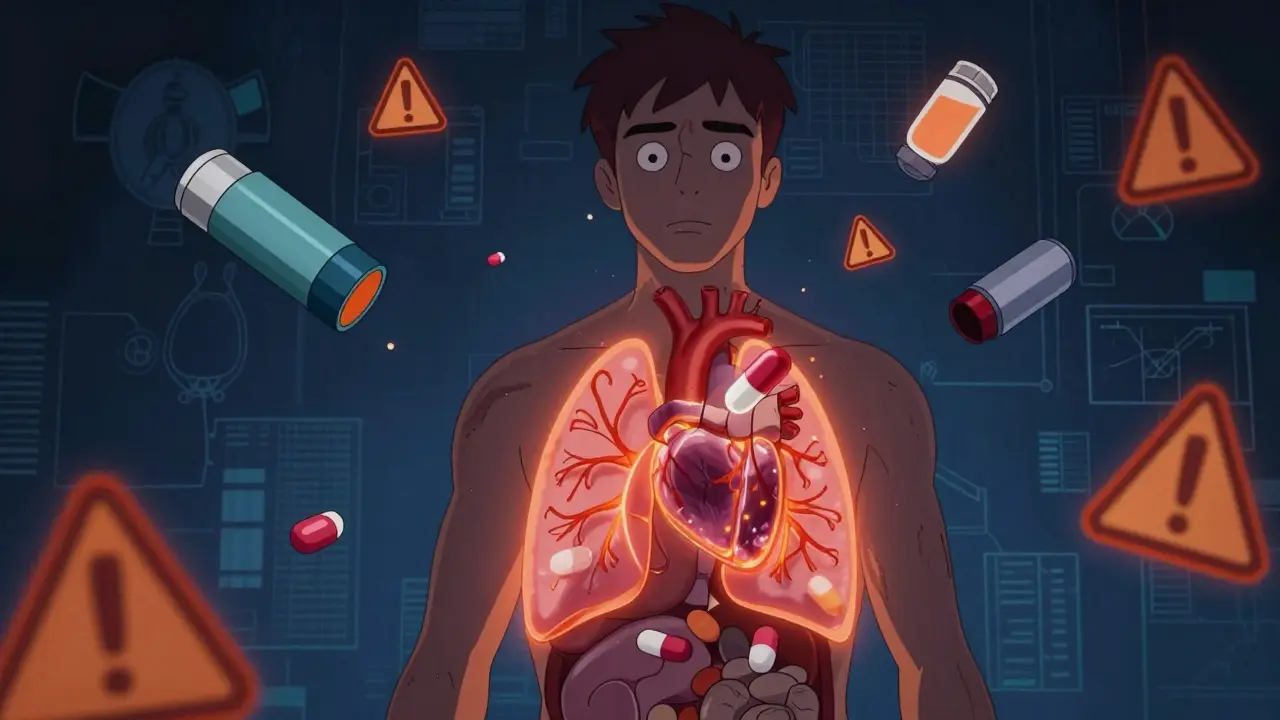
Most people know that mixing two pills can cause problems. But what if your health condition itself makes a medication dangerous? This isn’t rare. It’s happening right now to millions of people taking meds for one illness while silently worsening another.
Imagine someone with high blood pressure taking a beta-blocker. It helps their heart. But if they also have asthma, that same drug can tighten their airways and trigger a life-threatening attack. Or consider a diabetic on metformin. Their kidneys are already struggling. The drug builds up, leading to lactic acidosis - a condition that can shut down organs. These aren’t side effects. They’re drug-disease interactions: when your body’s existing health problems turn a normal medicine into a hidden threat.
How Your Body Turns Medicine Into a Risk
Drugs don’t work in a vacuum. They move through your liver, kidneys, heart, and brain - all of which can be damaged by other conditions. When that happens, the drug’s behavior changes in ways doctors sometimes miss.
One common mechanism is pharmacodynamic interference. That’s when the drug’s effect directly fights your disease. For example, NSAIDs like ibuprofen reduce pain and inflammation. But if you have heart failure, they cause your body to hold onto salt and water. That extra fluid makes your heart work harder - and can send you back to the hospital.
Then there’s pharmacokinetic alteration. This is about how your body processes the drug. Liver disease slows down how fast warfarin (a blood thinner) breaks down. That means even a standard dose can make your blood too thin, leading to dangerous bleeding. Same with kidney disease: it messes with how metformin, lithium, and many antibiotics leave your body. The result? Toxic buildup.
Another sneaky problem is masking symptoms. Beta-blockers for heart conditions can hide the shaking, sweating, and fast heartbeat that warn you your blood sugar is crashing. Diabetics might not realize they’re in danger until they pass out. Similarly, antidepressants can dull the signs of low sodium - a condition that’s already common in older adults with heart or kidney problems.
And then there’s direct toxicity. Some drugs just hurt certain organs. For instance, certain antibiotics can damage nerves in people with Parkinson’s. Anticholinergics - used for overactive bladder or allergies - can make dementia worse by fogging up the brain. These aren’t rare. They’re predictable. And they’re often ignored.
The Top Four Conditions That Turn Medications Dangerous
Not all health problems create the same level of risk. Based on data from the American Society of Health-System Pharmacists and the FDA, four conditions stand out as the biggest drivers of harmful drug-disease interactions:
- Chronic kidney disease: Affects 1 in 7 adults in the U.S. Over 80% of serious drug-disease interactions involve this. Drugs like metformin, NSAIDs, and contrast dyes for scans can pile up and cause organ failure.
- Heart failure: Nearly 40% of patients with heart failure take at least one drug that makes their condition worse. NSAIDs, most non-dihydropyridine calcium channel blockers, and even some diabetes meds like pioglitazone are red flags.
- Liver disease: The liver is the body’s main drug processor. If it’s damaged by alcohol, hepatitis, or fatty liver disease, drugs like statins, benzodiazepines, and acetaminophen can become toxic at normal doses.
- Psychiatric conditions: Depression, bipolar disorder, and anxiety are often treated with SSRIs or lithium. But these drugs can cause bleeding (especially with aspirin or NSAIDs), low sodium, or even serotonin syndrome if mixed with St. John’s wort - a popular herbal supplement.
These aren’t theoretical risks. In a 2023 study of over 120,000 hospital admissions, nearly 1 in 5 were linked to drug-disease interactions - and 78% involved one of these four conditions.
Why Doctors Miss These Interactions
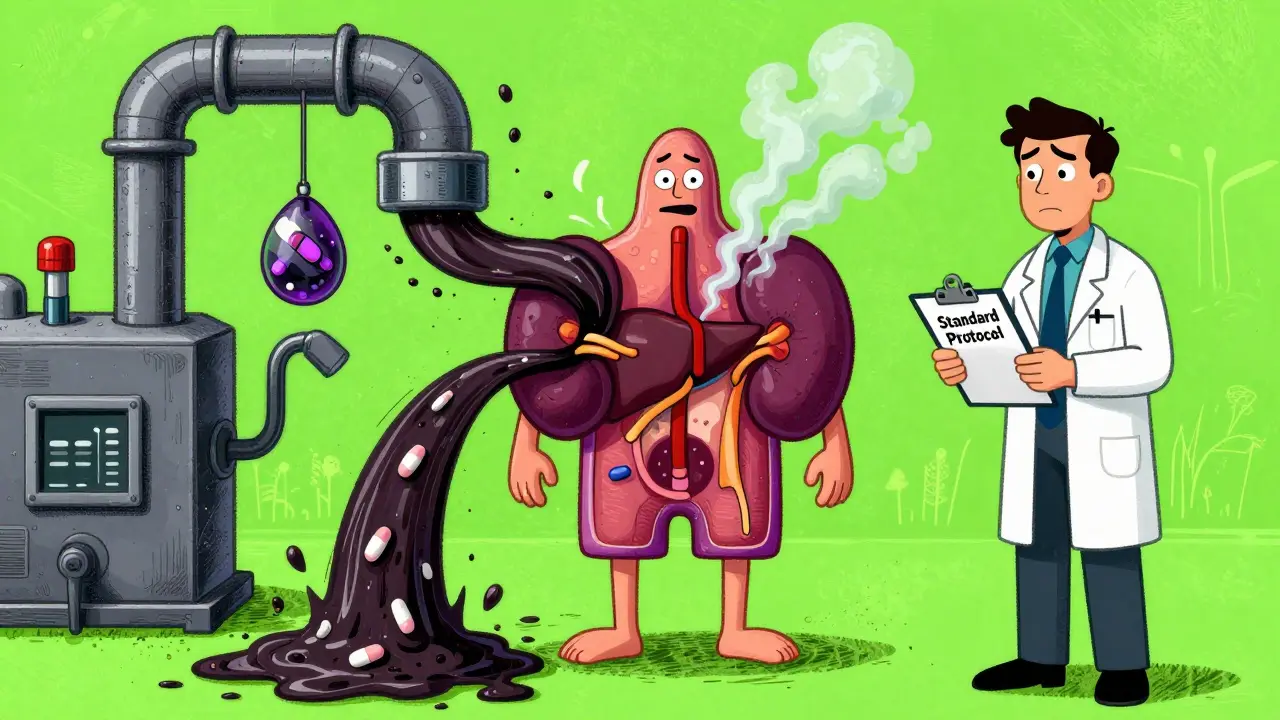
You’d think doctors would catch this. After all, they have access to your full medical history. But here’s the problem: most clinical guidelines don’t mention it.
A 2020 review found that only 16% of treatment guidelines for diabetes, depression, or heart failure included warnings about drug-disease interactions. That means if you follow the “standard” advice for your condition, you might be unknowingly taking a drug that harms another one.
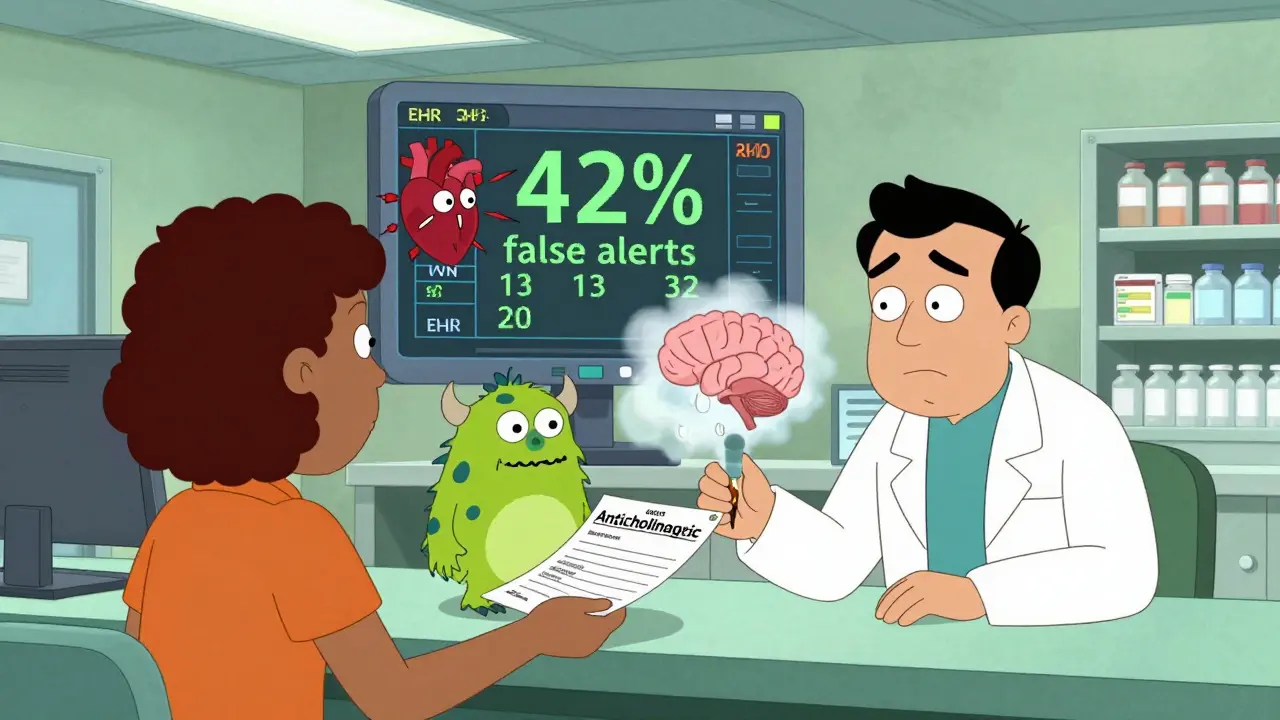
Electronic health records (EHRs) are supposed to help. Epic, Cerner, and other systems flag potential interactions. But they’re noisy. One study showed that 42% of the alerts are false positives - warnings for things that aren’t actually dangerous. Doctors start ignoring them. It’s called alert fatigue. And when that happens, the real dangers slip through.
Pharmacists see it too. In Australia and the U.S., community pharmacists spend an average of 13 minutes per patient just checking for these interactions. But most of that time happens during a 5-minute medication review - not during the initial prescription. By then, the harm may already be done.
And patients? Most don’t know to ask. A 2022 survey found only 22% of people with high blood pressure understood why decongestants like pseudoephedrine could spike their pressure. Yet 89% had been prescribed them at some point.
What You Can Do Right Now
You don’t need to be a doctor to protect yourself. Here’s what actually works:
- Make a complete list. Write down every pill, patch, injection, supplement, and herb you take - even the ones you only use occasionally. Include over-the-counter meds like ibuprofen, antacids, and sleep aids.
- Ask your pharmacist. Don’t wait for them to ask you. Walk up and say: “I have [condition]. Are any of these drugs risky for me?” They’re trained for this. And they’re paid to give you this advice.
- Know your red flags. If you start feeling worse after starting a new drug - more shortness of breath, swelling in your legs, confusion, dizziness, or unusual fatigue - don’t assume it’s just the disease getting worse. It could be the drug.
- Request a medication review. Especially if you’re over 65 or have three or more chronic conditions. Ask your doctor for a “medication reconciliation” - a formal check-up of everything you’re taking.
- Use the Beers Criteria. It’s a free, publicly available list of drugs that are risky for older adults with common conditions. You can search it online. If your drug is on it, ask why it’s still being prescribed.
There’s also a simple framework called DUP-OP-ALT: check for Duplication (are you taking two drugs that do the same thing?), Opposition (does this drug fight your condition?), and Alteration (is your body processing it differently because of another disease?).
The Future Is Personalized - But You Can’t Wait
Researchers are building AI tools that can predict your personal risk by analyzing your age, lab results, genetics, and all your conditions. One University of Toronto algorithm got 89% accuracy using 157 data points. The NIH’s All of Us program is linking DNA to health records to find hidden risks.
But these tools aren’t widely available yet. The FDA now requires drug makers to test their medications in people with kidney or liver disease - a big step. And the European Medicines Agency now demands a drug-disease interaction section in every new drug application.
But here’s the hard truth: you can’t wait for the system to fix itself. Right now, the burden is on you. The drugs you take are not one-size-fits-all. Your body is a complex system - and your conditions matter as much as the pills you swallow.
Don’t assume your doctor knows. Don’t assume your pharmacist will catch it. Don’t assume the EHR will warn you. Take control. Ask. Check. Speak up. Because in the world of drug-disease interactions, the safest medicine is the one you understand.
Frequently Asked Questions
Can over-the-counter drugs cause drug-disease interactions?
Yes, absolutely. Common OTC meds like ibuprofen, naproxen, pseudoephedrine, and even antacids can cause serious interactions. For example, NSAIDs can worsen heart failure and kidney disease. Pseudoephedrine can spike blood pressure in people with hypertension. Even calcium supplements can interfere with thyroid medication. Just because something is sold without a prescription doesn’t mean it’s safe with your conditions.
Are herbal supplements safe if I have chronic conditions?
Many are not. St. John’s wort can cause serotonin syndrome when taken with antidepressants. Garlic and ginkgo can increase bleeding risk with blood thinners. Licorice root can raise blood pressure and lower potassium. Herbal products aren’t tested the same way as prescription drugs. If you have heart, liver, kidney, or psychiatric conditions, assume any supplement could interact - and always tell your doctor what you’re taking.
Why don’t my prescriptions come with warnings about my conditions?
Prescription labels only list the most common side effects - not how your specific diseases might make those side effects worse. Drug labels are written for the general population. They don’t account for your unique mix of conditions. That’s why you need to talk to your pharmacist or doctor. They’re the ones who can connect your personal health history to the medication.
Is this only a problem for older adults?
No. While older adults are at higher risk because they often have multiple conditions and take more meds, younger people with chronic illnesses - like diabetes, asthma, or autoimmune diseases - are just as vulnerable. A 35-year-old with kidney disease on metformin is at the same risk as a 75-year-old. Age isn’t the issue. The number and type of health conditions are.
What should I do if I think a drug is making my condition worse?
Don’t stop taking it on your own. Call your doctor or pharmacist immediately. Write down when the symptoms started, what you were taking, and how you’re feeling. Bring your complete medication list. You might need a dose change, a different drug, or extra monitoring. Stopping suddenly can be dangerous. But ignoring the signs can be worse.
Jeffrey Hu
January 9, 2026 AT 17:47Let me break this down for you folks who think EHRs are magic. The system doesn't care about your kidney function unless you input it correctly. I've seen patients on metformin with eGFR of 32 and no alert because the lab result wasn't synced. It's not the algorithm's fault-it's the user's. You think your doctor is checking your labs? They're clicking through 200 alerts a day. Most just hit 'ignore all' and move on. The burden isn't on the tech-it's on YOU to know your numbers.
Kiruthiga Udayakumar
January 11, 2026 AT 13:45Stop blaming doctors. I'm from India, and my aunt was on ibuprofen for arthritis while having stage 3 CKD. Her doctor never asked about OTC meds. She ended up in dialysis. This isn't just an American problem-it's a global failure of education. People think 'natural' means safe. Licorice root? Garlic pills? They're not candy. If you have a chronic disease, every pill-even the ones you buy at the corner store-is a potential grenade. And no, your yoga instructor doesn't know pharmacology.
Gregory Clayton
January 13, 2026 AT 06:37Bro, I'm 42, diabetic, and my doc gave me metformin. I didn't even know kidneys were involved until I read this. Now I check my GFR every 3 months. But here's the real issue-why does Big Pharma still sell NSAIDs like they're water? My buddy took naproxen for back pain and got hospitalized. Nobody warned him. This isn't science-it's corporate negligence. We need lawsuits. Not just 'ask your pharmacist.' That's a Band-Aid on a gunshot wound.
Catherine Scutt
January 15, 2026 AT 04:41I have three chronic conditions and take 11 medications. I keep a color-coded spreadsheet. Red = high risk. Yellow = monitor. Green = safe. I print it and hand it to every new provider. No one ever asks for it. But I keep doing it because someone has to. I don't trust algorithms. I don't trust 'standard guidelines.' I trust my own notes. If you're not doing this, you're gambling with your organs.
Matthew Maxwell
January 16, 2026 AT 02:16It's appalling how little medical education emphasizes pharmacodynamic and pharmacokinetic interactions. Medical students are taught to memorize side effects, not to think in systems. A patient with liver disease on benzodiazepines? That's not an 'adverse reaction'-it's a predictable cascade of failure. And yet, residency programs still prioritize speed over safety. The entire system is designed to treat symptoms, not the whole organism. This isn't negligence-it's institutionalized ignorance.
Maggie Noe
January 16, 2026 AT 16:33It's funny how we treat medicine like it's a one-size-fits-all algorithm, but our bodies are ecosystems. A drug isn't just a molecule-it's a force interacting with a thousand other forces. Your kidney isn't a filter-it's a diplomat negotiating with every pill you swallow. And we act surprised when the negotiation fails? We don't treat the body as a network. We treat it like a car: 'Add this part, fix that part.' But you can't replace a failing liver like a spark plug. We need humility. Not more alerts. Not more apps. Just… awareness. That's the real medicine.
Lindsey Wellmann
January 16, 2026 AT 22:46OMG I JUST REALIZED I’VE BEEN TAKING IBUPROFEN FOR MY MIGRAINES AND I HAVE HIGH BP 😱😭 I’M SO SCARED RIGHT NOW. I JUST TEXTED MY PHARMACIST AND SHE SAID ‘OH HONEY YOU NEED TO STOP IMMEDIATELY’ AND I CRIED. THANK YOU FOR THIS POST. I’M SENDING THIS TO EVERYONE I KNOW. 🙏❤️ #DrugDiseaseAwareness #DontBeLikeMe
Ashley Kronenwetter
January 18, 2026 AT 02:53Thank you for the thorough and clinically accurate breakdown. I work in hospital pharmacy and see these interactions daily. The most dangerous myth is that ‘if it’s on the label, it’s safe.’ Labels are written for healthy populations. The real risk lies in the intersection of comorbidities-something rarely quantified in clinical trials. I encourage every patient with multiple conditions to request a comprehensive medication review. It’s a covered benefit under Medicare Part D. You don’t need to beg for it. It’s your right.