
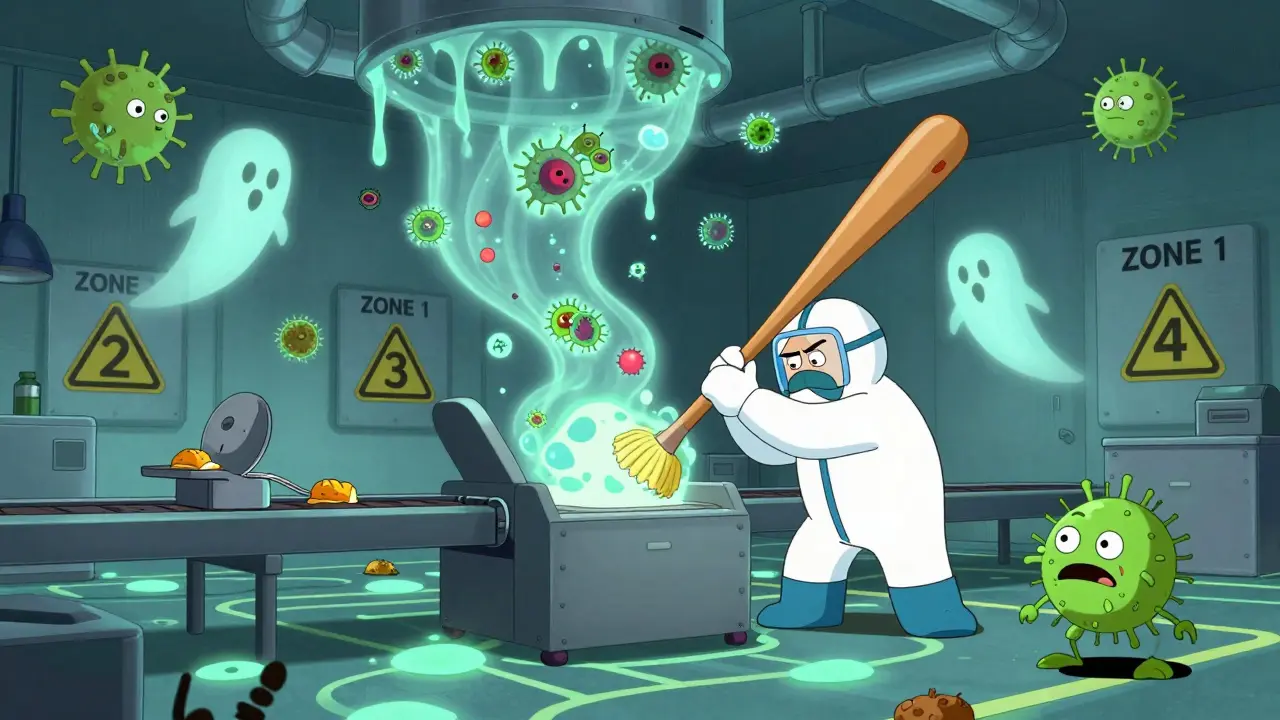
When you walk into a food processing plant or a pharmaceutical lab, you don’t see the real danger. It’s not the machines, the belts, or the workers. It’s what you can’t see: bacteria on a floor drain, mold spores drifting near a mixer, or metal particles in purified water. These invisible threats can ruin entire batches, trigger recalls, or worse - make people sick. That’s why environmental monitoring isn’t just paperwork. It’s the frontline defense in manufacturing quality.
What Environmental Monitoring Actually Does
Environmental monitoring is the routine testing of surfaces, air, water, and equipment to catch contamination before it touches your product. It’s not about reacting to a problem. It’s about stopping it before it starts. In pharmaceutical plants, this means checking if cleanroom air meets ISO Class 5 standards. In food facilities, it’s swabbing slicers and drains for Listeria. In cosmetics, it’s testing water systems for fungi. The goal? Keep your product safe, your regulators happy, and your customers trusting.The CDC says environmental monitoring is the best way to confirm a hazardous condition exists - and then prove you fixed it. That’s powerful. One study found that 87% of foodborne outbreaks linked to environmental contamination could have been prevented with proper sampling. That’s not a small number. It’s billions in lost sales, damaged brands, and lives at risk.
The Zone System: How to Prioritize Your Testing
Not all surfaces are created equal. That’s why every serious facility uses a zone classification system. Think of it like a risk map.- Zone 1: Direct food or product contact surfaces - slicers, mixing bowls, filling nozzles. These are high-risk. If something grows here, it goes straight into your product. Testing here happens daily or weekly.
- Zone 2: Surfaces near product contact - equipment housings, conveyor frames, refrigeration units. Contamination here can splash or drift onto Zone 1. Test weekly to monthly.
- Zone 3: Remote but still inside the production area - forklifts, tool carts, overhead pipes. Sounds low risk? Not always. A PPD Labs study found floors (a Zone 3 surface) caused 62% of all contamination events. Condensation dripping from pipes? That’s a hidden Zone 1 risk.
- Zone 4: Outside the production zone - break rooms, hallways, storage. Test monthly or quarterly. Still important, but lower priority.
Here’s the catch: one manager’s Zone 3 is another’s Zone 1. A pipe dripping condensation? That’s a contamination vector. If you treat it like a Zone 4 surface, you’re playing Russian roulette with your product. Risk assessments must be specific to your facility - not copied from a handbook.
How Testing Works: Tools and Methods
Different contaminants need different tools. You can’t use a swab to count air particles. Here’s what’s actually used in real facilities:- Microbial swabs and sponges: Used on surfaces. Sterile, pre-moistened, and handled like surgical tools. If you touch the swab tip, your sample is ruined.
- Air samplers: Liquid impingers suck air into liquid, trapping microbes. Solid impactors slam air onto agar plates. Both give results in CFU/m³ - colony-forming units per cubic meter. Critical for cleanrooms.
- ATP testing: This isn’t for identifying bugs. It’s for checking cleanliness. ATP (adenosine triphosphate) is found in all living cells. A handheld device reads it in seconds. Facilities using ATP see 32% faster turnaround between production runs because they don’t wait 48 hours for lab results.
- TOC and conductivity meters: Used for water systems. In pharma, water must meet USP <645> standards. TOC measures organic carbon. Conductivity checks for ions. Both are non-negotiable.
- ICP and chromatography: For heavy metals and chemical residues. Inductively Coupled Plasma detects lead, cadmium, mercury. HPLC finds pesticide traces or cleaning agent leftovers.
Here’s a reality check: 68% of facilities mess up sampling technique. Swabs get contaminated before they even touch the surface. Air samplers aren’t sterilized. People don’t wear gloves. These aren’t minor errors. They’re false negatives - and they cost companies millions.
Industry Differences: Pharma vs. Food vs. Cosmetics
What works in a drug factory won’t work in a bakery. The rules vary by sector.| Factor | Pharmaceutical | Food (RTE) | Cosmetics |
|---|---|---|---|
| Primary Contaminants | Endotoxins, airborne particles, sterile failure organisms | Salmonella, Listeria monocytogenes, mold | Molds, yeasts, Pseudomonas, preservative-resistant microbes |
| Air Monitoring | Continuous, real-time, ISO Class 5 (Grade B) required | Intermittent, focus on microbial load | Monthly, focus on fungal spores |
| Water Testing | USP <645> standards, TOC + conductivity daily | Follow EPA municipal standards | USP <645> for purified water, microbial limits |
| Regulatory Standard | EU GMP Annex 1 (2023), FDA 21 CFR Part 211 | USDA FSIS 9 CFR Part 430 (Listeria Rule) | US FDA Cosmetic GMP (2023 draft) |
| Testing Frequency (Zone 1) | Daily | Weekly (Listeria) | Weekly to biweekly |
Pharma is the strictest. A single particle in a vial can kill. Food is the most unpredictable. Listeria can grow in cold, wet, dirty places - and it doesn’t care if your plant is clean. Cosmetics? They’re the wildcard. People assume they’re low risk. But a moldy lotion can cause serious skin infections. And regulators are catching up.
The Hidden Costs of Poor Monitoring
Let’s say you skip Zone 3. You think, “It’s just the floor.” But a 2013 PPD study showed 62% of contamination events came from floors and drains - not the product contact surfaces. That’s not a fluke. It’s systemic.Small facilities struggle the most. Only 48% of companies under 50 employees have fully compliant programs. Why? Cost. Training. Time. A medium-sized food plant spends $15,000-$25,000 a year on testing supplies and lab fees. They need 2-3 full-time staff just to manage sampling, record data, and clean up false alarms.
But the real cost isn’t the budget. It’s the recall. A single Listeria outbreak can cost a food company $10 million in lost sales, legal fees, and brand damage. The USDA says foodborne illness costs the U.S. $77.7 billion a year. That’s not abstract. That’s your customer’s child, your supplier’s livelihood, your factory’s future.
What’s Changing in 2025
The rules aren’t staying still. In 2023, EU GMP Annex 1 demanded real-time data trending for critical parameters. That means no more paper logs. You need sensors feeding data into software that flags trends before they become problems.Next-generation sequencing (NGS) is starting to replace traditional culture methods. Instead of waiting 72 hours to identify a microbe, labs can now sequence its DNA in under 24 hours. AI is stepping in too - analyzing years of environmental data to predict where contamination is likely to pop up next. MarketsandMarkets predicts 38% of monitoring systems will use AI by 2027. That’s not science fiction. It’s already happening in top-tier facilities.
Another shift: antimicrobial resistance. In 2020, CDC data showed 19% of Listeria strains from food plants were resistant to multiple antibiotics. That’s alarming. It means even if you kill the bug, its DNA might survive - and pass on resistance. Monitoring now includes tracking not just presence, but genetic profiles.
How to Get It Right
You don’t need to be perfect. You need to be consistent.- Map your zones. Don’t guess. Walk every inch of your facility. Where does moisture collect? Where do people move between clean and dirty areas? That’s your risk map.
- Train your team. 40 hours of hands-on training isn’t optional. If your staff doesn’t know how to swab properly, your data is garbage.
- Integrate your data. Don’t have ATP results in Excel, microbiology in a binder, and air sampling in a logbook. Use software that brings it all together. The IDFA says 37% of facilities struggle with this. Don’t be one of them.
- Review monthly. Look for trends. Is one drain always positive? Is contamination spiking after a cleaning crew shift? That’s your clue.
- Don’t overdo it. PPD Labs found that excessive monitoring doesn’t improve outcomes. Focus on zones and methods that matter. Less noise. More signal.
Environmental monitoring isn’t about checking boxes. It’s about building a culture of vigilance. The best facilities don’t just test surfaces - they test their assumptions. They ask: What if we’re wrong? What if we missed something? That’s the mindset that keeps products safe - and companies alive.
What’s the difference between environmental monitoring and product testing?
Product testing checks the final item - like a bottle of medicine or a pack of deli meat - for contamination. Environmental monitoring checks the surroundings: floors, air, water, equipment. The key difference? Environmental monitoring catches contamination before it gets into the product. It’s preventative. Product testing is reactive. You need both, but environmental monitoring stops problems before they start.
How often should I test Zone 1 surfaces?
Zone 1 surfaces - anything that touches your product - should be tested daily in high-risk areas like pharmaceutical filling lines or ready-to-eat food slicers. In lower-risk settings, weekly testing is common. The FDA requires weekly Listeria testing in RTE food Zone 1 areas. Frequency must match your risk assessment, not a calendar.
Is ATP testing enough for environmental monitoring?
No. ATP testing tells you if a surface is clean - but not what’s on it. It can’t identify bacteria, mold, or allergens. It’s a quick check for sanitation, not a full environmental monitoring program. Use ATP to speed up cleaning verification, but always follow up with microbiological or chemical testing to identify actual contaminants.
Why do some facilities test floors more than product contact surfaces?
Because contamination often starts on floors and spreads. A 2013 study found 62% of contamination events came from Zone 3 and 4 surfaces like floors and drains. Water drips from pipes onto floors. Shoes track in dirt. Air currents lift particles. Even if a surface isn’t direct contact, it can become a source. That’s why smart facilities monitor floors aggressively - not because they’re high-risk by design, but because they’re high-risk by reality.
Can small manufacturers afford proper environmental monitoring?
Yes - but they need to be smart. You don’t need 24/7 air monitoring or a full-time lab team. Start with Zone 1 and 2. Use ATP for quick checks. Partner with a local lab for microbiological testing. Focus on high-risk products and processes. The USDA found only 48% of small facilities (<50 employees) are fully compliant - not because they can’t afford it, but because they don’t know where to start. Prioritize. Document. Train. You don’t need perfection. You need control.
What happens if I fail an environmental monitoring inspection?
It depends. In pharma or food, a single positive result for Listeria or Salmonella can trigger a regulatory hold - meaning you can’t ship product until you prove you fixed it. In worst cases, you get a warning letter from the FDA, a recall, or a shutdown. But if you’ve documented your corrective actions, trained staff, and showed you’re improving, regulators often give you time to fix it. The key is transparency. Hide data, and you’ll lose trust. Show you’re learning, and you might keep your license.
Celia McTighe
December 28, 2025 AT 14:57Love this breakdown! 🙌 I work in a small cosmetic lab and we just started using ATP testing last month-game changer. We cut our downtime by almost half and our QA manager finally stopped yelling at the cleaning crew. Still doing swabs for mold, but now we know when we’re *really* clean. 🌿
Hakim Bachiri
December 30, 2025 AT 03:54Ugh. Another ‘environmental monitoring’ lecture. Look, if you’re not using NGS and AI-driven predictive analytics, you’re basically using a candle to fight a wildfire. I’ve seen plants spend $200K/year on swabs and still miss contamination because their ‘Zone 3’ was just a guy’s sneaker print. Pathetic. Real innovation? That’s what matters. Not your 2012 checklist.
ANA MARIE VALENZUELA
December 30, 2025 AT 06:24Everyone’s acting like this is new info. It’s not. The CDC’s been screaming about this since 2008. The fact that 48% of small manufacturers still don’t have compliant programs? That’s not ignorance. That’s negligence. And if your CEO thinks ‘ATP is enough’? Fire them. Now. Your customers aren’t guinea pigs.
Bradly Draper
December 30, 2025 AT 22:04My cousin works at a meat plant. He said they used to skip the floor swabs because ‘it’s just dirt.’ Then someone got sick. Now they test every shift. He says it’s scary how easy it is to miss stuff if you’re not looking. Just… be careful out there.
Debra Cagwin
December 31, 2025 AT 07:02Thank you for writing this with such clarity. I’ve trained new staff on Zone systems for over a decade, and I’ve never seen a resource that explains the real-world nuance so well. Especially the part about condensation dripping from pipes becoming Zone 1-that’s a lightbulb moment for so many. Please keep sharing this. We need more people like you in this field.
Nicole Beasley
December 31, 2025 AT 16:47Wait-so if NGS can ID microbes in 24 hours… does that mean we could eventually have real-time contamination alerts? Like a smoke alarm for bacteria? 😮 That would be wild. Is anyone doing that yet?
Ryan Touhill
January 2, 2026 AT 01:35Let’s be honest: the real issue isn’t monitoring-it’s the regulatory capture. Big Pharma and the FDA have turned this into a bureaucratic circus. I’ve seen facilities spend more time filling out digital forms than actually cleaning. And don’t get me started on the ‘antimicrobial resistance tracking’ mandate-it’s a data grab disguised as safety. The science is sound, but the system? Corrupt.
Teresa Marzo Lostalé
January 2, 2026 AT 06:28It’s funny… we treat our food like it’s sacred, our medicine like it’s divine… but we treat the space around it like it’s just ‘background noise.’ Maybe the real contamination isn’t on the floor-it’s in our mindset. We think ‘clean’ means ‘no visible dirt.’ But safety? That’s invisible. And it demands humility. 🌫️
Samantha Hobbs
January 3, 2026 AT 22:50So… if Zone 3 floors cause 62% of outbreaks… why aren’t we all wearing shoe covers 24/7? And why does no one talk about the fact that the janitorial staff are the real frontline? They’re the ones who touch everything. No training. No gloves. Just ‘clean it and move on.’
Gran Badshah
January 5, 2026 AT 01:21we have a small plant in delhi. we test zone 1 every 3 days because we can't afford daily. is that bad? we use swabs and a local lab. we don't have ATP. we just pray.
Ellen-Cathryn Nash
January 6, 2026 AT 04:54Someone’s going to read this and think, ‘Oh, I’ll just copy the FDA checklist.’ And then they’ll have a recall. And then they’ll cry. And then they’ll blame ‘the system.’ But the system didn’t fail. They did. Because they didn’t ask: ‘What if I’m wrong?’ That’s the only question that matters. And if you’re not asking it… you’re already losing.