
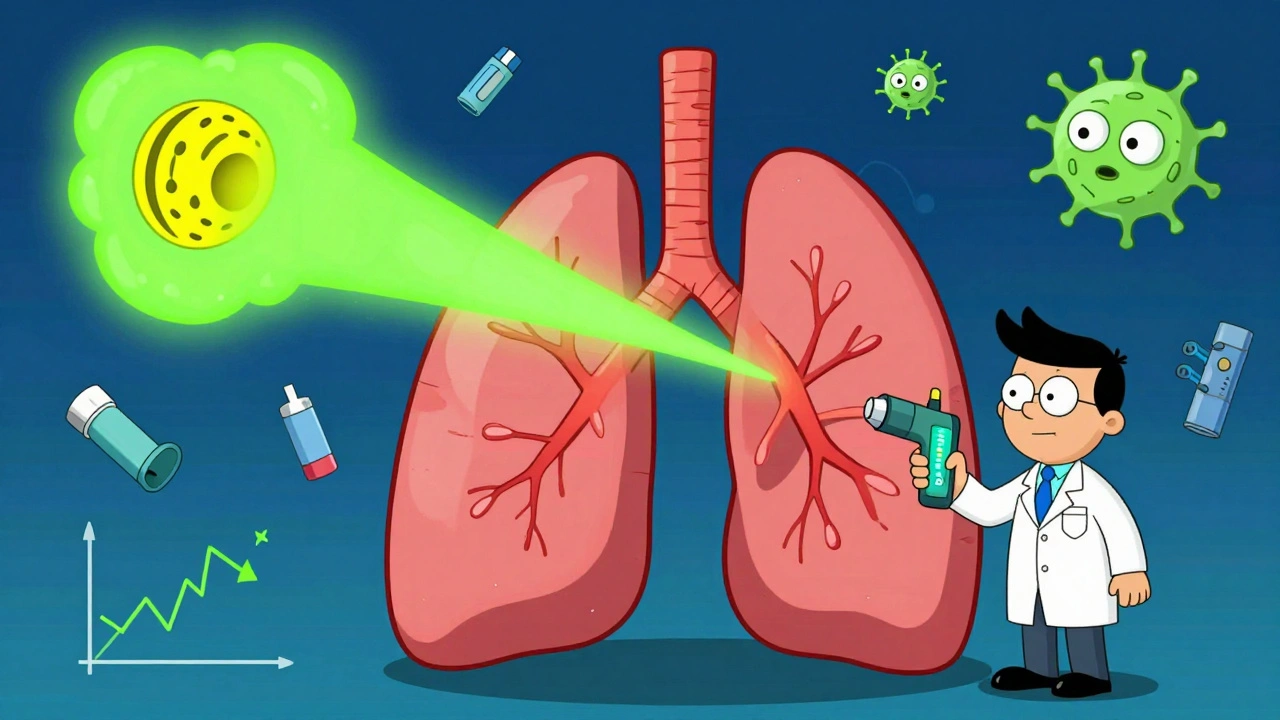
What Is FeNO Testing and Why Does It Matter for Asthma?
FeNO testing measures the amount of nitric oxide in your breath - a simple, non-invasive way to see if your airways are inflamed. This isn’t just another lab test. It gives doctors a direct look at the type of inflammation driving your asthma, especially the kind caused by eosinophils, a type of white blood cell linked to allergic reactions. When these cells are active, they produce extra nitric oxide, which shows up in your exhaled breath. A high FeNO reading doesn’t mean you have asthma for sure, but it strongly suggests that steroid inhalers will likely help you.
Before FeNO, doctors relied mostly on symptoms and spirometry - breathing tests that measure how much air you can push out. But those can be misleading. Someone might breathe fine during a test but still have hidden inflammation flaring up between visits. FeNO fills that gap. It’s like a smoke alarm for your lungs: it goes off before the fire gets big. Studies show that when FeNO levels are high, the chance of an asthma diagnosis is up to seven times greater than with spirometry alone.
How the Test Works - No Need to Be an Expert
You don’t need to be a scientist to do this test. All you do is breathe in deeply through a filter that blocks outside air, then exhale slowly and steadily into a handheld device for about 10 seconds. The machine reads the nitric oxide level in parts per billion (ppb). It’s quiet, quick, and painless. Kids as young as five can do it. No needles. No blood. No discomfort.
There are a few simple rules to follow before the test. Don’t eat, drink (except water), smoke, or exercise hard for at least an hour beforehand. If you’ve used a rescue inhaler or steroid inhaler recently, let your provider know - those can lower your reading. The test should always come before spirometry or bronchodilators, because those can mask inflammation.
Devices like the NIOX VERO®, NObreath®, and Aeroallerg® are FDA-approved and used in most clinics. They give results in under a minute. Some newer models even connect to smartphones, letting you track your numbers over time. The whole process takes less time than checking your phone.
What Do the Numbers Mean?
FeNO levels are measured in ppb. But what’s normal? It depends on your age and whether you smoke.
- For adults: 25 ppb or higher suggests active eosinophilic inflammation - a sign asthma meds like inhaled steroids will probably work.
- For children aged 5-12: 20 ppb or higher is considered elevated.
- Levels below 20 ppb in adults usually mean little to no type 2 inflammation.
- Smokers often have lower FeNO readings - sometimes 30-50% lower - because smoking suppresses nitric oxide production.
Doctors break results into three zones:
- Low (<25 ppb in adults): Unlikely to benefit from steroids.
- Medium (25-50 ppb): Moderate inflammation; may respond to low-dose steroids.
- High (>50 ppb): Strong inflammation; likely needs higher-dose treatment or biologics.
These aren’t hard rules. Your doctor looks at your symptoms, history, and other tests too. But if your FeNO is high and you’re still wheezing, it’s a clear signal: your current treatment isn’t controlling the inflammation.
How FeNO Compares to Other Tests
FeNO isn’t the only tool for checking asthma inflammation. But it’s often the most practical.
Compared to spirometry: Spirometry measures airflow, not inflammation. You might have normal lung function but still have inflamed airways. FeNO catches what spirometry misses. It’s less sensitive - meaning it won’t catch every case of asthma - but it’s more specific. If your FeNO is high, it’s very likely you have eosinophilic asthma.
Compared to blood eosinophil counts: Blood tests measure eosinophils in your bloodstream. But those don’t always match what’s happening in your lungs. FeNO reflects lung inflammation more directly. Studies show FeNO correlates better with sputum eosinophils (the gold standard) than blood counts do.
Compared to sputum tests: Sputum analysis requires you to cough up mucus, which many patients hate. It’s also slow - labs take days to process. FeNO gives instant results and is much easier to repeat over time.
But here’s the catch: FeNO only sees type 2 inflammation. If your asthma is triggered by stress, pollution, or non-allergic factors, your FeNO might be normal even if you’re struggling. That’s why it’s never used alone. It’s a piece of the puzzle, not the whole picture.
How FeNO Changes Treatment - Real Patient Stories
Many patients say FeNO testing changed their lives.
One 34-year-old woman had been told for seven years she had chronic bronchitis. She used rescue inhalers constantly but never got better. Her FeNO reading was 48 ppb - clearly elevated. Her doctor switched her to a steroid inhaler and later added a biologic. Within months, her attacks dropped from weekly to once a year.
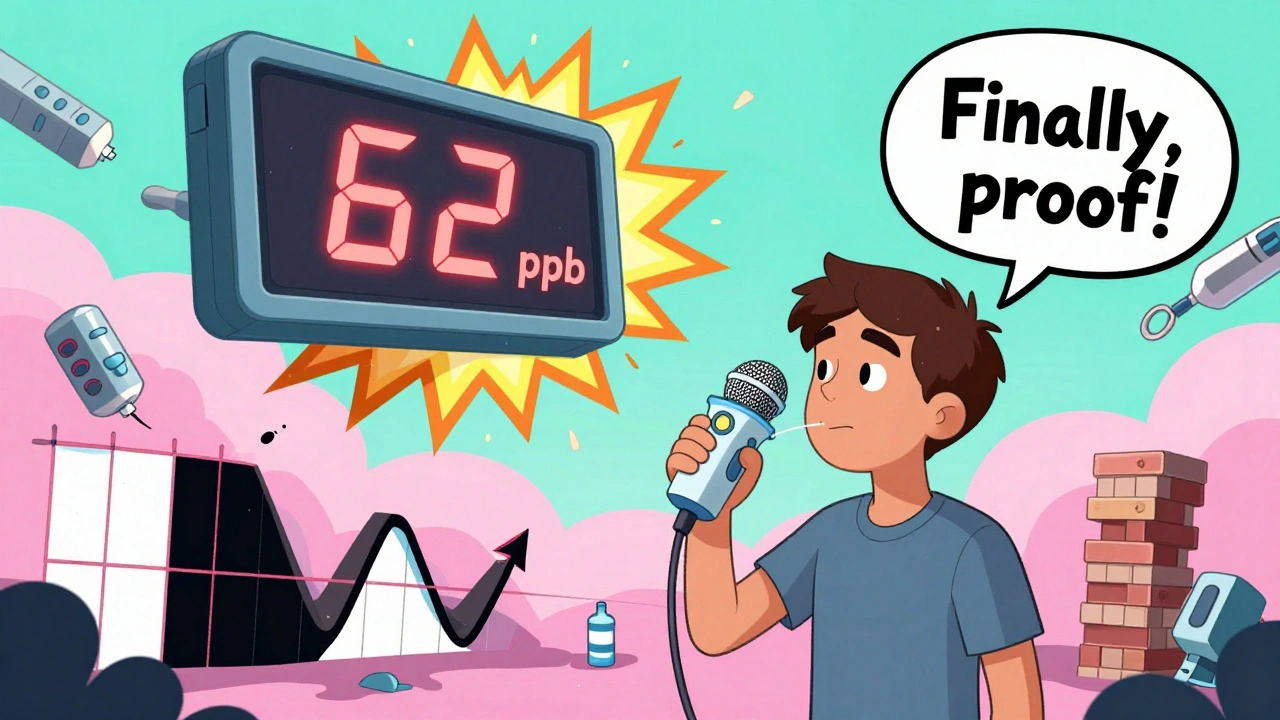
Another patient, a teenager with frequent ER visits, had normal spirometry every time. His FeNO was 62 ppb. His doctor realized his symptoms weren’t just anxiety or poor technique - they were inflammation. He started a low-dose steroid, and his school attendance improved dramatically.
On community forums, 73% of users said FeNO helped them understand why their inhalers weren’t working. One wrote: “Finally, objective proof my inhaler wasn’t working.” Another said: “It helped my doctor realize I needed biologics.”
But not everyone has a smooth experience. Some report inconsistent results, or insurance denials. One patient on HealthUnlocked said: “My insurance denied it three times - even though I had three ER visits last year.” Coverage varies wildly. Medicare covers it for asthma management, but many private insurers still question its value.
Who Benefits Most From FeNO Testing?
FeNO isn’t for every asthma patient - but it’s a game-changer for specific groups:
- People with unclear asthma diagnosis: If symptoms are vague or spirometry is normal, FeNO helps confirm if inflammation is present.
- Those not responding to standard treatment: If you’re using your inhaler correctly but still having flare-ups, FeNO shows whether inflammation is the culprit.
- Patients considering biologics: Drugs like dupilumab and benralizumab target type 2 inflammation. FeNO helps pick who will respond.
- Children and elderly patients: If they can’t do spirometry well, FeNO is easier and more reliable.
- People with allergic rhinitis or eczema: These often go with eosinophilic asthma. High FeNO can connect the dots.
On the flip side, it’s less useful for smokers, people with non-allergic asthma, or those with COPD. It’s not a general lung health test - it’s a targeted tool for a specific type of inflammation.
How Often Should You Get Tested?
Once you’re on treatment, FeNO isn’t a one-time thing. It’s a tracking tool.
Guidelines suggest testing every 3-4 months if you’re stable on maintenance therapy. If your doctor is adjusting your meds - increasing steroids, adding a biologic, or trying to wean you off - testing every 4-6 weeks helps see what’s working.
For example, if your FeNO drops from 60 ppb to 20 ppb after starting a new inhaler, that’s a win. If it stays high, your treatment needs a rethink. Studies show that using FeNO to guide treatment cuts asthma attacks by up to 50%.
Some devices now let patients test at home. The FDA cleared the first smartphone-connected FeNO monitor in early 2023. While still new, it opens the door to more frequent monitoring without clinic visits.
Limitations and What Doctors Still Disagree On
FeNO isn’t perfect. Even experts debate its limits.
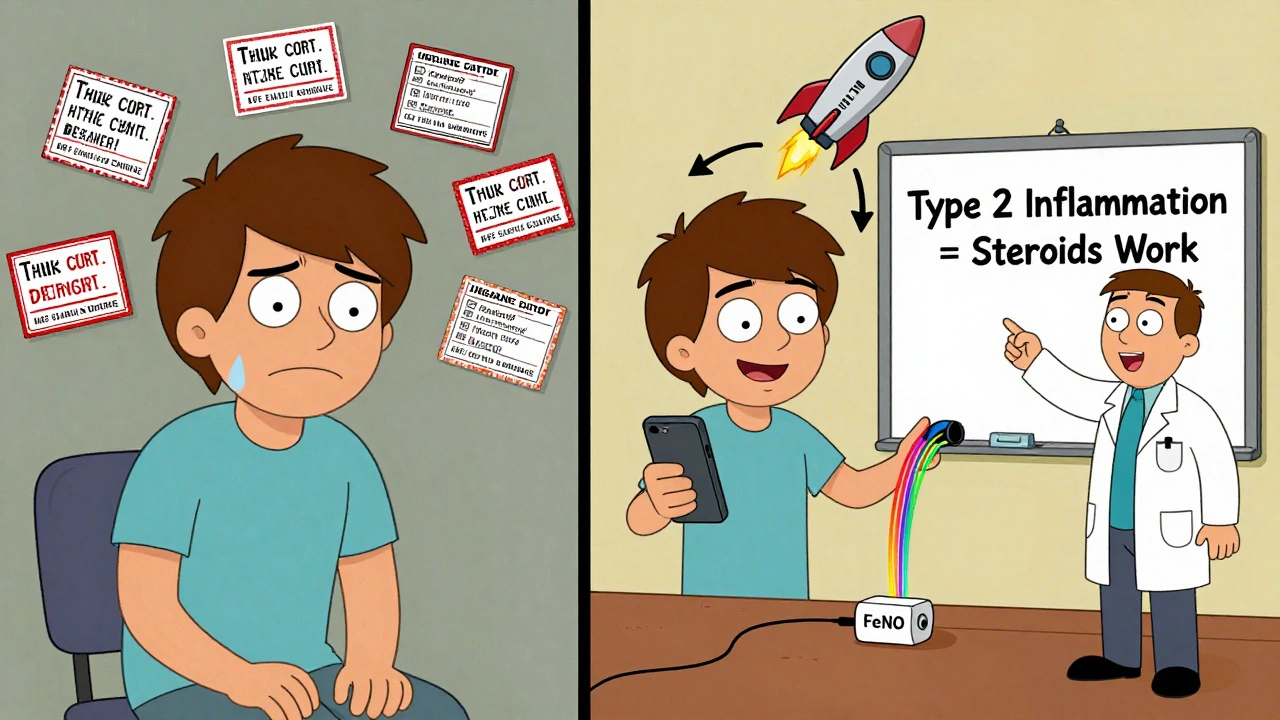
Dr. Sally Wenzel, a leading asthma researcher, warns: “FeNO has low sensitivity - it can’t rule out asthma.” That’s true. If your FeNO is low, you might still have asthma - just not the type that responds to steroids.
Also, FeNO can be high in other conditions: allergic rhinitis, eosinophilic bronchitis, or even after a viral infection. That’s why context matters. A high number with no wheezing? Maybe it’s just seasonal allergies.
Another issue: device variability. Different machines can give slightly different readings. That’s why doctors don’t compare your FeNO from last year to this year if you switched devices. Consistency in equipment matters.
And cost? Insurance coverage is messy. Only 58% of U.S. commercial plans cover it without restrictions. Rural clinics often don’t have the equipment. Urban centers? 67% have it. Rural? Just 22%.
The Future of FeNO: More Than Just a Test
The future of asthma care is personalized. And FeNO is becoming a key part of that.
New research shows FeNO can predict who will respond to expensive biologic drugs - saving thousands in unnecessary treatments. The European Respiratory Society now recommends it for biologic selection. The NIH is funding large studies to see if FeNO can help prevent attacks before they happen.
As devices get smaller, cheaper, and connected to apps, patients may start tracking their own FeNO at home. Imagine getting a notification: “Your FeNO is rising - call your doctor.” That’s not sci-fi. It’s coming.
Dr. Eugene Bleecker put it best: “As biologics become more targeted and expensive, objective biomarkers like FeNO will become essential for appropriate patient selection and cost-effective care.”
Final Takeaway: FeNO Is a Tool, Not a Magic Bullet
FeNO testing doesn’t replace your doctor. It doesn’t replace your inhaler. But it gives your doctor a clear, objective view of what’s happening inside your airways - something no symptom diary or breathing test can do.
If you’ve been struggling with asthma control, ask about FeNO. If your doctor hasn’t mentioned it, bring it up. It’s simple, safe, and backed by major guidelines from GINA, NICE, and the American Thoracic Society.
It’s not about having a high number. It’s about having a number that makes sense - and using it to get your life back.
Shawna B
December 3, 2025 AT 21:53No more coughing fits at 3am.
Jerry Ray
December 4, 2025 AT 22:56David Ross
December 6, 2025 AT 14:12Sophia Lyateva
December 7, 2025 AT 01:21AARON HERNANDEZ ZAVALA
December 8, 2025 AT 10:50Just wish it was cheaper.
Lyn James
December 9, 2025 AT 10:55Craig Ballantyne
December 10, 2025 AT 01:04Victor T. Johnson
December 11, 2025 AT 09:45Nicholas Swiontek
December 11, 2025 AT 10:46Robert Asel
December 13, 2025 AT 06:52