
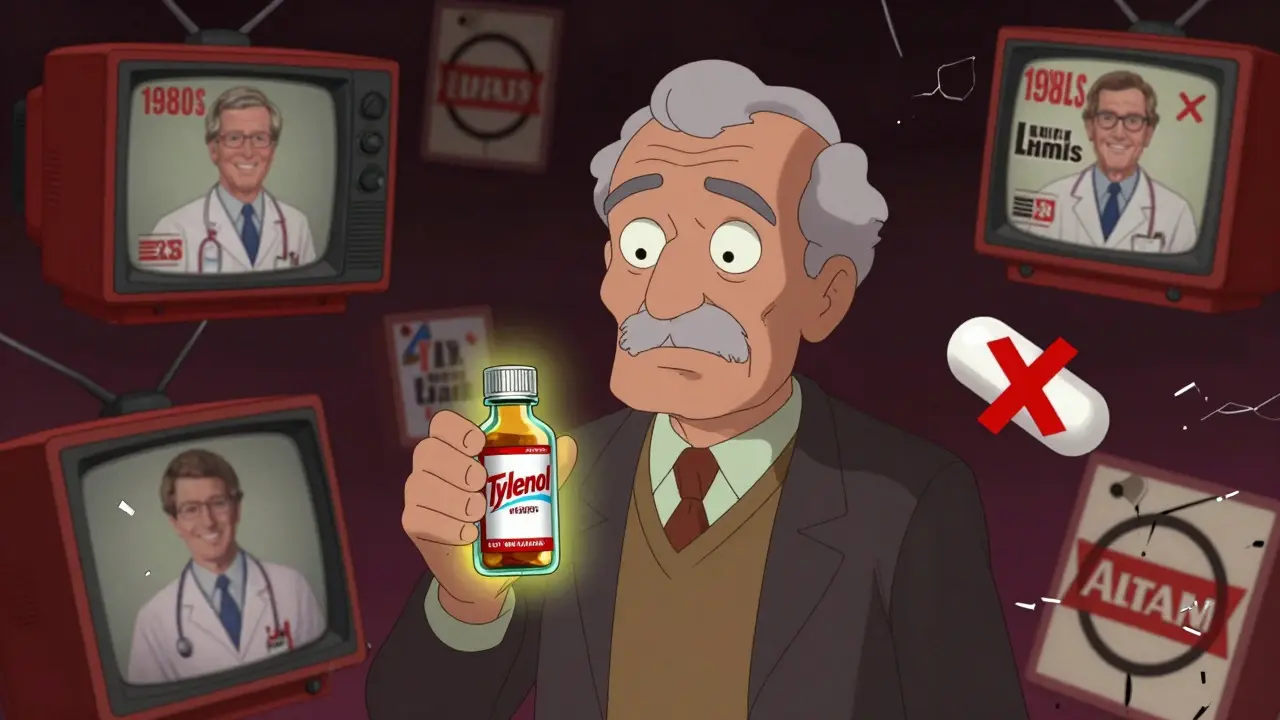
Why do some people refuse to take a generic pill even when it’s half the price and approved by the same regulators as the brand-name version? It’s not about science. It’s about trust. And trust doesn’t work the same way for everyone-especially when it comes to your age.
Generations Don’t See Pills the Same Way
If you’re 70, you probably remember when pills came in little glass bottles with paper labels. You trusted the name on the box because that’s all you knew. Brand names like Tylenol, Lipitor, or Nexium weren’t just labels-they were promises. They were the result of TV ads, doctor visits, and years of seeing the same packaging. That kind of loyalty sticks. Now look at someone 25. They grew up with Google searches, YouTube reviews, and apps that compare prices in seconds. To them, a generic drug isn’t a compromise-it’s a smart choice. They don’t care if the pill looks different. They care if it works, and if it saves them $40 a month. This isn’t just preference. It’s a generational divide rooted in experience, exposure, and how each group learned to think about medicine.Why Older Adults Hesitate
People over 55 are more likely to believe generics are less effective-even when they know the facts. Why? Because their first experiences with medication were shaped by a time when generics weren’t common. Back then, brand-name drugs were the only option. When you’ve relied on the same pill for 20 years to manage high blood pressure or diabetes, switching feels risky. Studies show that 35% of the general public thinks generic drugs are weaker than branded ones. That number jumps among older adults. It’s not ignorance. It’s conditioning. They’ve seen commercials that made brand names feel like heroes. They’ve heard stories from friends who swore a generic didn’t work. And even if their doctor says it’s the same, that voice competes with decades of marketing noise. There’s also a quiet fear: What if this one doesn’t work like the last one? For someone managing chronic illness, that uncertainty isn’t just inconvenient-it’s terrifying.Younger People Just Want It to Work
Millennials and Gen Z don’t have the same emotional attachment to brand names. They grew up in a world where everything is customizable, affordable, and transparent. They check drug prices on GoodRx before they even walk into the pharmacy. They’ve seen influencers talk about switching to generics without side effects. They’ve watched their parents struggle with bills and decided they won’t repeat that. For them, the active ingredient is the only thing that matters. If the FDA says it’s bioequivalent, they trust it. They don’t need the logo. They don’t need the fancy packaging. They just need the medicine to do its job-and not break their budget. One 2023 survey found that 68% of adults under 35 said they’d choose a generic over a brand-name drug even if it wasn’t covered by insurance. Only 39% of those over 65 said the same.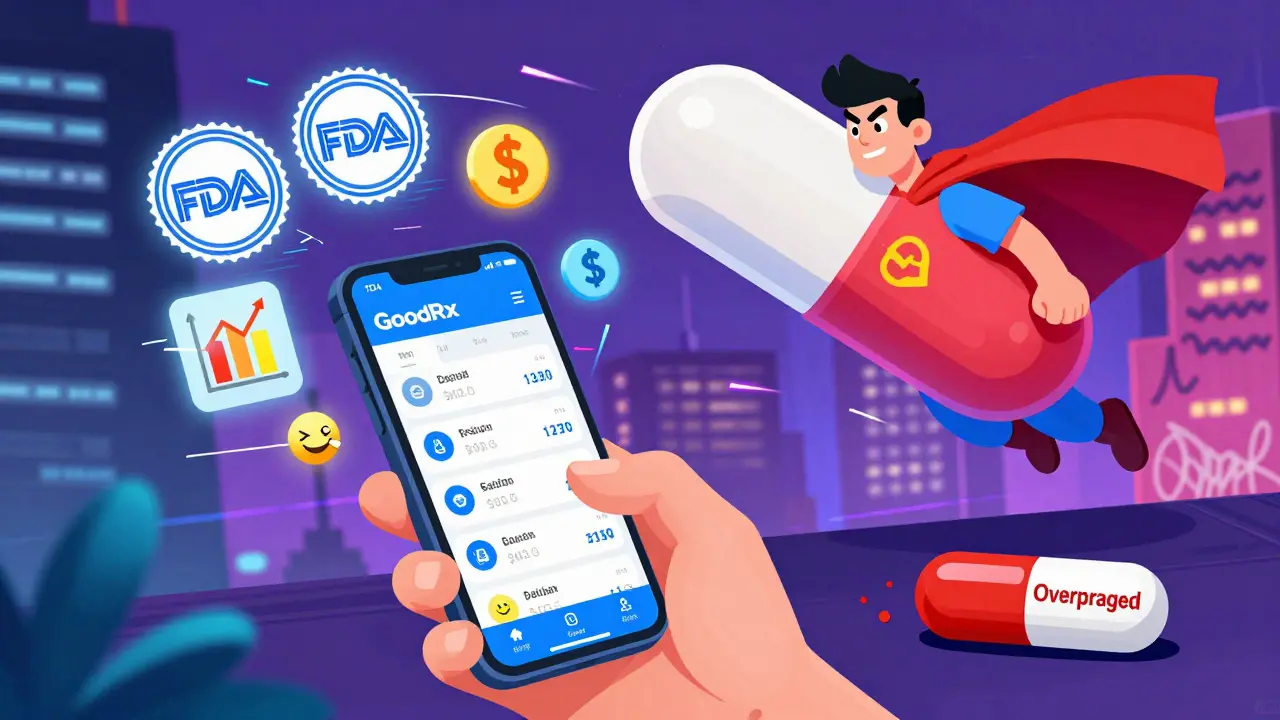
The Role of Health Literacy
It’s not just about age-it’s about how much you understand about how drugs work. Older adults often have more experience taking medications, but that doesn’t mean they know how generics are approved. Many still think generics are made in cheaper factories with lower standards. They don’t know that the FDA requires generics to have the same active ingredient, strength, dosage form, and route of administration as the brand. They don’t know that generics must meet the same strict manufacturing rules. Meanwhile, younger people are more likely to have learned this in school, through online health portals, or from apps like Medscape or WebMD. They’ve read the fine print. They’ve compared ingredient lists. They’ve seen the FDA’s own data showing generics perform just as well. This gap in objective knowledge is real. And it’s growing. Older generations were taught to trust doctors and brands. Younger generations are taught to question, compare, and verify.Doctors Don’t Always Help
Even healthcare professionals aren’t fully aligned. A 2022 study found that only about half of doctors believed generics were as safe and effective as brand-name drugs. Pharmacists, who see the cost savings every day, were more likely to support generics. But physicians-who spend more time with patients and are more influenced by brand marketing-often hesitate to recommend them. That matters. If your doctor says, “I’d take the brand myself,” you’re going to believe them-even if they didn’t mean it that way. That kind of message reinforces the idea that generics are second-rate. And here’s the twist: many doctors don’t even realize they’re sending that message. They say “this one’s better” because they’re used to prescribing it. They don’t think about how it sounds to someone who’s trying to afford their next refill.How Framing Changes Everything
The way we talk about generics makes a huge difference. Saying “this is a generic version” triggers doubt. Saying “this is the same medicine, just cheaper” changes the game. One study showed that when patients were told a generic drug was “FDA-approved and identical in effectiveness,” acceptance rose by 40%. But if they were told “this is a cheaper alternative,” trust dropped-even though both statements were technically true. That’s why communication matters more than ever. For older patients, you need to emphasize safety, consistency, and FDA approval. For younger patients, you need to emphasize savings, transparency, and efficiency. It’s not about dumbing things down. It’s about speaking their language.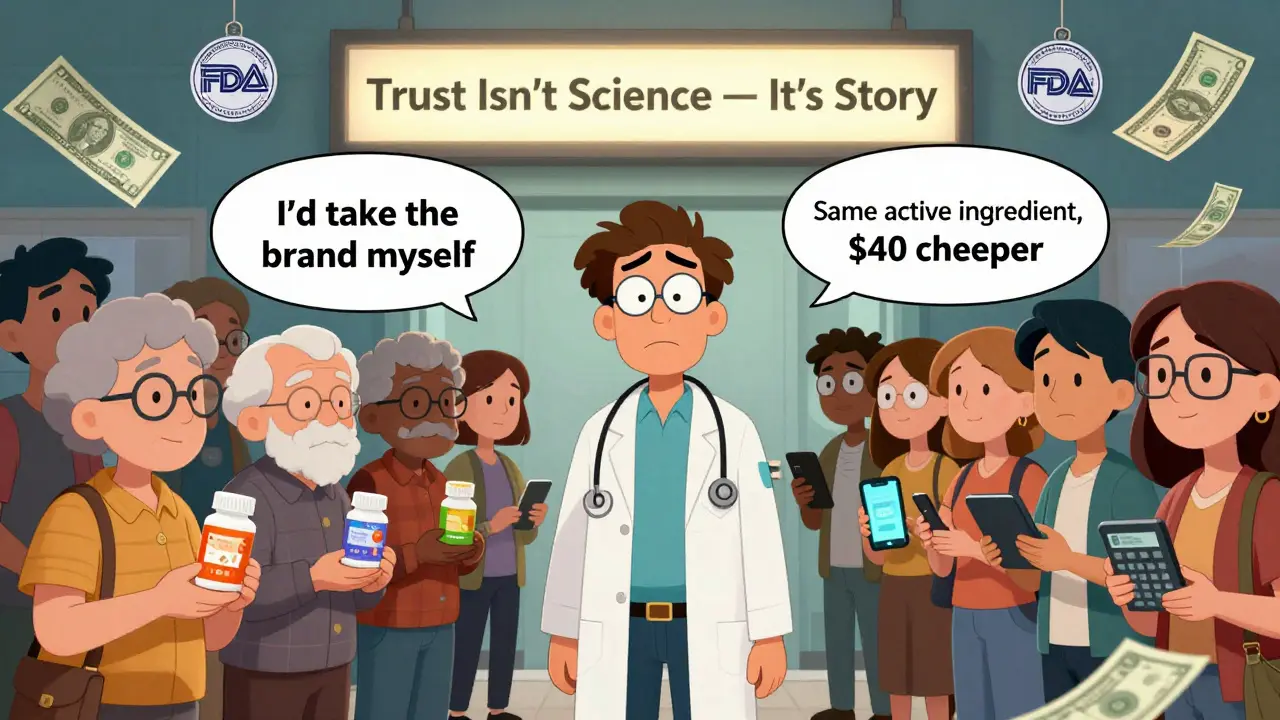
The Real Cost of Not Switching
In the U.S., generics make up 90% of all prescriptions filled-but only 23% of drug spending. That means people are paying billions extra for the same medicine just because they’re afraid to switch. That’s not just a personal cost. It’s a system-wide problem. People skip doses because they can’t afford the brand. They delay refills. They go without. And then they end up in the ER. In Australia, where I live, the PBS (Pharmaceutical Benefits Scheme) makes generics widely available and affordable. But even here, some older patients still ask for the brand name because “that’s what my doctor used to give me.” We’re not just losing money. We’re losing health.What Can Be Done?
There’s no single fix. But here’s what actually works:- For older adults: Use clear, simple language. Say “this is the exact same medicine, just without the brand name.” Show them the FDA or TGA (Therapeutic Goods Administration) approval stamp. Bring up their own past experience: “You’ve been on this medicine for years-this is the same thing.”
- For younger adults: Give them tools. Apps that show price comparisons, side-by-side ingredient lists, and patient reviews. Make it easy to switch. Celebrate the smart choice.
- For providers: Train doctors and pharmacists to stop saying “I’d take the brand” and start saying “This is what I prescribe to my own family.”
- For policymakers: Make the switch automatic where possible. Don’t make patients ask. Don’t make them jump through hoops. Just give them the generic unless there’s a medical reason not to.
It’s Not About Being Right-It’s About Being Understood
The science is clear: generics work. They’re safe. They’re effective. But science doesn’t change behavior. Stories do. Trust does. Experience does. If we keep treating generational differences as a problem to be fixed, we’ll keep failing. We need to meet people where they are. For some, that means honoring decades of brand loyalty. For others, it means empowering them with data. The goal isn’t to make everyone think the same way. It’s to make sure everyone can afford to get better.Are generic medications really as effective as brand-name drugs?
Yes. By law, generic medications must contain the same active ingredient, strength, dosage form, and route of administration as the brand-name version. They must also meet the same strict manufacturing standards set by the FDA (U.S.) or TGA (Australia). Bioequivalence studies prove they work the same way in the body. The only differences are in inactive ingredients-like color or filler-which don’t affect how the drug works.
Why do some people feel generics don’t work as well?
It’s mostly psychological. People associate brand names with quality because of decades of advertising, doctor recommendations, and personal experience. Even when they know generics are the same, the brain still expects something different. Some report side effects or reduced effectiveness after switching-but studies show this is often due to the nocebo effect, where expecting a problem causes you to feel one. The medicine hasn’t changed. Your expectation has.
Do older people have more trouble accepting generics than younger people?
Yes. Studies consistently show that people over 55 are more likely to distrust generics. This is linked to longer exposure to brand-name drugs, less familiarity with modern drug approval systems, and higher levels of brand loyalty. Younger generations, raised on price comparison tools and transparent information, are far more likely to choose generics based on cost and evidence-not brand recognition.
Can doctors influence whether patients take generics?
Absolutely. A doctor’s words carry weight. If a doctor says, “I’d take this one myself,” or “This is what I prescribe to my family,” patients are much more likely to accept the generic. On the other hand, phrases like “this is the best one” or “I don’t trust the generic” reinforce doubt-even if the doctor didn’t mean it that way. Training providers to use clear, positive language around generics can dramatically improve adoption.
Why don’t pharmacies always offer generics first?
In many places, pharmacies are legally allowed to substitute generics unless the doctor writes “dispense as written.” But some still default to the brand because they assume the patient expects it-or because they’re not trained to explain the switch. It’s not about profit; it’s about habit and lack of communication. When pharmacists take the time to explain the cost savings and safety, patients overwhelmingly agree to switch.
Are there any cases where you shouldn’t use a generic?
Very few. For most medications-antibiotics, blood pressure pills, antidepressants, diabetes drugs-generics are perfect substitutes. The only exceptions are drugs with a very narrow therapeutic window, like warfarin or levothyroxine, where tiny differences in absorption could matter. Even then, studies show generics are still safe and effective for most people. If your doctor says to stick with the brand, ask why. Make sure it’s based on evidence, not tradition.
Rohit Kumar
February 1, 2026 AT 07:18Generics aren't just about cost-they're about equity. In India, where I'm from, brand-name drugs are often unattainable for the working class. We don't have the luxury of emotional attachment to packaging. We have to survive. The FDA's standards are rigorous, but what's more important is that people in rural clinics get the same active ingredient, regardless of the logo. Trust isn't built on advertising-it's built on results. And for millions, generics deliver.
Jodi Olson
February 2, 2026 AT 03:55My grandmother takes her blood pressure med every day. She switched to generic last year after her pharmacy did it automatically. She didn't notice a difference. But she noticed the $38 she saved every month. She said, 'If it's good enough for the hospital, it's good enough for me.' Sometimes the science doesn't need explaining. Just let people live.
Marc Bains
February 3, 2026 AT 04:10Let's be real-this isn't a science problem. It's a marketing problem. Pharma spent decades convincing people that their pill was special. Now they're shocked that people still believe it. But here's the thing: younger people aren't rejecting tradition. They're rejecting exploitation. If you want trust, stop selling pills like luxury handbags. Show them the data. Let them see the same FDA stamp on both bottles. And for god's sake, stop having doctors say 'I'd take the brand.' That's not advice. That's brand loyalty dressed up as medical authority.
Eliana Botelho
February 4, 2026 AT 01:54Okay but like, I think we're all missing the real issue here-why do we even have brand names in the first place? Like, if the FDA says they're identical, why do we let companies patent the color of the pill? Why does it matter if it's blue or white? Why can't we just call it 'metoprolol 25mg' and be done with it? I mean, we don't call water 'Dasani H2O' or 'Aquafina Liquid'-we just say water. Why is medicine different? It's like we're still in the 1980s, terrified of anything that doesn't have a jingle. And don't even get me started on how pharmacies still default to brand because they're afraid of a patient yelling at them. We're literally paying for branding like it's a subscription service. And the worst part? No one's even asking if this is sustainable. We're just… accepting it. Like, what even is this system?
April Allen
February 5, 2026 AT 16:04The pharmacokinetic equivalence data is robust-bioavailability curves for generics are statistically indistinguishable from innovators in over 90% of cases. The nocebo effect is empirically documented in double-blind crossover trials, particularly for CNS-active agents like SSRIs and antiepileptics. What we're observing isn't therapeutic failure-it's perceptual dissonance rooted in cognitive bias. The FDA's ANDA pathway requires dissolution profiles within 85–115% of the reference product, with tight limits on impurity profiles. The only clinically relevant exceptions involve narrow-therapeutic-index drugs like warfarin, where therapeutic monitoring is non-negotiable. The real barrier is not pharmacology-it's health communication design. We need standardized patient-facing materials that explicitly map FDA equivalence criteria to lived experience, not just regulatory jargon.
Donna Fleetwood
February 6, 2026 AT 18:07My mom used to cry when she had to switch her cholesterol med to generic. She said it felt like betrayal. But after we sat down and showed her the FDA letter comparing ingredients side-by-side? She took it without a word the next month. She didn't need a lecture. She needed to feel heard. That's what changed her mind-not the science, but the kindness.
Melissa Cogswell
February 8, 2026 AT 00:53Just wanted to add-when I worked at a community pharmacy, the biggest factor in patients accepting generics was the pharmacist taking 30 seconds to say, 'This is the same medicine, just cheaper. I give this to my dad.' Simple. Human. No jargon. It worked every time.
Diana Dougan
February 8, 2026 AT 14:13Wow. So we're all just supposed to trust the FDA now? Like, what if they're wrong? What if the generic has a little more filler and it's slowly poisoning people? I mean, have you seen how they approve stuff? I bet they just slap a stamp on it while eating donuts. Also, I switched to generic and got a rash. Coincidence? I think not. Also, my cousin's dog took a generic and now it's weirdly calm. Weird, right?
Shubham Dixit
February 10, 2026 AT 04:55You Americans think this is a big deal? In India, we've been using generics for decades. We don't care about logos. We care about whether the medicine works. And guess what? It does. Our doctors prescribe generics because they know the truth: the active ingredient doesn't care if it's in a red capsule or a white one. The problem isn't the patient. The problem is the system that lets companies charge $200 for a pill that costs $2 to make. And now you're surprised people are angry? You built this. You made it expensive. You made it confusing. And now you want us to feel bad for choosing the cheaper option? Shame on you.
KATHRYN JOHNSON
February 11, 2026 AT 21:40Generics are not inferior. They are identical. The FDA mandates bioequivalence. The TGA confirms it. The WHO endorses it. Any deviation is a violation of federal law. The continued public misconception is a failure of public health education-not of pharmaceutical science. To suggest otherwise is to undermine evidence-based medicine and enable misinformation. This is not a cultural preference. It is a preventable public health crisis.