
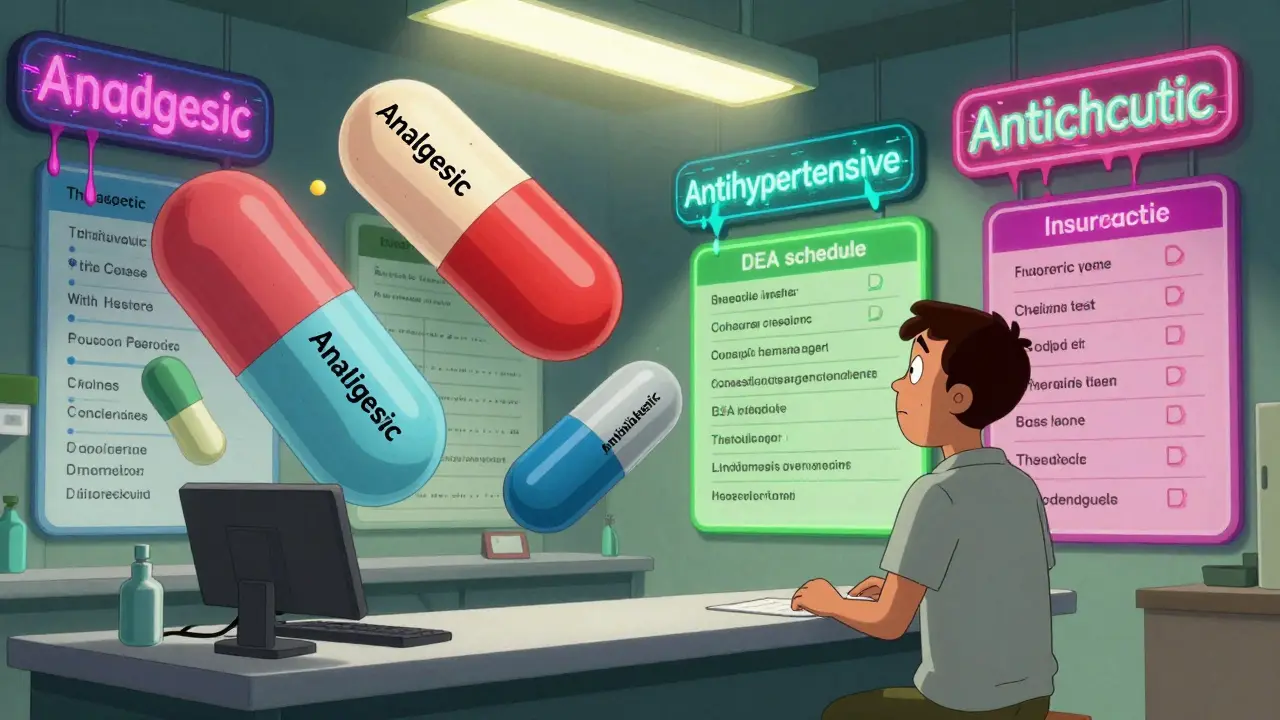
When you pick up a prescription, you might not think about how the drug is organized in the system behind the scenes. But every pill, injection, or inhaler you take belongs to a specific generic drug classification. These aren’t just labels-they’re critical tools that help doctors prescribe safely, pharmacists fill orders correctly, and insurers manage costs. Understanding how drugs are grouped can help you make smarter choices and avoid confusion when your medication changes names or costs.
Therapeutic Classification: What the Drug Treats
This is the most common way drugs are grouped in hospitals and clinics. It’s simple: drugs are classified by the medical condition they’re meant to treat. If you’re taking something for high blood pressure, it’s a cardiovascular agent. If it’s for pain, it’s an analgesic. The FDA and USP use this system as the backbone of clinical decision-making.
Here are some major therapeutic categories:
- Analgesics - Pain relievers, split into non-opioid (like ibuprofen) and opioid (like morphine)
- Antihypertensives - Drugs that lower blood pressure, such as lisinopril or amlodipine
- Antidiabetics - Medications like metformin or glimepiride for managing blood sugar
- Antidepressants - Including SSRIs like sertraline and SNRIs like venlafaxine
- Antineoplastics - Cancer drugs, such as paclitaxel or capecitabine
- Endocrine agents - Hormone treatments like levothyroxine or insulin
Therapeutic classification works well in most cases. But it has a flaw: some drugs treat more than one condition. Aspirin, for example, is used for pain, fever, and preventing heart attacks. Should it be in analgesics, antipyretics, or anticoagulants? The FDA’s 2023 update now allows a primary-secondary hierarchy to handle these overlaps, but many electronic systems still struggle with it.
Pharmacological Classification: How the Drug Works
If therapeutic classification asks, "What does it treat?" pharmacological classification asks, "How does it work?" This system dives into the science. It groups drugs by their biological target or mechanism of action.
For example:
- ACE inhibitors - Block the angiotensin-converting enzyme (e.g., enalapril, ramipril)
- Beta-blockers - Reduce heart rate and blood pressure by blocking adrenaline (e.g., metoprolol, atenolol)
- SSRIs - Increase serotonin in the brain (e.g., fluoxetine, escitalopram)
- Proton pump inhibitors - Shut down stomach acid production (e.g., omeprazole, pantoprazole)
This classification is powerful for researchers and specialists. It explains why two drugs from different therapeutic groups might interact. For instance, a beta-blocker and a calcium channel blocker both lower blood pressure, but through different pathways. That’s why doctors need to know both how a drug works and what it’s used for.
The downside? It’s not user-friendly for the average patient or even general practitioners. You won’t find "beta-blocker" on your prescription bottle. But if you see a drug ending in "-lol," like propranolol or carvedilol, that’s a clue-it’s part of the stem naming system tied to this classification.
DEA Scheduling: Legal Status and Abuse Risk
Not all drugs are treated the same under the law. The Drug Enforcement Administration (DEA) classifies controlled substances into five schedules based on their potential for abuse and accepted medical use.
Here’s how it breaks down:
- Schedule I - No accepted medical use, high abuse potential (e.g., heroin, LSD, marijuana under federal law)
- Schedule II - High abuse potential, but medical use (e.g., oxycodone, fentanyl, Adderall)
- Schedule III - Moderate abuse potential, accepted medical use (e.g., ketamine, buprenorphine, some steroid formulations)
- Schedule IV - Low abuse potential (e.g., benzodiazepines like alprazolam, zolpidem)
- Schedule V - Very low abuse potential, mostly OTC in limited doses (e.g., cough syrups with less than 200mg codeine per 100ml)
This system affects prescriptions. Schedule II drugs can’t be refilled without a new prescription. Pharmacies track them closely. And despite marijuana being legal for medical use in 38 states, it’s still Schedule I federally-a major point of conflict.
Experts point out inconsistencies. Oxycodone, a Schedule II drug, has caused more overdose deaths than Schedule I heroin in recent years. Meanwhile, drugs like dronabinol (synthetic THC) are Schedule II, even though they treat the same conditions as marijuana. This mismatch makes it harder for doctors to make evidence-based decisions.
Insurance Tiers: What You Pay Out of Pocket
Your insurance plan doesn’t care how a drug works or what it treats-it cares about cost. That’s why most plans use a tier system, usually with five levels:
- Tier 1 - Preferred generics (cheapest, often 75% of all prescriptions)
- Tier 2 - Non-preferred generics (slightly higher copay)
- Tier 3 - Preferred brand-name drugs
- Tier 4 - Non-preferred brand-name drugs
- Tier 5 - Specialty drugs (expensive, often biologics like Humira or Enbrel)
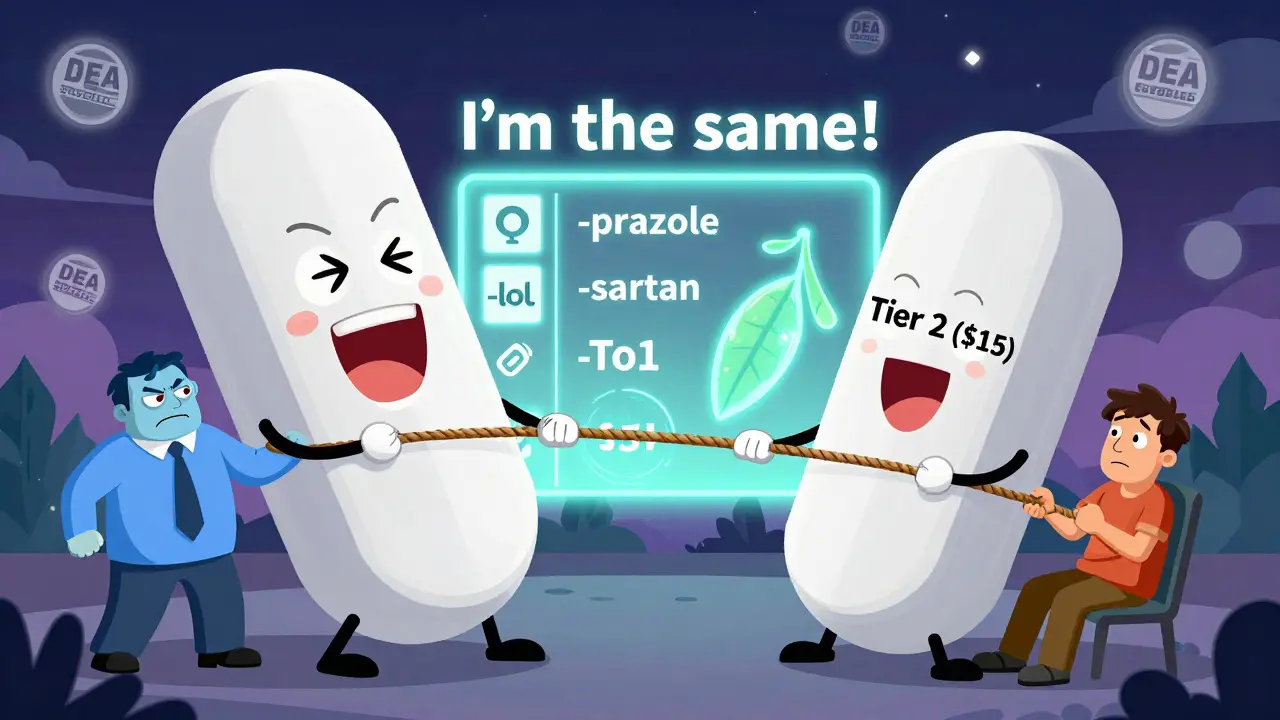
Here’s the catch: two identical generic drugs can be on different tiers based on which manufacturer your insurer negotiated with. One version of metformin might cost $5, while another costs $15-even though they’re chemically the same. Pharmacists report that 43% of prior authorization requests come from tier disputes, not medical necessity.
Insurers justify this by saying it pushes patients toward cheaper options. But studies show patients often don’t know why they’re being switched, leading to confusion, skipped doses, or abandonment of treatment.
The Stem Naming System: Clues in the Name
Have you ever noticed that many generic drugs end with the same few syllables? That’s not a coincidence. The USP introduced a standardized naming system in 1964 to help identify drug classes just by the name.
Here are some common stems:
- -lol - Beta-blockers (metoprolol, propranolol)
- -prazole - Proton pump inhibitors (omeprazole, esomeprazole)
- -sartan - Angiotensin II receptor blockers (losartan, valsartan)
- -dipine - Calcium channel blockers (amlodipine, nifedipine)
- -oxacin - Fluoroquinolone antibiotics (ciprofloxacin, levofloxacin)
- -nib - Tyrosine kinase inhibitors (imatinib, sunitinib)
Since its full adoption, this system has reduced medication errors by 18%, according to NEJM data. It’s especially helpful for pharmacists and nurses who verify prescriptions. But newer biologic drugs-like monoclonal antibodies-don’t fit this pattern. That’s why the FDA’s 2023 update is exploring new naming conventions for these complex therapies.
Why Classification Confusion Costs Time and Money
Healthcare workers don’t use just one system-they juggle all of them. A doctor might think therapeutically ("This patient needs pain relief"). A pharmacist checks the DEA schedule ("Is this a controlled substance?"). An insurer checks the tier ("Is this on formulary?"). And the patient just wants to know why their $10 pill just became $40.
Surveys show that 68% of physicians report confusion between therapeutic and pharmacological classifications as a "moderate to severe" barrier. Family doctors, in particular, spend 12-18 minutes per patient just sorting through conflicting information.
And it’s not just time. The U.S. healthcare system spends $2.1 billion annually just to maintain proper classification records. Hospitals pay $120,000-$200,000 per year to update their electronic systems. When a drug is misclassified-even by one level-it can delay treatment, trigger insurance denials, or lead to dangerous interactions.
But there’s progress. The FDA’s Therapeutic Categories Model 2.0, rolling out in 2025, will let a drug have multiple primary indications. AI tools like IBM Watson Health’s Drug Insight platform are already predicting the right classification with 92.7% accuracy. And if the MORE Act passes, marijuana could move from Schedule I to III-triggering one of the biggest classification shifts in decades.
What You Should Know
You don’t need to memorize all the categories. But you should understand this:
- If your generic drug suddenly costs more, it’s likely been moved to a higher insurance tier-not because it’s different, but because of a contract change.
- If your doctor switches your medication and you notice a different ending (like from "-olol" to "-dipine"), they’re changing the mechanism, not just the brand.
- If you’re prescribed a controlled substance, ask why it’s scheduled where it is. That classification affects refill rules and monitoring.
- Always check if your pharmacy has multiple versions of your generic. Sometimes, switching to a lower-tier version saves money without changing effectiveness.
Drug classification isn’t just bureaucracy. It’s the invisible framework that keeps prescriptions safe, affordable, and effective. As new drugs emerge-especially those that treat multiple conditions at once-this system will keep evolving. Staying informed helps you stay in control of your care.
Mayank Dobhal
February 8, 2026 AT 02:21Ashley Hutchins
February 9, 2026 AT 17:43Savannah Edwards
February 10, 2026 AT 08:33Lakisha Sarbah
February 12, 2026 AT 07:38Mary Carroll Allen
February 12, 2026 AT 14:09AMIT JINDAL
February 14, 2026 AT 09:18Gouris Patnaik
February 15, 2026 AT 10:05Paula Sa
February 15, 2026 AT 13:01Eric Knobelspiesse
February 16, 2026 AT 15:43Ritu Singh
February 18, 2026 AT 01:30Tola Adedipe
February 18, 2026 AT 13:23Heather Burrows
February 20, 2026 AT 11:24Mark Harris
February 21, 2026 AT 20:35Ariel Edmisten
February 23, 2026 AT 17:19