
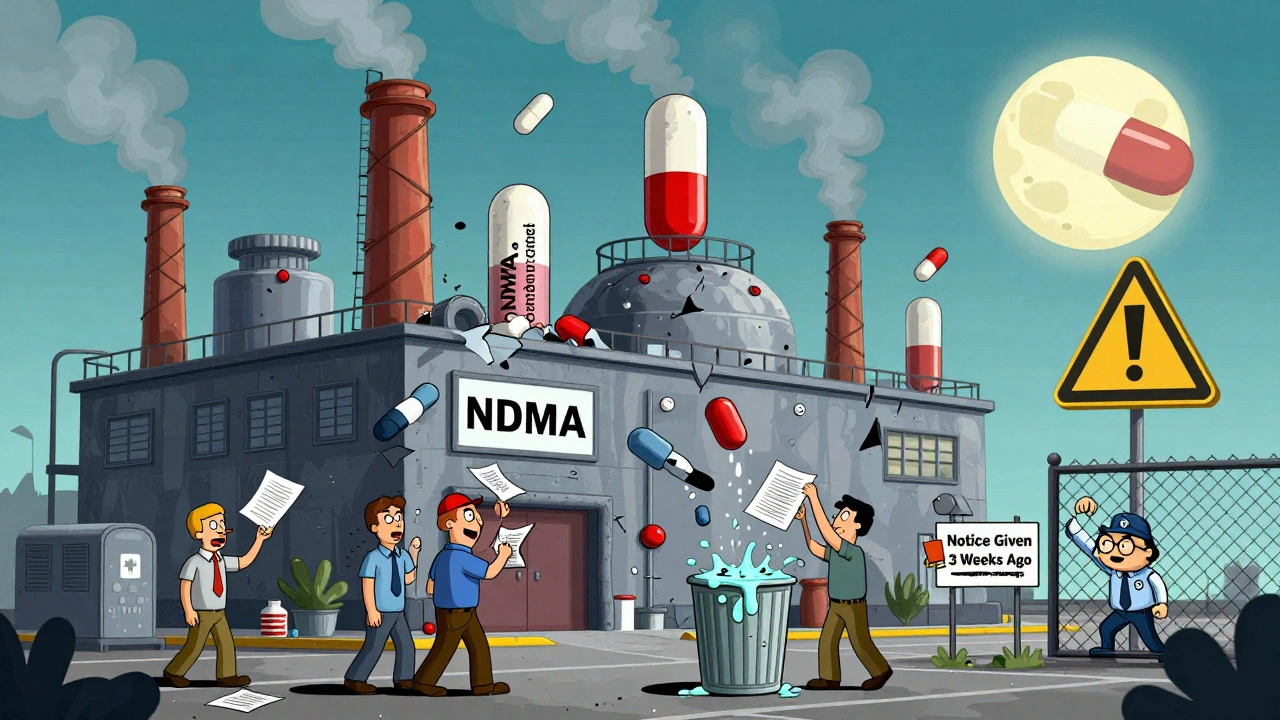
When you pick up a generic pill at the pharmacy, you expect it to work just like the brand-name version. But behind that simple promise lies a complex, often broken system. In 2022, the FDA reported 3,944 drug recalls-many tied to manufacturing flaws at overseas plants. These aren’t rare mistakes. They’re systemic failures that put patients at risk.
What Goes Wrong in Generic Drug Manufacturing?
Generic drugs are supposed to be identical to brand-name drugs in strength, dosage, and effect. But when manufacturing plants cut corners, that promise breaks. The biggest problems come from violations of Current Good Manufacturing Practices (cGMP). These are the rules that ensure every pill is safe, pure, and effective.Common failures include:
- Inadequate quality control: Labs don’t test properly. Some facilities skip tests entirely or manipulate results.
- Poor data integrity: 24.8% of FDA observations in 2022 found records were altered, deleted, or never created. One Indian plant was caught throwing away quality documents into a trash can full of acid.
- Uncontrolled impurities: In 2018, a cancer-causing chemical called NDMA was found in blood pressure meds like valsartan. It came from a flawed chemical reaction in a Chinese factory. Over 2 million patients were exposed.
- Weak packaging: 12.3% of FDA observations cited packaging that didn’t protect drugs from moisture or light-leading to degraded pills.
- Insufficient stability data: Companies don’t test how long drugs last under real conditions. Some generics expire faster than they should.
These aren’t just paperwork issues. They directly affect how your body absorbs the medicine. For drugs with a narrow therapeutic index-like blood thinners, seizure meds, or immunosuppressants-even a 10% difference in absorption can mean the difference between life and death.
Why Are Foreign Plants More Problematic?
Eighty percent of the active ingredients in U.S. drugs come from abroad-mostly China and India. But inspections tell a troubling story.U.S. facilities get fewer FDA warning letters than foreign ones. In 2022:
- Chinese plants had 28.6% more cGMP violations per inspection than U.S. plants.
- Indian plants had 19.3% more violations.
Why? Because the FDA can’t just show up.
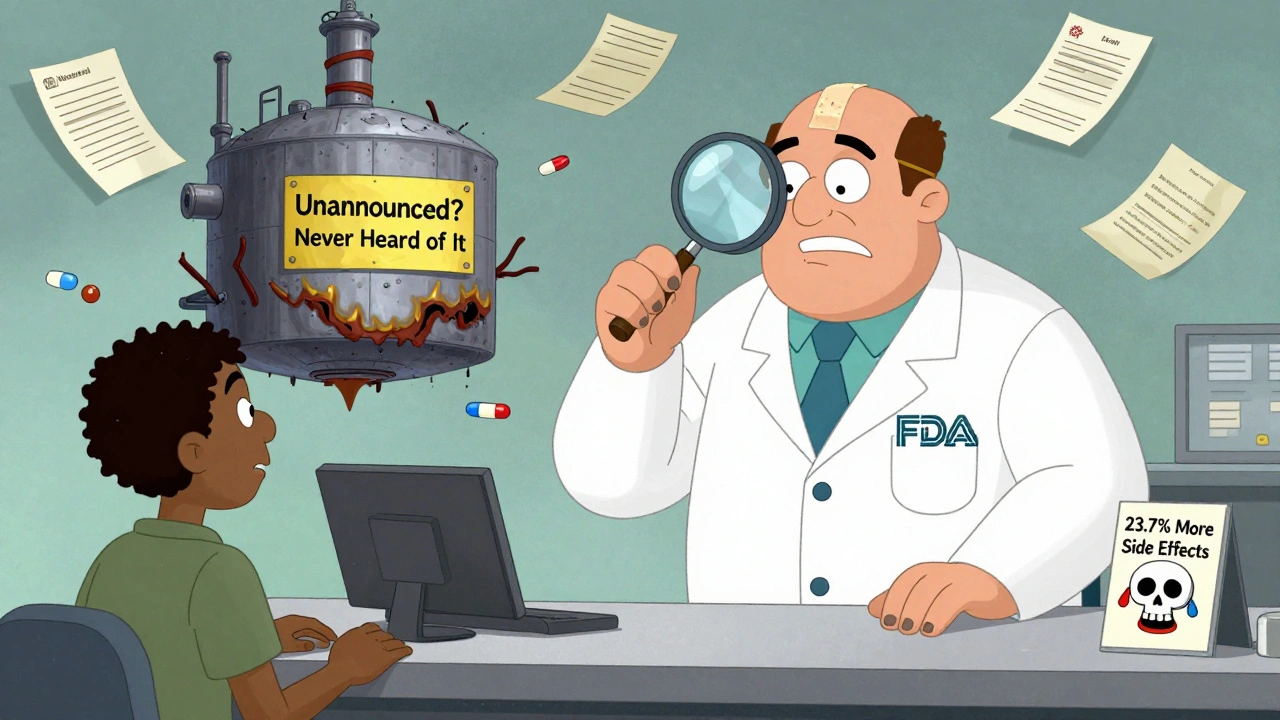
In the U.S., inspections are unannounced. Plants can’t clean up, hide documents, or rehearse answers. But overseas, the FDA has to give advance notice-sometimes weeks. That gives manufacturers time to fix the obvious problems, while leaving deeper issues untouched.
A 2023 study from Ohio State University found that generic drugs made in India caused 23.7% more severe adverse events than those made in the U.S. The same drugs, same labels, different outcomes-because of how they were made.
The Hidden Cost of Cheap Drugs
The generic drug market is worth over $420 billion. But price pressure is crushing quality.Between 2018 and 2022, average generic drug prices dropped 18.3% per year. To stay profitable, manufacturers slashed budgets. Quality control spending fell by 22.7% on average.
Meanwhile, FDA fees for submitting a generic drug application jumped from $129,250 in 2018 to $210,500 in 2023. That’s a 63% increase. But the money doesn’t go to better inspections-it goes to the agency’s operating costs.
Only 23.8% of generic manufacturers have fully adopted Quality by Design (QbD), a science-based approach that builds quality into every step of production. The rest rely on old-school testing after the fact-like checking a car’s brakes only after it crashes.
Who’s Getting Hurt?
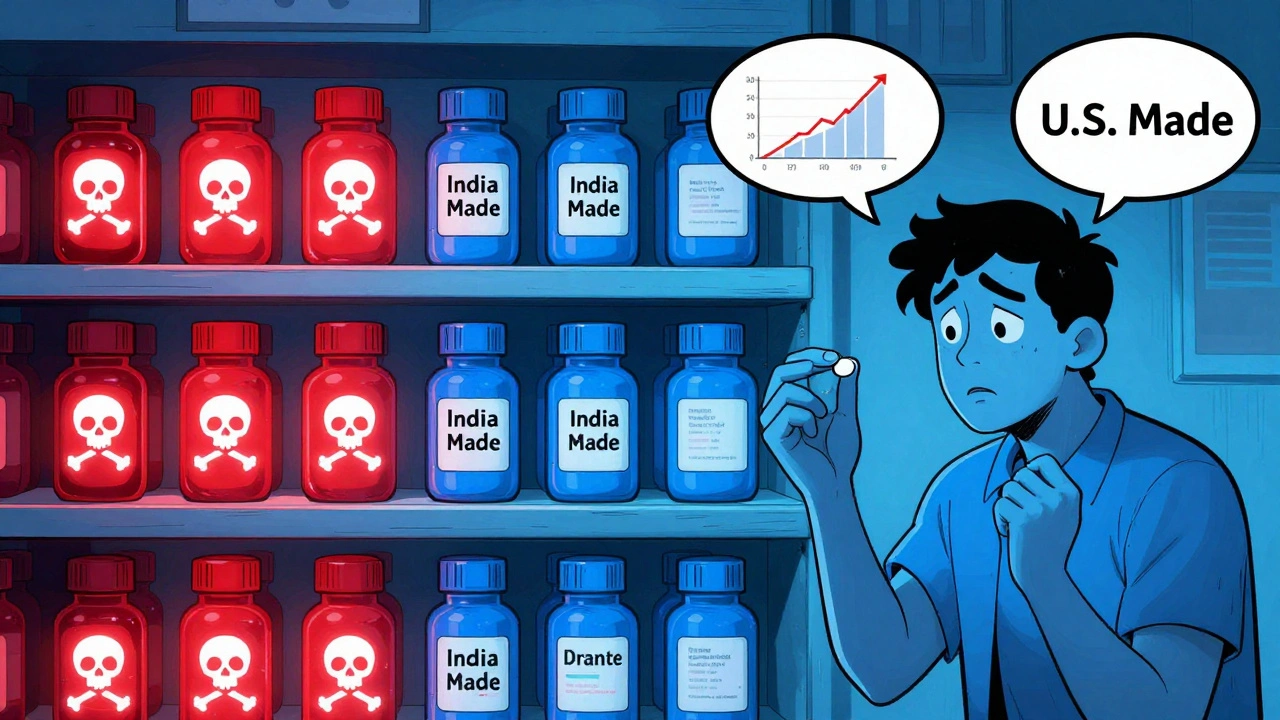
It’s not just statistics. Real people are affected.- A 2022 survey of hospital pharmacists found 67.3% had seen at least one case where a generic drug failed to work as expected.
- On Drugs.com, generic valsartan from one Indian manufacturer has a 3.2-star rating. The U.S.-made version? 4.1 stars. Patients wrote: “Didn’t lower my blood pressure.” “Felt dizzy all day.” “Went back to the brand.”
- The FDA’s adverse event database logged 1,842 reports linked to generic drug quality issues between 2019 and 2022. One batch of nitroglycerin tablets from Impax Laboratories failed to dissolve properly-leaving heart patients without relief during a crisis.
And it’s not just the patients. Pharmacists are stuck in the middle. They’re told to substitute generics to save money. But when a patient has a bad reaction, the pharmacist is the one who has to explain why.
What’s Being Done-And What’s Not
The FDA issued 147 warning letters for cGMP violations in 2022-up 28.5% from the year before. But here’s the problem: they inspected only 13% of foreign facilities that year.The FDA oversees 73% of finished drug products made overseas. But with only 1,200 inspections a year, and 3,000+ foreign plants, they’re outgunned. Even with a new $56.7 million boost from Congress, they’re aiming to hit 1,800 inspections by 2027. That’s still less than 60% of the total.
Meanwhile, the European Medicines Agency (EMA) started unannounced inspections in January 2023. Result? A 41.2% increase in critical findings. No warning. No cleanup. Just the truth.
The FDA’s 2023-2027 plan says it will prioritize “high-risk” facilities-like those making heart meds, cancer drugs, or injectables. That’s a start. But without random, unannounced visits, it’s still playing catch-up.
What You Can Do
You can’t control the factory. But you can make smarter choices.- Ask your pharmacist: “Is this made in the U.S.?” Some pharmacies stock U.S.-made generics-often at the same price.
- Check the label: Look for the manufacturer’s name. If it’s a company you’ve never heard of, do a quick search. Some have multiple warning letters.
- Track your symptoms: If you switch to a new generic and feel worse-fatigue, dizziness, chest tightness-tell your doctor. It might not be in your head.
- Use trusted sources: The FDA’s Drug Shortage Database shows which drugs are in short supply due to quality issues. If your med is on that list, ask about alternatives.
There’s no perfect system. But awareness gives you power. You don’t have to accept a pill that doesn’t work.
What’s Next?
The tide is turning. More countries are demanding unannounced inspections. More hospitals are refusing to stock generics from flagged plants. And patients are speaking up.The FDA’s 2023 Drug Competition Action Plan now requires 100% more stability data and 75% more bioequivalence testing for complex generics. That’s a big step. But it only matters if it’s enforced.
Until then, the burden falls on you. Don’t assume all generics are equal. Ask questions. Demand transparency. Your health depends on it.
Why are generic drugs cheaper if they’re supposed to be the same?
Generic drugs are cheaper because they don’t need to repeat expensive clinical trials. The brand-name company already proved the drug works. Generic makers only need to show their version is absorbed the same way. But that doesn’t mean they spend the same on quality control. Many cut costs on testing, staffing, and facility maintenance to keep prices low.
Are all generics made in China and India unsafe?
No. Many facilities in China and India follow strict standards and produce safe, effective drugs. But the problem is inconsistency. Some plants operate at world-class levels. Others cut corners. The FDA can’t inspect them all, and advance notice lets bad actors hide issues. That’s why it’s hard to know which batch is safe.
How can I tell if my generic drug is from a bad manufacturer?
Check the label for the manufacturer’s name. Then search the FDA’s website for warning letters or inspection reports. You can also ask your pharmacist if they know the source. Some pharmacies track which generics have had issues. If you’ve had side effects after switching, that’s a red flag.
Do U.S.-made generics really work better?
Studies show they often do. U.S. facilities have fewer violations, more frequent unannounced inspections, and better data integrity. A 2023 study found U.S.-made generics caused 23.7% fewer severe side effects than those made in India. That doesn’t mean every U.S. product is perfect-but the system is more reliable.
What should I do if my generic drug stops working?
Don’t ignore it. Contact your doctor immediately. Keep the pill bottle-you may need to report the issue to the FDA’s MedWatch program. Sometimes switching back to the brand or trying a different generic fixes it. But never stop taking a critical medication without medical advice.
Anthony Breakspear
December 2, 2025 AT 22:33Yo, I just got my blood pressure med switched to a new generic last month and now I’m dizzy as hell. Thought it was me, turns out it’s probably the batch from some factory in Hyderabad that skipped 3 quality checks. Wild how we’re gambling with our lives for $3 savings.
Sheryl Lynn
December 4, 2025 AT 13:48Let’s be real-this isn’t about ‘cheap drugs,’ it’s about capitalism eating its own children. We outsource manufacturing to countries with weaker regulations, then act shocked when the pills turn into paperweights. The FDA’s just a corporate lapdog with a badge and a budget that gets raided every fiscal year.
Meanwhile, Big Pharma laughs all the way to the bank while grandma chews on a tablet that doesn’t dissolve. Classy.
Doug Hawk
December 4, 2025 AT 21:44So the FDA inspects 13% of foreign plants? That’s like checking 1 out of 8 cars on the highway for brake failure and calling it ‘safety.’ And the worst part? They give warning letters months in advance. Imagine if the TSA let airlines clean up before inspections. We’d all be flying on planes with no engines.
QbD isn’t some buzzword-it’s the difference between a drug that works and one that kills. Yet only 24% of manufacturers use it. The rest are playing Russian roulette with your heart.
Chelsea Moore
December 5, 2025 AT 07:58THIS IS A MASS MURDER SCHEME. PEOPLE ARE DYING BECAUSE SOMEONE IN CHINA DECIDED TO THROW AWAY LAB REPORTS IN ACID. ACID. I’M NOT KIDDING. MY DAD WAS ON NITROGLYCERIN AND THE GENERIC FAILED. HE HAD A HEART ATTACK BECAUSE THE PILLS WERE JUST SUGAR COATED DUST. WHO DO I SUE? THE FDA? THE PHARMACY? THE MANUFACTURER WHO’S TOO FAR AWAY TO EVEN BE SERVED?
WE NEED A NATIONAL OUTRAGE. NOT JUST A POST. A PROTEST. A RIOT. THIS ISN’T HEALTHCARE. THIS IS A CRIME.
Saurabh Tiwari
December 6, 2025 AT 12:07India makes a lot of generics, sure. But also a lot of good ones. My mom takes her epilepsy med from an Indian company and she’s been stable for 8 years. The problem isn’t the country-it’s the lack of oversight. Same way some US plants mess up too. Just need more random checks, not blame games.
Also, emojis are cool but this is serious. 🙏
Paul Santos
December 6, 2025 AT 23:30It’s a classic case of epistemic fragility in pharmaceutical governance. The FDA’s reliance on pre-announced inspections reflects a neoliberal epistemology that privileges efficiency over truth. The EMA’s unannounced model is a phenomenological rupture-a return to empirical authenticity. One wonders if the FDA’s inertia stems from institutional capture or mere bureaucratic inertia.
Also, 🤷♂️
Shubham Pandey
December 7, 2025 AT 04:02Why care? Pills work for most people. If yours doesn't, switch back to brand. Easy.
John Morrow
December 7, 2025 AT 11:36Let’s contextualize the data. The 23.7% higher adverse events from Indian generics? That’s statistically significant, yes-but confounded by variables like patient adherence, comorbidities, and polypharmacy. The FDA’s warning letter count doesn’t correlate directly with clinical outcomes. Many violations are administrative-missing paperwork, not dangerous contaminants. We’re conflating regulatory noncompliance with clinical failure. The real issue? Lack of transparency in bioequivalence thresholds. The 80-125% range is too wide for narrow-therapeutic-index drugs. That’s the systemic flaw-not geography.
Also, U.S.-made generics aren’t flawless. Look at the 2020 ranitidine recall. That was a U.S. plant. But we don’t cry about that. We cry about India. Confirmation bias is a drug too.
John Biesecker
December 9, 2025 AT 06:15It’s wild how we treat medicine like a commodity. Like a pair of socks you buy on sale. But your body doesn’t care about the price tag. It cares if the molecule works. I had a friend who switched to a cheap generic for thyroid meds and went from feeling fine to barely able to get out of bed. Took 3 months to fix. He’s lucky he didn’t crash a car or have a stroke.
We need to stop pretending ‘generic = same.’ It’s not. It’s ‘same-ish, maybe, if they didn’t cut too many corners this batch.’
Also, 🤕💊
Kristen Yates
December 10, 2025 AT 22:09My grandmother in rural Kansas takes her pills from the local pharmacy. She doesn’t know where they’re made. She just knows she needs them to live. We talk about inspections and data integrity, but for her, it’s about dignity. She shouldn’t have to become a detective just to stay alive. Maybe the real solution isn’t more testing-it’s more compassion.
Genesis Rubi
December 11, 2025 AT 16:11Of course U.S. generics are better. We’re the greatest country on Earth. We invented modern medicine. Why would we let some third-world factory make our life-saving drugs? It’s a national security issue. We need to ban all foreign-made generics. Bring manufacturing back. Tax the hell out of imports. America First, pills first.
Eddy Kimani
December 13, 2025 AT 15:43Wait, so if I ask my pharmacist for a U.S.-made generic, they can actually give me one? And it’s the same price? That’s insane. I’ve been assuming all generics are the same. This changes everything. I’m switching my next script tomorrow. Thanks for the heads-up.