
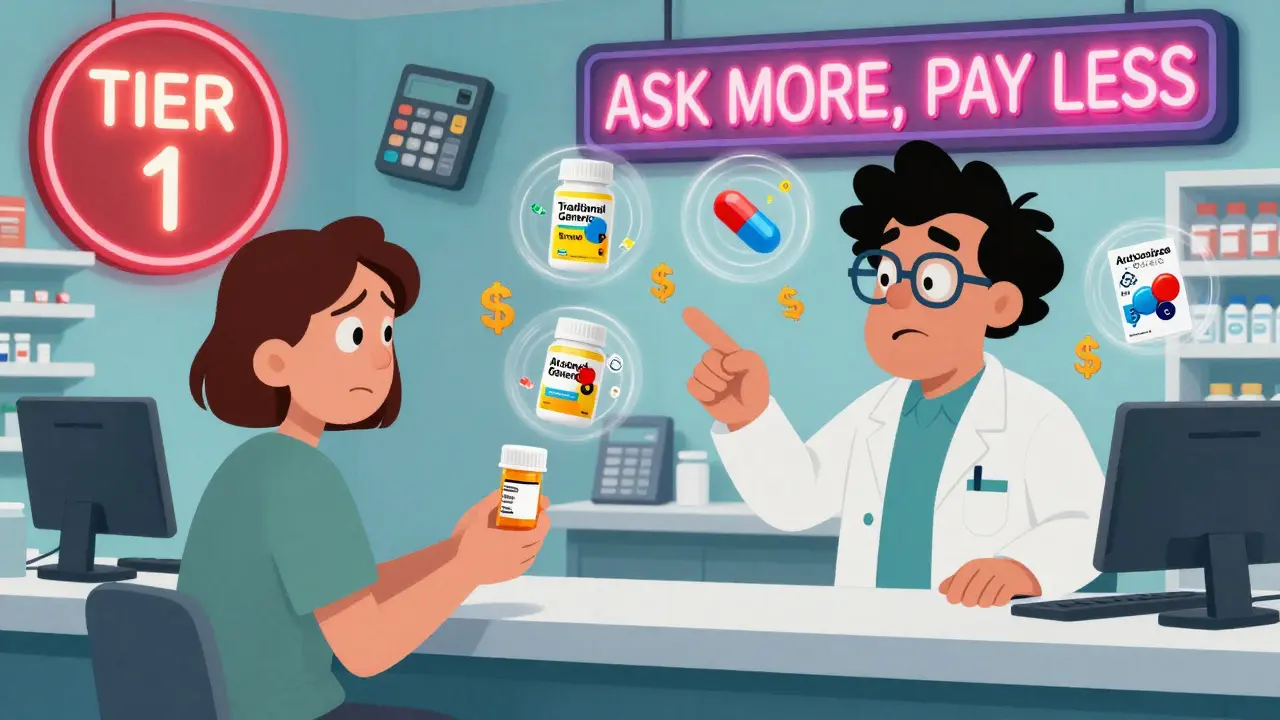
Switching to a generic version of your medication can cut your bill by 80% or more. But not all generics are the same-and if you don’t ask the right questions, you might still be overpaying. Many people think "generic" means cheap and identical, but there’s a hidden layer: authorized generics. These are exact copies of brand-name drugs made by the same company, sold under a different label. They often cost less than the brand, but not always less than traditional generics. And your insurance? It might treat them differently. Here’s how to ask the right questions to actually save money.
Understand the Difference Between Generic and Authorized Generic
A generic drug contains the same active ingredient as the brand-name version. It’s been tested and approved by the FDA to work the same way. But an authorized generic? It’s the exact same pill, same factory, same packaging-just without the brand name on it. The brand company makes it, then sells it to a generic distributor or markets it themselves under a generic label. This often happens right after the brand’s patent expires. Why does this matter? Because authorized generics sometimes have lower list prices than the brand. But that doesn’t always mean lower out-of-pocket costs for you. Insurance plans and pharmacy benefit managers (PBMs) can place authorized generics on higher tiers than traditional generics. That means even if the list price is lower, your copay might be higher.Ask Your Pharmacist These Four Questions
Most pharmacists know what generics are. But only about 43% can clearly explain how authorized generics affect your bill. Don’t assume they’ll volunteer the info. Ask directly:- "Is there a generic version available for this prescription?" This opens the door. If yes, you’re already ahead.
- "Is this an authorized generic?" If the answer is yes, ask why. Some pharmacies stock them because they’re cheaper for the store-but not always for you.
- "How does my insurance treat authorized generics versus traditional generics?" This is the key. Your plan might have different copays for each. Some plans treat authorized generics like brand-name drugs. Others put them on the lowest tier.
- "Can I save money by switching between generic types?" Sometimes, the traditional generic costs less than the authorized one-even if the authorized one has a lower list price. It’s all about how rebates and formulary tiers stack up.
A 2023 study in the Journal of the American Pharmacists Association found patients who asked all four questions saved 15-25% more than those who just asked if a generic was available.
Check Cash Prices-Even If You Have Insurance
Insurance doesn’t always mean lower prices. High-deductible plans, coinsurance, and rebate structures can make paying cash cheaper than using your insurance. Use tools like GoodRx or SingleCare to compare prices across pharmacies for:- The brand-name drug
- The traditional generic
- The authorized generic
For example, insulin used to cost $350 per vial as a brand. After an authorized generic hit the market, the list price dropped to $90. But one patient on Reddit reported their copay stayed at $45 because their plan classified the authorized generic as a brand-tier drug. Meanwhile, the traditional generic was priced at $25 cash-no insurance needed.
Always check cash prices. Sometimes, paying out of pocket for a traditional generic saves more than using insurance for an authorized one.

Why Authorized Generics Can Sometimes Cost More
It sounds backwards, but it’s true. Authorized generics often have lower wholesale prices than the brand. But they don’t always get the same rebates as traditional generics. PBMs negotiate big discounts with traditional generic manufacturers. Those discounts don’t always apply to authorized generics because they’re made by the brand company itself. Think of it this way: if you buy a generic from a third-party maker, the PBM gets a rebate. If you buy an authorized generic, the brand company keeps more of the money. That means the PBM might not pass savings to you. Also, some insurance plans have rules that treat authorized generics as brand-name drugs for tiering purposes. So even if the drug is chemically identical, your copay might be $45 instead of $10.Real Savings Are in the Numbers
The FDA reports that generic drugs saved the U.S. healthcare system $408 billion in 2022. That’s huge. But most of that savings goes to insurers and PBMs-not directly to patients. The real win for you comes when you get a generic with a low copay. Here’s what the data shows:- 93% of generic prescriptions have copays under $20
- Average generic copay: $6.16
- Average brand-name copay: $56.12
But here’s the catch: 28% of patients still pay over $20 for a generic, according to Patients for Affordable Drugs. Why? Because their plan puts the generic on a higher tier. Or they’re getting an authorized generic that’s treated like a brand.
That’s why asking questions matters. A patient on blood pressure medication switched from an authorized generic to a traditional one and saved $20 a month-even though both drugs were identical. The difference? The traditional generic was on Tier 1. The authorized one was on Tier 2.
What to Do If Your Pharmacy Doesn’t Know
If your pharmacist can’t explain the difference between an authorized generic and a traditional one, don’t panic. You’re not alone. Many don’t know the details of PBM contracts or rebate structures. Here’s what to do:- Ask to speak with the pharmacist in charge or the pharmacy manager.
- Call your insurance company’s member services. Ask: "What tier is [drug name] on my plan? Is it listed as an authorized generic?"
- Use your plan’s online formulary tool. Search for your drug and look for the tier designation.
- If you’re still confused, ask for a formulary specialist. Most plans have one.
Some plans even let you request a formulary exception if a cheaper generic isn’t covered. You might need a note from your doctor, but it’s worth trying.
Don’t Assume All Generics Are Created Equal
You might hear, "It’s all the same drug." And technically, yes-the FDA requires generics to be bioequivalent. But that doesn’t mean your out-of-pocket cost is the same. Two pills can be chemically identical, but one might cost you $10 and the other $45 based on your plan’s rules. The goal isn’t just to get a generic. It’s to get the right generic. The one that fits your plan’s lowest tier. The one that’s cheapest when you check cash prices. The one your pharmacist actually knows how to explain.What’s Changing in 2025
The use of authorized generics to delay cheaper traditional generics is declining, according to recent reports. But it hasn’t disappeared. Some brand companies still launch an authorized generic right after patent expiration to lock in market share and delay competitors. The FDA’s 2023 Drug Competition Action Plan is pushing to speed up approvals for complex generics-like inhalers, skin creams, and injectables-where competition has been slow. That means more options coming soon. Also, new legislation is being discussed to tie U.S. drug prices to international benchmarks. If passed, it could make even brand-name drugs cheaper-and push generics even lower.Bottom Line: Ask, Compare, Switch
You don’t need to be a pharmacist to save hundreds a year on prescriptions. You just need to ask.- Always ask if a generic is available.
- Ask if it’s an authorized generic.
- Ask how your insurance treats it.
- Compare cash prices.
- If you’re not saving, switch.
Medication costs are complicated. But the biggest mistake people make is not asking. You’re entitled to know what you’re paying for-and why. Don’t settle for the first answer. Push for the one that saves you money.
Mussin Machhour
December 25, 2025 AT 03:32Just switched my blood pressure med to the traditional generic after reading this and saved $22/month. My pharmacist didn’t even know the difference between authorized and regular generic until I asked. Now I’m asking about every script. This stuff is wild, but it’s free money if you know how to ask.
Also, GoodRx showed the cash price for the regular generic was $8. I was paying $38 with insurance. Mind blown.
Carlos Narvaez
December 26, 2025 AT 19:54How quaint. You’re treating pharmaceutical economics like a DIY home repair project. The system isn’t broken-it’s optimized. You’re just not the target demographic for the savings. PBMs aren’t your friends. They’re intermediaries extracting value. You think asking questions changes that? Cute.
Winni Victor
December 27, 2025 AT 11:26Okay but what if the ‘authorized generic’ is just the brand name in a dumber box and your insurance is scamming you by pretending it’s not the same thing? I swear Big Pharma is running a cult where they make you pay extra to get the exact same pill with a different label. My pharmacist looked at me like I asked if the moon is made of cheese. I asked her if she’d take the ‘authorized’ version if she had to pay out of pocket. She said ‘no.’ That’s all I needed to know.
Also, why do they even have two types of generics? To confuse us? To make us feel guilty for not being smart enough? I’m done.
Terry Free
December 28, 2025 AT 08:30Of course you’re paying too much. You’re trusting a pharmacist who got paid $15 an hour to memorize 3000 formularies while being yelled at by seniors who think insulin should be free because ‘it’s a basic human right.’
Here’s the real issue: you’re not asking your insurer. You’re asking the guy who scans your prescription and calls your doctor for a refill. That’s like asking a gas station clerk how your car’s transmission works.
Stop wasting time. Go to your plan’s website. Look up the tier. If it says ‘Tier 2’ and the label says ‘authorized generic,’ you’re being nickel-and-dimed. File a formulary exception. Or pay cash. Either way, stop being passive.
Lindsay Hensel
December 29, 2025 AT 01:19Thank you for this thoughtful, meticulously researched piece. It is both compassionate and pragmatic, offering tangible pathways for individuals navigating an opaque and often exploitative system.
I have witnessed elderly patients in my community pay hundreds more than necessary due to misunderstanding these distinctions. Your guidance empowers them with dignity and agency. May this message reach every pharmacy, every insurance portal, and every patient who has ever felt too intimidated to ask.
Linda B.
December 30, 2025 AT 23:41Authorized generics are a government-Pharma collusion to keep prices high while pretending there's competition. The FDA is in on it. The same people who approved the brand also approved the 'generic'-same factory, same people, same contracts. They just changed the label to trick you into thinking you're saving. GoodRx? That's a middleman that takes a cut. Your insurance? They're billing you for the brand and pocketing the rebate. You're being played. Always pay cash. Always.
And don't trust the pharmacist. They're trained to say what the PBM tells them to say. They don't even know what a PBM is. They just scan the barcode.
Oluwatosin Ayodele
December 31, 2025 AT 22:12Why are you Americans so confused about generics? In Nigeria, we have no authorized generics. We have generics. And if the brand is expensive, we buy the generic. Simple. If the generic is fake, we go to a different pharmacy. We don’t need four questions. We need one: does it work? If yes, we take it. If no, we find another. Your system is overengineered because you have too many middlemen and too little trust.
Also, cash price? We always pay cash. Insurance? We don’t have it.
Jason Jasper
January 1, 2026 AT 02:42Just wanted to say thanks for the practical advice. I’ve been using GoodRx for a year now and it’s saved me over $600. I didn’t realize how much the tiering mattered until I started comparing the authorized vs. traditional versions side by side. The difference was $30 a month on a medication I take daily. That’s a whole grocery run.
Also, I started asking my doctor to write ‘dispense as written’ if I wanted the traditional generic. It helps avoid the pharmacy auto-switching to authorized without telling me. Small thing. Big difference.