
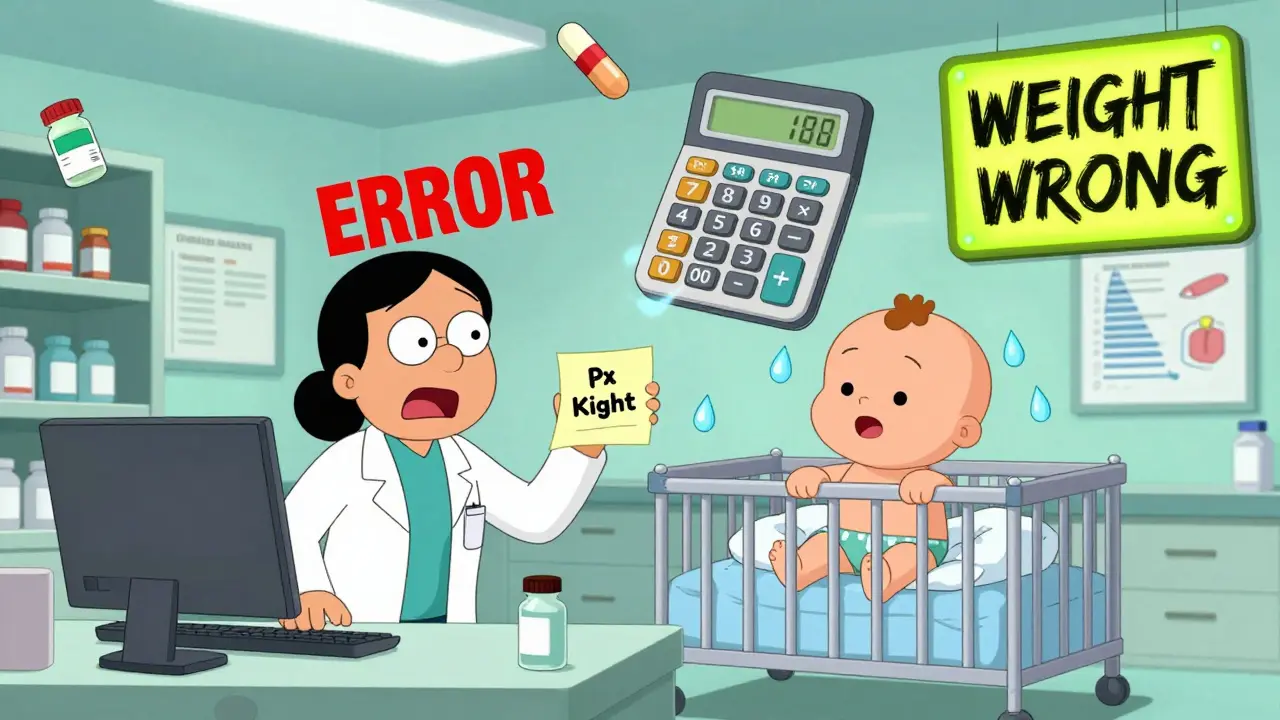
Every year, thousands of children receive the wrong dose of medicine-not because someone was careless, but because a simple number was off. A weight written in pounds instead of kilograms. A calculation done on a phone calculator instead of a verified system. A nurse guessing a child’s weight because the scale hadn’t been updated in weeks. These aren’t rare mistakes. They’re preventable failures-and they happen far too often.
Children aren’t small adults. Their bodies process medicine differently. A dose that’s safe for a 70-pound teenager could be deadly for a 15-pound infant. That’s why weight-based verification isn’t just a best practice-it’s the single most effective way to stop pediatric dispensing errors before they happen.
Why Weight Is the Key to Pediatric Medication Safety
Medications for kids are almost always dosed by weight: milligrams per kilogram (mg/kg) or milligrams per square meter of body surface area. That means if the weight is wrong, the dose is wrong. And wrong doses lead to harm.
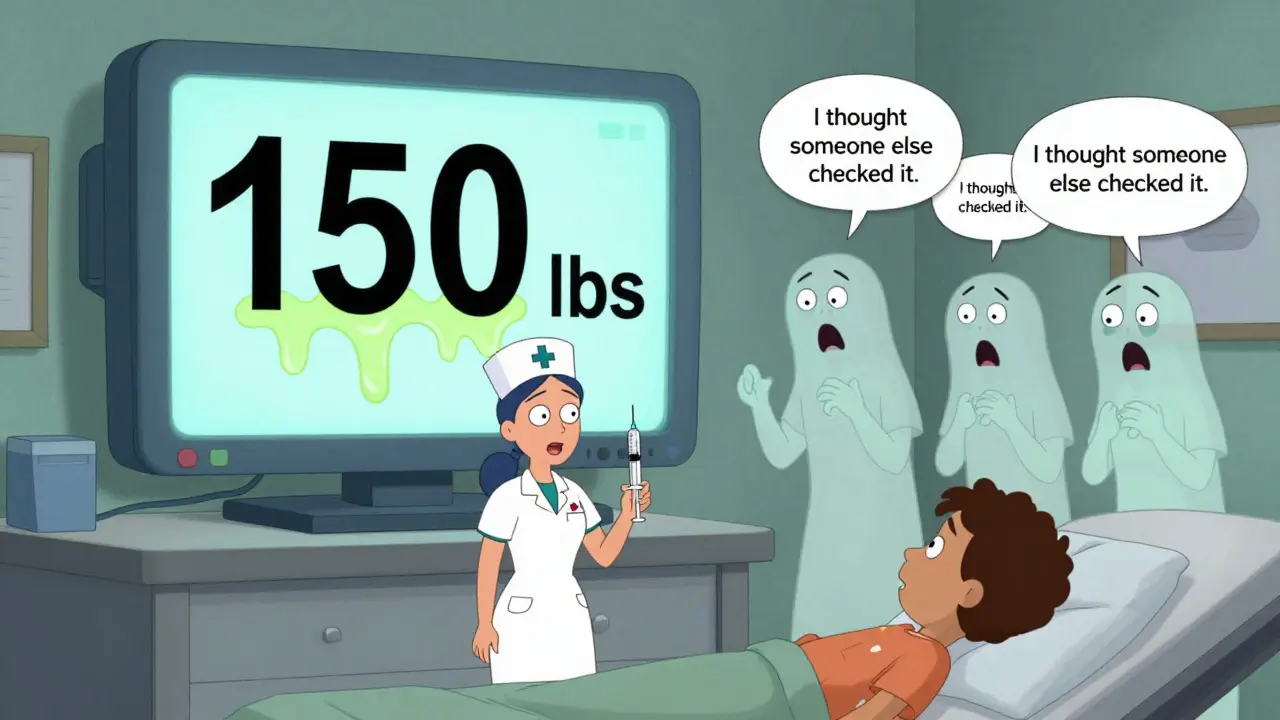
The World Health Organization says children are three times more likely to suffer a medication error than adults. Why? Because the math is harder. Converting pounds to kilograms. Calculating doses for a 4-month-old who weighs 6.2 kg. Double-checking that the liquid concentration matches the prescribed dose. One slip-up-like typing 150 lbs instead of 15 lbs-can turn a life-saving dose into a lethal one.
According to a 2021 review of 63 studies, over 32% of pediatric dispensing errors involved incorrect weight-based calculations. Nearly 9% of those errors caused real harm: seizures, breathing problems, organ damage. The CDC found that 40% of liquid medication errors in kids under 4 came from simple weight-to-dose mistakes. These aren’t theoretical risks. They’re documented, preventable tragedies.
The Three Critical Points of Verification
Preventing these errors isn’t about one magic fix. It’s about building layers of protection. Experts agree: you need weight verification at three key moments.
- Prescription entry - When the doctor orders the medicine, the system must require the patient’s current weight in kilograms. No weight? No order.
- Pharmacy verification - Before the medication leaves the pharmacy, a pharmacist must confirm the weight matches the dose. No exceptions.
- Bedside administration - The nurse giving the medicine must check the weight again. This is the last line of defense.
Dr. Matthew Grissinger from the Institute for Safe Medication Practices calls this the “triple-check” system. And it works. Hospitals that enforce all three steps cut pediatric dosing errors by more than 80%.
But here’s the catch: if any one of these steps is skipped, the system fails. A doctor enters a weight from last year’s visit. A pharmacist trusts the EHR without verifying. A nurse doesn’t have time to check. That’s when errors slip through.
Technology That Actually Works
Manual checks are slow and error-prone. The best defense is smart technology built into the workflow.
Electronic Health Records (EHRs) with Clinical Decision Support Systems (CDSS) are the backbone of modern safety. These systems automatically calculate doses based on weight, flag doses that are too high or too low, and block orders if weight is missing. A 2022 study showed that when properly configured, these systems reduce dosing errors by 87.3%.
But not all systems are equal. Many still let users enter weight in pounds. That’s a problem. The American Society of Health-System Pharmacists (ASHP) says weight must be entered in kilograms only. Why? Because 12.6% of all pediatric dosing errors come from pounds-to-kilograms conversion mistakes. A nurse typing “30” thinking it’s kilograms, when it’s actually pounds? That’s a 66-pound difference. That’s not a typo-it’s a potential overdose.
Automated dispensing cabinets (ADCs) with weight verification help too. They won’t release a medication unless the patient’s weight matches the prescribed dose. One hospital saw a 68.9% drop in dispensing errors after installing them. But they also added 2.3 minutes per prescription to workflow. That’s a trade-off-but one worth making.
Barcode medication administration (BCMA) systems tie the patient’s weight to the medication label. When the nurse scans the patient’s wristband and the drug, the system checks: “Is this dose correct for this weight?” If not, it stops them. Studies show this cuts administration errors by 74.2%.
What Hospitals and Pharmacies Must Do
Technology alone won’t fix this. You need policies, training, and culture.
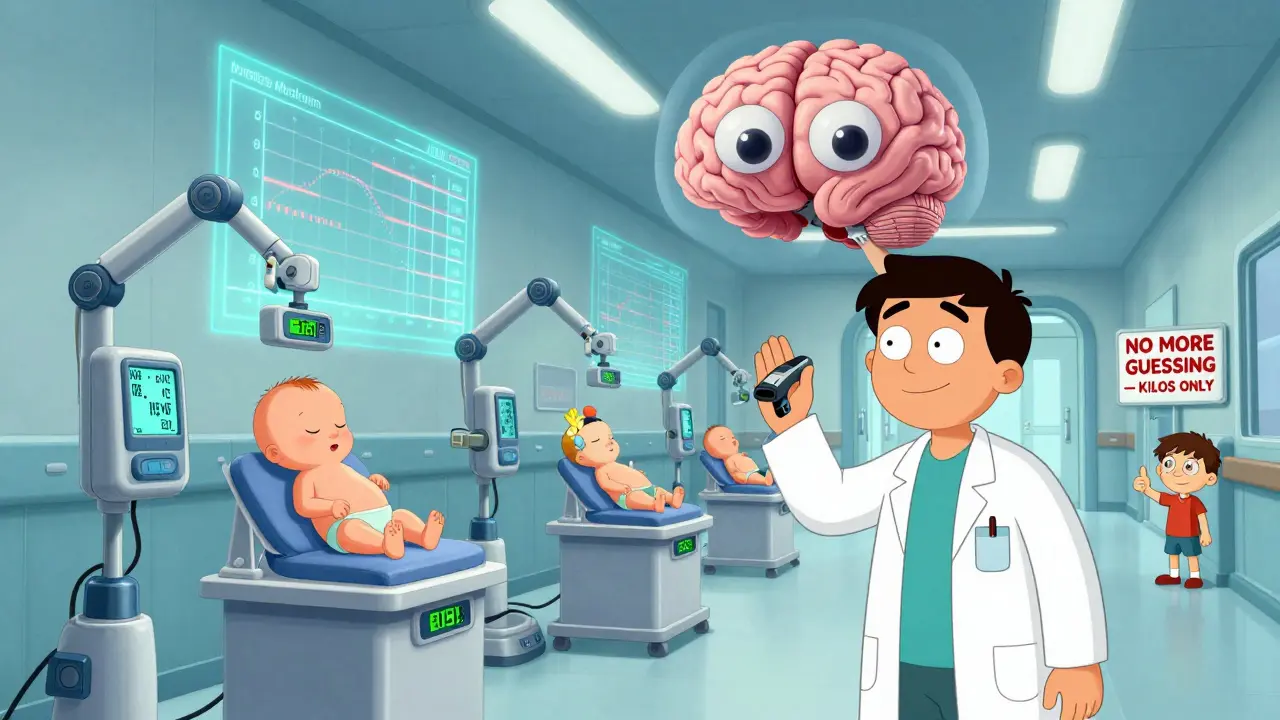
1. Standardize weight measurement. Use digital scales that display only in kilograms. Infants: precise to 0.1 kg. Older kids: 0.5 kg. No pounds. No rounding. No estimates.
2. Require updated weights. The Institute for Safe Medication Practices says: if the weight is older than 24 hours in acute care, or 30 days in outpatient, it’s invalid. Don’t rely on last year’s weight from a well-child visit. Measure it again.
3. Use standard concentrations. If every hospital uses the same concentration for common drugs-like vancomycin at 5 mg/mL-there’s less room for math errors. A 2023 study found this cut calculation mistakes by 72.4%.
4. Train everyone. Pharmacists, nurses, doctors-all need training on pediatric pharmacokinetics. A 2022 survey found 37.8% of pharmacy staff lacked basic knowledge of how children metabolize drugs. That’s not acceptable.
5. Allocate staff. You need pharmacists dedicated to verification. One study found you need 2.5 full-time pharmacists per 100 pediatric beds to make it work. That’s expensive. But so is a child’s death.
The Reality: It’s Not Perfect
Even the best systems have flaws.
Alert fatigue is real. Clinicians get so many warnings-many of them false-that they start ignoring them. One study found 41.7% of weight-based alerts were overridden. And 18.3% of those overrides were actual errors that should’ve been caught.
Some EHRs flag doses as “too high” for teenagers who are approaching adult weight. Pharmacists on Reddit say Epic’s system keeps throwing warnings for 13-year-olds who weigh 110 pounds-when the dose is perfectly safe. That breeds frustration.
And in rural hospitals? Only 32.7% have full weight-based systems. In big children’s hospitals? 94.3%. That’s not just a gap. It’s a danger zone for kids in underserved areas.
Even with all the tech, 63.2% of pediatric nurses reported seeing weight documentation errors in the past year. And 41.7% said those errors caused delays in giving medicine. That’s not just a safety issue-it’s a care issue.
What’s Next: Smarter Systems
The field is evolving. In January 2024, Epic released a new module that uses growth charts to predict expected weight ranges-not just fixed numbers. If a 2-year-old weighs 30 kg, the system knows that’s impossible and flags it. Beta testing cut false alerts by 63.2%.
The FDA is pushing for EHRs to integrate growth charts automatically. The Institute for Safe Medication Practices is testing AI that predicts a child’s weight based on age, height, and past records-with 92.4% accuracy in early trials.
Future tools might include wearable scales for kids with chronic illnesses, or blockchain systems that lock weight data so it can’t be altered. But none of this matters if the culture doesn’t change.
As Dr. Robert Wachter from UCSF says: “Technology alone cannot prevent errors. A culture of safety-with non-punitive reporting, open communication, and shared responsibility-is what makes these systems work.”
Preventing pediatric dispensing errors isn’t about buying the fanciest software. It’s about doing the basics, every time, without exception. Measure weight correctly. Enter it in kilograms. Verify it three times. Train your team. And never assume someone else checked it.
Because when it comes to children’s medicine, there’s no room for “close enough.”
Laura Arnal
January 29, 2026 AT 13:25Thank you for this. I work in a pediatric ER and we just implemented the triple-check system last year. We’ve cut our dosing errors by 80%. It’s not perfect, but it’s saved lives. Seriously. One kid last month? If the nurse hadn’t double-checked the weight, she’d have gotten 10x the dose. 😭🙏
Ryan Pagan
January 31, 2026 AT 07:04Let’s be real-this isn’t about tech. It’s about lazy workflows. I’ve seen nurses grab last year’s weight from a well-child visit like it’s gospel. Then they blame the system when the kid codes. We need to stop treating pediatric dosing like a suggestion and start treating it like a damn life-or-death protocol. No more ‘close enough.’
Sheryl Dhlamini
January 31, 2026 AT 14:17I work in a rural hospital with 4 pediatric beds. We don’t have ADCs. We don’t have BCMA. We don’t even have a scale that doesn’t blink in pounds. And yet-we still give meds. Every day. The system is broken, and the kids paying the price aren’t even old enough to ask why.
Megan Brooks
February 2, 2026 AT 06:00While technology is essential, the human element remains irreplaceable. A culture that incentivizes silence over reporting near-misses will always fail. We must normalize saying, ‘I’m not sure about this weight,’ without fear of reprimand. That’s the foundation of safety-not the algorithm.
DHARMAN CHELLANI
February 3, 2026 AT 01:46weight in kg? lol. in india we use lbs and guess. its fine. kids dont die that easy. also why u need 2.5 pharmacists per 100 beds? u rich ppl got too much money
Doug Gray
February 3, 2026 AT 14:14Alert fatigue is a real thing. I’ve overridden 47 weight-based alerts this month. 45 were false positives. The system thinks a 120lb 14yo is ‘overdosing’ because it’s programmed for 50lb toddlers. It’s not helping-it’s noise.
Robin Keith
February 5, 2026 AT 09:23It’s not the weight, it’s the epistemology of measurement. We assume quantification equals safety, but what if the very act of reducing a child’s being to a kilogram is the root of the alienation in healthcare? We’re not just calculating doses-we’re commodifying vulnerability. And when the system fails, we blame the nurse, not the ontology of the algorithm.
Eli In
February 5, 2026 AT 11:02My cousin’s kid almost got a fatal dose because the EHR auto-filled an old weight. We’re lucky she was seen by a pharmacist who noticed the discrepancy. This isn’t just policy-it’s love. Love for kids who can’t speak up. ❤️
Jasneet Minhas
February 6, 2026 AT 17:21Wow. So we need more pharmacists, better scales, AI predictions, blockchain, growth chart integrations… and still, someone will mess up. 🤷♂️ Maybe the real solution is just… don’t give kids meds unless absolutely necessary? Just saying.
LOUIS YOUANES
February 7, 2026 AT 07:36Of course it’s not perfect. You think a hospital in Ohio gives a damn about a kid in rural Mississippi? This is capitalism. You pay for safety. If you’re poor, your kid gets a guess. End of story.
Paul Adler
February 7, 2026 AT 14:58I’ve seen the opposite too: a nurse refusing to give a perfectly correct dose because the EHR said ‘weight not updated’-even though the child had been weighed that morning. Rigidity can be just as dangerous as negligence.
Kacey Yates
February 8, 2026 AT 17:55Why are we still using pounds in EHRs? Just fix it. Stop letting users type anything. Force kg. Done. No debate. No exceptions. Why is this so hard?
kabir das
February 9, 2026 AT 00:29...And yet, the system still fails... because humans are flawed... and we keep trusting machines... to fix what we refuse to fix in ourselves... 😔💔... the weight is wrong... the dose is wrong... the soul is wrong... and nobody wants to look in the mirror...
Keith Oliver
February 10, 2026 AT 05:22Everyone’s talking about tech, but nobody’s talking about the fact that 70% of pediatric nurses aren’t trained in pharmacokinetics. You can have the fanciest EHR, but if the person entering the weight thinks ‘kg’ means ‘kilograms per second,’ you’re screwed. Train people. Not just systems.
Kristie Horst
February 10, 2026 AT 08:08Let’s be honest: this isn’t a technical problem. It’s a moral one. We have the tools. We have the data. We have the science. What we lack is the collective will to treat every child’s life as non-negotiable. Until that changes, no algorithm will save them.