
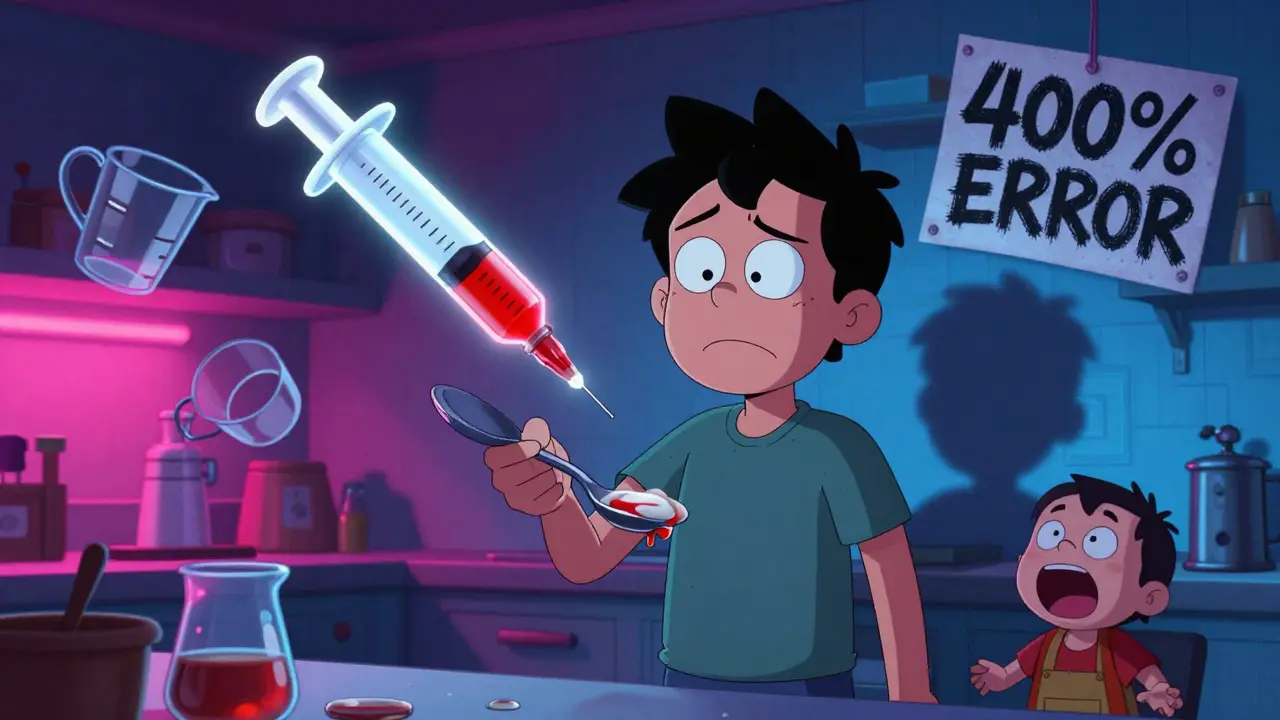
Giving liquid medicine to a child isn’t as simple as pouring it into a spoon. One wrong milliliter can mean the difference between relief and harm. Every year, thousands of children end up in emergency rooms because of dosing mistakes - not because parents are careless, but because they’re using the wrong tools or the wrong technique. The good news? You can avoid this entirely with a simple, cheap, and highly accurate tool: the dosing syringe.
Why Dosing Syringes Are the Only Safe Choice
Kitchen spoons? Measuring cups? Those are dangerous. A standard teaspoon can hold anywhere from 2.5 to 10 milliliters - that’s a 400% variation. If your child needs 5 mL of ibuprofen and you use a spoon that holds 8 mL, you’ve given them almost 60% too much. That’s not a mistake - that’s a risk. Oral syringes, on the other hand, are designed to measure within ±5% of the exact dose. The American Academy of Pediatrics and the FDA both say they’re the gold standard for kids under 5. Even for older kids, they’re the safest option when precision matters. A 2023 study showed that when parents used oral syringes correctly, dosing errors dropped from 40% to just 8%. That’s not a small improvement - it’s life-changing.Choosing the Right Syringe Size
Not all syringes are the same. They come in four standard sizes, each with different markings for accuracy:- 1 mL syringe: For doses under 1 mL. Marked in 0.01 mL increments. Used for very small doses, like antibiotics for newborns.
- 3 mL syringe: Best for doses between 1-3 mL. Marked in 0.1 mL increments. Most common for infant acetaminophen or ibuprofen.
- 5 mL syringe: For doses between 3-5 mL. Marked in 0.2 mL increments. Good for older toddlers.
- 10 mL syringe: For doses over 5 mL. Marked in 0.5 mL increments. Used for larger volumes, like some antibiotics or antifungals.
Always pick the smallest syringe that can hold your child’s dose. A 10 mL syringe is too imprecise for a 2 mL dose. You’ll struggle to read the line accurately. A 3 mL syringe is perfect for most common doses.
Look for syringes labeled “for oral use only.” This isn’t just a suggestion - it’s a safety rule. In the past, some parents accidentally attached these syringes to IV lines, causing deadly mistakes. Since the FDA required this labeling in 2010, those incidents have dropped by 92%.
How to Measure the Dose Correctly
Getting the dose right starts before you even touch the medicine.- Shake the bottle for 10-15 seconds. Many liquid meds are suspensions - the active ingredient settles at the bottom. If you don’t shake it, you might give your child mostly water and no medicine.
- Check the label. Make sure you’re using the right concentration. Acetaminophen comes in 160 mg/5 mL or 80 mg/0.8 mL. Using the wrong one can lead to overdose.
- Draw the dose slowly. Insert the syringe tip into the bottle, pull the plunger back until the top of the black rubber ring lines up exactly with your dose mark. Don’t guess. Don’t round up. If the dose is 2.3 mL, get it to 2.3 mL - not 2.5.
- Remove air bubbles. If you see bubbles, gently tap the syringe and push the plunger slightly to push them out, then pull back again to the correct line.
Never fill the syringe to the top. Always measure to the exact mark. That’s how you avoid giving too much.
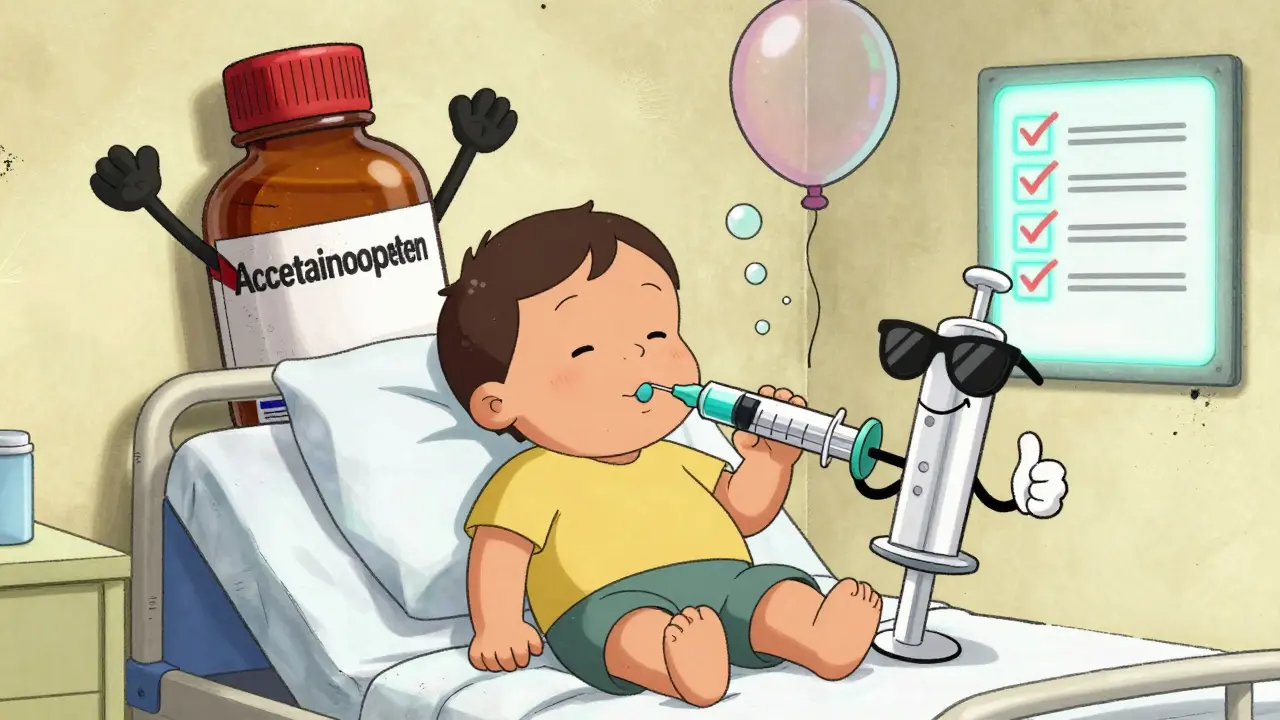
How to Give the Medicine Without a Fight
Measuring is half the battle. Administering it is the other half.Most parents make one big mistake: they squirt the medicine straight into the back of the throat. That’s how choking happens.
Here’s the right way:
- Hold your child upright. Never lie them flat. This helps them swallow and reduces choking risk.
- Place the syringe tip between the cheek and gum. Not the tongue. Not the throat. The space between the cheek and the side of the gums is safest.
- Press the plunger slowly. Give 0.5 mL at a time, then pause for 5-10 seconds. Let them swallow before giving more. This gives them time and reduces gagging.
- Don’t force it. If your child spits out or pushes the syringe out with their tongue, wait a few seconds, then try again. Forcing leads to fear - and next time, they’ll fight harder.
Some parents swear by a trick: freeze the syringe tip for 30 seconds in the fridge before use. The cold numbs the tongue slightly, making it less likely the child will spit it out. It’s not magic, but it works for some.
What About Thick Medicines Like Amoxicillin?
Antibiotics like amoxicillin can be thick, sticky, and hard to draw into the syringe. That’s normal. Don’t force it.Try this:
- Warm the bottle slightly by holding it in your hands for a minute. Heat makes liquids flow easier.
- Use a 3 mL or 5 mL syringe - larger barrels have more space to draw thick fluids.
- Draw the medicine slowly. Pull the plunger back gently, like you’re pulling honey. If it’s too hard, stop and try again after warming.
- If it still won’t draw, ask your pharmacist for a special syringe with a wider tip. Some brands make them for thick suspensions.
One parent on Reddit shared: “I used to give my daughter amoxicillin with a spoon and she’d gag every time. Switched to the syringe, warmed the bottle, and now she takes it like candy.”
Common Mistakes (And How to Avoid Them)
Even with the right tool, mistakes happen. Here are the top three, based on real data from hospitals:- Compressing the plunger too fast - 41% of parents do this. It sprays the medicine into the airway. Slow is safe. Slow is effective.
- Not checking the markings - 33% of parents misread the line. Always double-check. Hold the syringe at eye level. Use a flashlight if needed.
- Leaving the cap on - 12% of parents forget to remove it. That cap is a choking hazard. Always remove it before drawing the dose.
Pro tip: Color-coded syringes are becoming more common. Green for acetaminophen, purple for ibuprofen. If your pharmacy offers them, grab them. They cut down on mix-ups.

When to Use a Medication Cup Instead
Oral syringes are best for doses under 5 mL. For older kids who can drink from a cup - say, a 4-year-old needing 10 mL of cough syrup - a dosing cup can work.But only if:
- The cup has clear metric markings (mL, not teaspoons)
- You pour it slowly and watch the line
- Your child drinks it all without spilling
Studies show dosing cups have an 8% error rate for 10 mL doses - much better than spoons, but still higher than syringes. For infants, toddlers, or any child under 3, stick with the syringe.
What’s New in 2026
The field is improving fast. In 2023, the FDA approved the first color-changing syringe - it turns from blue to green when you’ve drawn the right dose. Clinical trials showed it cut errors by 37%.By late 2025, smart syringes with Bluetooth will hit the market. They’ll connect to your phone, log when the dose was given, and even remind you if you’re due for the next one.
And the World Health Organization now requires oral syringes for all children’s liquid medications worldwide. By 2027, they expect to prevent 250,000 dosing errors a year just by making sure every child gets the right tool.
Final Checklist Before You Give the Medicine
Before you give any liquid medicine to your child, run through this quick checklist:- ✅ Did I shake the bottle for 10-15 seconds?
- ✅ Did I check the concentration on the label?
- ✅ Did I pick the right syringe size?
- ✅ Did I pull the plunger to the exact mL mark?
- ✅ Did I remove the cap?
- ✅ Did I place the syringe between the cheek and gum?
- ✅ Did I give the medicine slowly, in small bursts?
If you answered yes to all seven, you’ve done everything right. You’ve given your child the best chance at safe, effective treatment.
Can I reuse a dosing syringe?
Yes, you can reuse a dosing syringe if you clean it properly. Rinse it with warm water after each use, then let it air dry. Don’t boil it or put it in the dishwasher - that can warp the plastic. If the plunger gets sticky or the tip cracks, replace it. Most syringes last 3-6 months with regular cleaning.
What if my child spits out the medicine?
If your child spits out most of the dose within 1-2 minutes, it’s safe to give the full dose again. If they swallowed it and then spit out some, don’t re-dose - wait until the next scheduled time. Giving too much can be dangerous. If you’re unsure, call your pharmacist or pediatrician.
Can I use a syringe for eye or ear drops?
No. Never use a dosing syringe for anything other than oral medication. Eye and ear drops need special droppers designed for those areas. Using the wrong tool can cause injury or infection. Always use the device that came with the medicine.
Why do some syringes have a red tip?
Red tips are a safety feature. They’re designed to be visually distinct from IV syringes, which usually have blue or clear tips. This helps prevent accidental IV use. If your syringe has a red tip, it’s meant only for the mouth. Never force it into an IV line - even if it fits.
Do I need a prescription to buy a dosing syringe?
No. You can buy oral syringes over the counter at any pharmacy, grocery store, or online. Many pharmacies give them for free when you pick up a liquid prescription. If they don’t offer one, ask - they’re required to provide a measuring device with pediatric liquid meds.
Susannah Green
January 22, 2026 AT 20:26Just used a 3mL syringe for my 18-month-old’s amoxicillin today-no more gagging, no more tears. I used to use spoons because I thought they were ‘easier.’ Wrong. So wrong. The difference is night and day. Also, warming the bottle? Genius. I didn’t know that trick. Thank you.
Vanessa Barber
January 24, 2026 AT 07:55Maybe it’s just me, but I’ve never had a problem with spoons. My kids took medicine fine. Maybe you’re overcomplicating this.
charley lopez
January 25, 2026 AT 18:21While the statistical reduction in dosing errors is statistically significant (p < 0.01), the ecological validity of self-reported parental compliance remains unverified in most studies cited. The behavioral inertia of entrenched practices (e.g., spoon use) may attenuate real-world efficacy despite clinical recommendations.
Anna Pryde-Smith
January 27, 2026 AT 02:42THIS IS WHY KIDS ARE DYING AND NO ONE TALKS ABOUT IT. I almost lost my son because I used a kitchen spoon. I didn’t know. No one told me. Pharmacies don’t hand these out unless you ASK. This should be mandatory. Like seatbelts. Like smoke detectors. Someone needs to make this law NOW.
Stacy Thomes
January 27, 2026 AT 12:21YESSSSSS! I used to cry every time I had to give medicine. Now? I use the syringe, chill the tip, and my toddler says ‘more!’ like it’s ice cream. Life changed. You’re a lifesaver. Seriously.
Andrew Smirnykh
January 27, 2026 AT 12:32In Nigeria, many parents use spoons out of necessity-oral syringes are expensive or unavailable. I wonder if there’s a low-cost, locally manufacturable alternative being developed. The principle is universal, but access isn’t.
Kerry Evans
January 28, 2026 AT 00:57People who use spoons are just irresponsible. This isn’t rocket science. If you can’t follow basic medical instructions, maybe you shouldn’t be parenting. The FDA and AAP have been clear for over a decade. This isn’t a suggestion-it’s a standard.
Sue Stone
January 30, 2026 AT 00:44My kid hates syringes. I tried the cheek trick. Didn’t work. Ended up mixing it with applesauce. Works fine. As long as it’s all gone, right?
Dawson Taylor
January 30, 2026 AT 02:12Accuracy in pharmaceutical administration is a non-negotiable ethical imperative in pediatric care. The margin of error must be constrained by design, not by parental diligence alone.
Sallie Jane Barnes
January 31, 2026 AT 21:16Thank you for writing this. I’m a nurse, and I see so many parents stressed about this. You’ve made it clear, calm, and practical. I’m sharing this with every new parent I meet.
Laura Rice
February 2, 2026 AT 17:12i had no idea about the red tip thing. i thought it was just for looks. also, i always thought you could wash em in the dishwasher. oops. thanks for the heads up!!
Kerry Moore
February 3, 2026 AT 03:03Could you clarify whether the 2023 FDA-approved color-changing syringe is commercially available in the U.S. yet? I’ve checked three pharmacies and none carry them. Is this a regional rollout or still in pilot?
Oladeji Omobolaji
February 3, 2026 AT 11:10Here in Lagos, we use spoons because syringes cost more than the medicine. Maybe we need a global initiative to distribute them for free with prescriptions.
Janet King
February 5, 2026 AT 01:09Always check the concentration. I once gave my daughter 10 mL of 160mg/5mL thinking it was 80mg/0.8mL. She slept for 12 hours. We went to the ER. Don’t be me.
dana torgersen
February 6, 2026 AT 09:37so… like… if you use a syringe… and your kid spits it out… do you give it again? or wait? i’m so confused now. i think i did it wrong last time. help?