
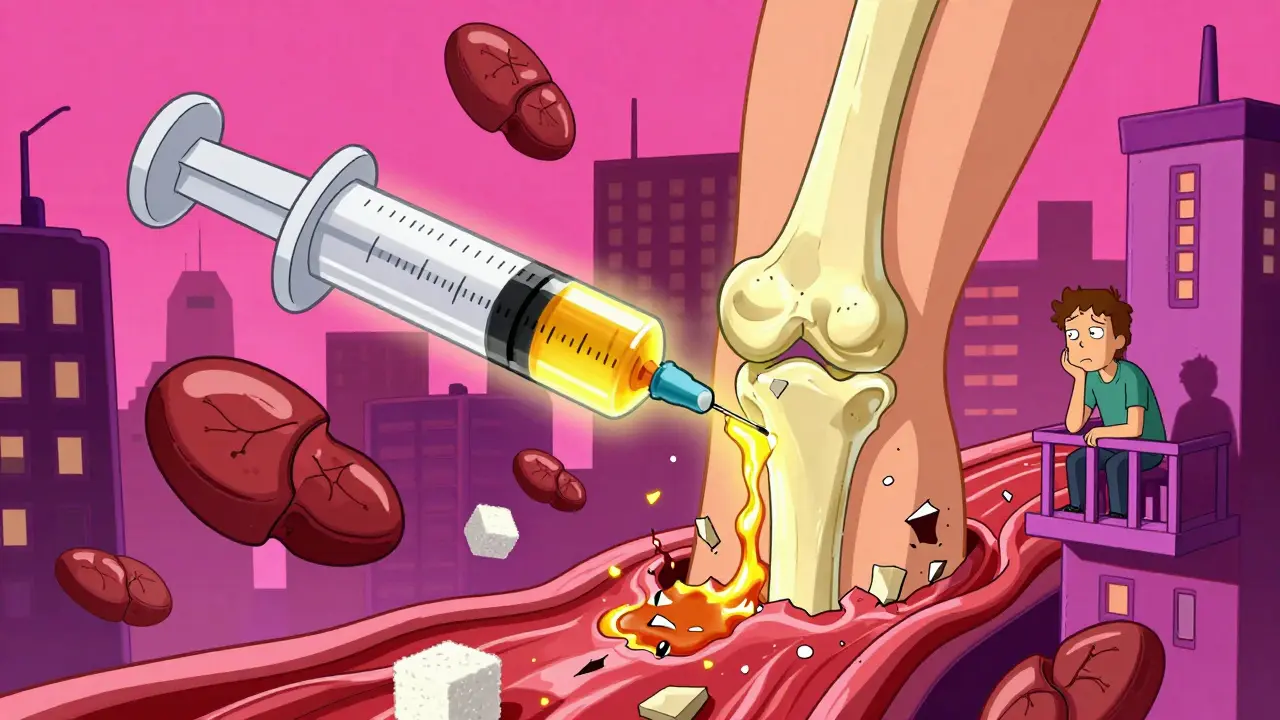
Every year, about 12 million people in the U.S. get a corticosteroid shot directly into a painful joint. It’s quick, it’s common, and for many, it brings fast relief from arthritis pain. But what happens when the steroid doesn’t stay in the joint? What if it leaks into your bloodstream and starts affecting your whole body? And what if, over time, it actually makes your joint worse instead of better?
The Promise and the Problem
Intra-articular steroid injections have been around since the 1950s. They were a breakthrough back then-finally, a way to stop joint inflammation without swallowing pills that hit your stomach and liver. Doctors loved them. Patients loved them. The idea was simple: put the medicine exactly where it’s needed, and avoid the rest of your body. But new research is turning that idea on its head. A 2023 study in Radiology followed over 1,000 patients who got knee or hip steroid shots. The results were startling. A full 1% developed serious joint damage within a year: bone death (osteonecrosis), stress fractures under the cartilage, or rapid loss of joint space. That might sound rare, but when you’re one of those people, it’s not rare at all. Even more concerning? Patients who got repeated injections were 4.67 times more likely to show worsening joint damage on X-rays than those who didn’t get any. That’s not just a small risk. That’s a pattern.How Steroids Escape the Joint
It’s not magic. Steroids don’t stay put. After a shot, some of the medication leaks out of the joint capsule and into your bloodstream. That’s normal. But how much leaks? That depends on the type of steroid, the dose, and your body. Triamcinolone acetonide-often used in knee and shoulder shots-has one of the highest rates of systemic absorption. That means even if you get a shot in your knee, some of it travels to your liver, your adrenal glands, your bones, and your blood vessels. And that’s where the trouble starts.Systemic Side Effects You Might Not Expect
Most people think the worst that can happen is a little pain at the injection site. But the real risks are hidden inside your body.- High blood sugar: Even if you don’t have diabetes, a steroid shot can spike your glucose levels for days. For diabetics, this can mean hospital visits or insulin adjustments.
- Bone thinning: Steroids interfere with how your body rebuilds bone. Over time, repeated shots can lead to osteoporosis-especially in postmenopausal women.
- Adrenal suppression: Your body makes its own cortisol. When you get extra steroids from a shot, your adrenal glands slow down. If you stop the shots suddenly, your body might not know how to restart cortisol production. That can cause fatigue, dizziness, or even life-threatening adrenal crisis.
- High blood pressure: Fluid retention from steroids can push your blood pressure up. This is especially risky if you already have heart disease.
- Facial flushing and mood swings: Some people get a red, warm face for a few hours after the shot. Others report irritability or trouble sleeping.
Can Steroid Shots Actually Destroy Your Joint?
This is the biggest shocker: the treatment might be accelerating the disease it’s meant to treat. Cartilage doesn’t heal. Once it’s worn down, it’s gone. Studies show that patients who get repeated steroid injections have faster joint space narrowing-the key sign of osteoarthritis getting worse. In one study, 44% of patients with hip injections showed significant joint space loss in just six months. Dr. Ali Guermazi, who led the Radiology study, put it bluntly: “We’ve been telling patients that even if these injections don’t relieve your pain, they’re not going to hurt you. But now we suspect that this is not necessarily the case.” It’s not that steroids cause arthritis. It’s that they might make existing arthritis worse-especially in younger patients or those with early-stage disease. If you’re 50 and just starting to feel stiffness in your knee, a steroid shot might give you months of relief. But if you’re 55 and get four shots a year for five years, you might be racing toward a knee replacement sooner than you need to.
The Controversy: Why Do Doctors Still Recommend Them?
You might be wondering: if the risks are real, why are these shots still so common? Because for many people, the benefits still outweigh the risks. A 2023 NIH review found no major difference in side effects between steroid shots and placebo in some studies. Another trial by Dr. Raynauld found no change in joint space narrowing on X-rays. The American Academy of Orthopaedic Surgeons still conditionally recommends them for knee osteoarthritis. The truth? The science is mixed. Some patients get years of relief. Others see their joint collapse after a few shots. We don’t yet know why. That’s why the conversation has shifted. It’s no longer about “Are these shots safe?” It’s about “Who should get them-and when?”Who Should Avoid Steroid Injections?
Not everyone is a good candidate. You should think twice-or skip the shot entirely-if you:- Have diabetes and struggle to control your blood sugar
- Are postmenopausal or have low bone density
- Have had a joint infection in the past
- Are planning joint replacement surgery within the next 6 months
- Have already had 3 or more steroid shots in the same joint in the past year
- Have pain that doesn’t match your X-ray findings (e.g., severe pain but minimal joint damage)
What Are the Real Limits?
Most guidelines say: no more than 3 to 4 shots per joint per year. But that’s not a magic number. It’s not just about frequency. It’s about total dose. If you’re getting triamcinolone at 40 mg per shot, and you get four shots a year, that’s 160 mg of steroid entering your system annually. Add in oral steroids for other conditions? That’s a lot. Doctors should be tracking your total glucocorticoid exposure-every shot, every pill, every inhaler. But few do. And here’s the hard truth: there’s no known safe long-term dose. The more you get, the higher the risk. That’s why many specialists now recommend a “steroid pause”-try physical therapy, weight loss, or braces first. If those fail, then consider the shot. Not the other way around.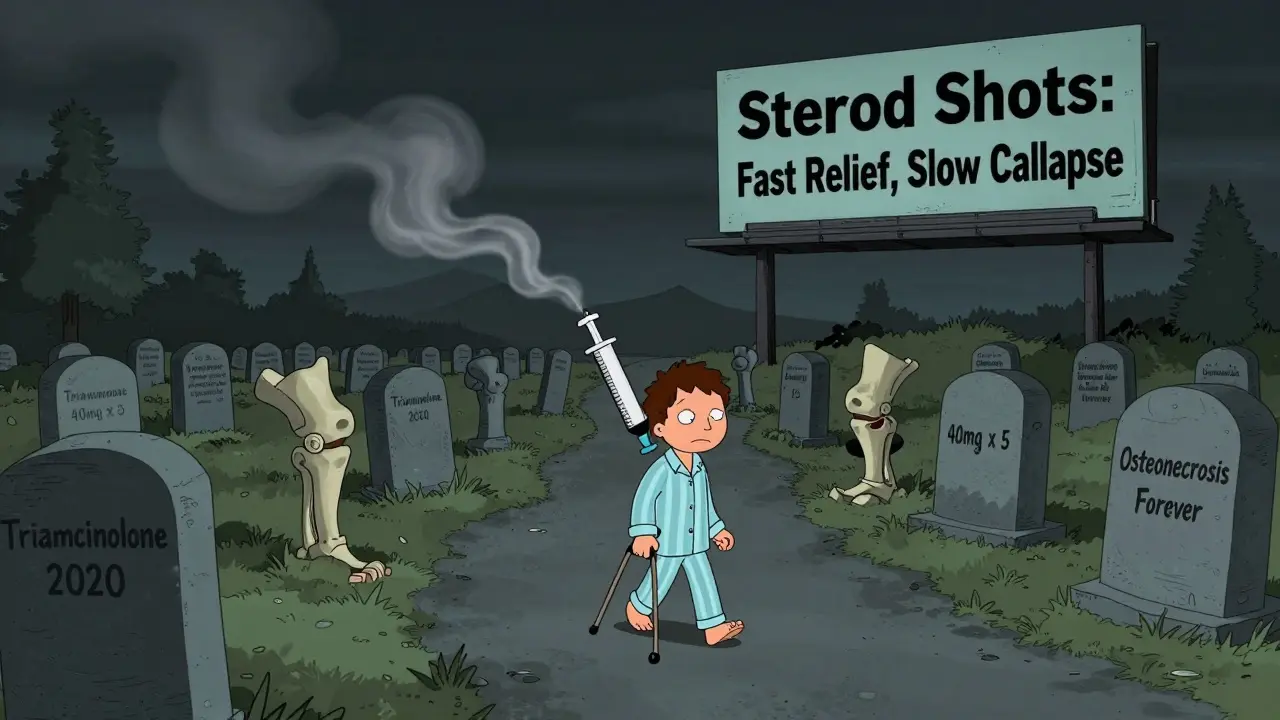
What Comes Next?
The medical community is starting to look for alternatives. Platelet-rich plasma (PRP) and hyaluronic acid injections are being studied more seriously. Some early data suggest they may offer similar pain relief without the same systemic risks. Researchers are also trying to find biomarkers-blood tests or imaging signs-that can predict who’s likely to have bad reactions. That way, you won’t get a shot if you’re at high risk. For now, the message is simple: don’t treat steroid shots like a routine refill. They’re powerful tools. And like any powerful tool, they can help-or harm-depending on how and when you use them.What to Do If You’ve Already Had Steroid Shots
If you’ve had one or more joint steroid injections in the past year, here’s what to do:- Ask your doctor: “How many have I had in this joint? What was the dose?”
- Get a bone density test if you’re over 50 or have other risk factors.
- If you have diabetes, check your blood sugar closely for 3-5 days after each shot.
- Track your pain. If it’s getting worse between shots, that’s a red flag.
- Ask about alternatives: physical therapy, weight management, or non-steroid pain relievers.
Final Thought
Steroid shots aren’t evil. They’ve helped millions of people walk again. But they’re not harmless, either. The days of treating them as a quick fix are over. The real question isn’t whether they work-it’s whether they’re worth the cost to your body over time. If you’re considering one, ask for the full picture. Not just the promise of relief-but the real risks. Because sometimes, the fastest way to feel better is the slowest way to stay healthy.Can intra-articular steroid injections cause weight gain?
Yes, but not always. Steroid shots can cause fluid retention, which leads to temporary weight gain-usually a few pounds over a week or two. This is different from the long-term weight gain seen with oral steroids. If you notice sudden swelling or puffiness after a shot, it’s likely fluid, not fat. It usually goes away on its own.
How long do systemic side effects last after a steroid injection?
Systemic effects like high blood sugar, mood changes, or fluid retention usually peak within 24-48 hours and fade over 1-3 weeks. But adrenal suppression can last longer-up to several weeks-especially after multiple injections or high doses. If you feel unusually tired, dizzy, or nauseous weeks after a shot, talk to your doctor.
Is it safe to get steroid shots every 3 months?
It’s not recommended. Most guidelines limit injections to 3-4 times per year per joint. Getting one every 3 months hits that upper limit. If you need relief more often, it’s a sign the underlying issue isn’t being addressed. Physical therapy, weight loss, or other treatments may be more effective long-term.
Do steroid injections cause osteoporosis?
Repeated injections can contribute to bone loss, especially in people already at risk-like postmenopausal women or those with low vitamin D. Steroids reduce bone formation and increase breakdown. One study showed bone density dropped in patients who received more than three joint injections over two years. If you’re getting frequent shots, ask for a bone density scan.
What are the signs of a steroid flare after an injection?
A steroid flare is a temporary worsening of pain, swelling, or warmth in the joint, usually starting 6-24 hours after the shot. It lasts 1-3 days and is caused by crystals in the steroid solution irritating the joint. It’s not an infection. Ice, rest, and over-the-counter pain relievers usually help. If pain lasts longer than 3 days or you develop fever, call your doctor-it could be an infection.
Can steroid injections cause diabetes?
They don’t cause diabetes, but they can trigger high blood sugar in people who are already prediabetic. One study found that up to 30% of non-diabetic patients had elevated glucose levels after a steroid shot. If you have risk factors-like obesity, family history, or high triglycerides-ask your doctor to check your blood sugar before and after the injection.
Joseph Snow
January 6, 2026 AT 07:51Let me guess-Big Pharma paid the Radiology journal to scare people away from steroid shots so they can sell you expensive PRP treatments instead. You think this is new? I’ve been getting these injections since 2010. My knee still works. My bank account still exists. Meanwhile, your ‘research’ is just fear-mongering dressed up as science.
melissa cucic
January 7, 2026 AT 20:02It’s fascinating-this tension between immediate relief and long-term consequence-how medicine, in its zeal to alleviate suffering, sometimes inadvertently accelerates the very pathology it seeks to suppress. The body is not a machine with isolated parts; it is an ecosystem. When we introduce potent, systemic agents-even via localized delivery-we disrupt homeostasis. And yet, we lack the biomarkers to predict who will adapt… and who will collapse. This is not merely clinical-it is philosophical.
Akshaya Gandra _ Student - EastCaryMS
January 9, 2026 AT 17:04so wait so if i get a shot and then my sugar goes up is that like… bad? i have no idea what to do lol. also can i still eat pizza after? 😅
Jacob Milano
January 10, 2026 AT 21:56I’ve had three of these in my hip over the last two years. First one? Magic. Second? Still good. Third? I felt like I’d been hit by a truck for three days-flushed, jittery, couldn’t sleep. Then I started tracking my pain and realized: the better I took care of my body-weight loss, PT, walking instead of driving-the less I needed the shots. Now I’m down to one a year. It’s not about avoiding the needle-it’s about not becoming dependent on it. Your body’s smarter than you think.
saurabh singh
January 12, 2026 AT 00:35Bro, I'm from India and we don't even have access to these shots most of the time. We use turmeric paste and yoga. But I get it-when you're in pain, you want it gone NOW. Still, this article is a wake-up call. Don't just chase the quick fix. Talk to your doc. Try PT. Move your body. You don't need a needle to be strong. 💪
Dee Humprey
January 12, 2026 AT 09:06Got my 3rd shot last month. Blood sugar spiked to 180 for 4 days. My doctor didn’t warn me. I’m getting a bone scan next week. If you’re getting these, track your numbers. And ask: ‘Is this helping me move better-or just masking the problem?’ I’m switching to PT. No more needles unless I absolutely have to. 🙏
Shanna Sung
January 12, 2026 AT 16:57They’re lying. All of them. The FDA knows steroid shots cause joint collapse but they let it happen because insurance won’t pay for PRP. You think your doctor cares? They get paid per injection. You’re not a patient-you’re a revenue stream. And they’re slowly turning your bones to dust while you’re scrolling through TikTok wondering why you can’t walk. Wake up.
Mandy Kowitz
January 13, 2026 AT 23:38Wow. So after 70 years of doctors saying these are safe… now we’re supposed to panic because some study says ‘maybe’? I’ll stick with my 40mg triamcinolone and my ice pack, thanks. The real problem? People who think they’re entitled to zero discomfort. Pain is a teacher. Steroids? Just a really expensive eraser.