
Driving While on Medication Isn’t Just Risky-It’s Often Illegal
You take your pills like clockwork. Your blood pressure is under control. Your sleep is better. But if you’re getting behind the wheel after taking them, you might be driving while impaired-even if you feel fine.
It’s not just alcohol that kills on the road. Prescription and over-the-counter drugs are now responsible for 18% of all traffic fatalities in the U.S., according to Shane Smith Law’s 2022 analysis. That’s more than double the number killed by illicit drugs alone. And most people have no idea they’re putting themselves and others at risk.
These Common Medications Slow Your Reactions More Than You Think
Not all drugs that affect driving are strong narcotics. Some of the most dangerous ones are the ones you pick up without a prescription.
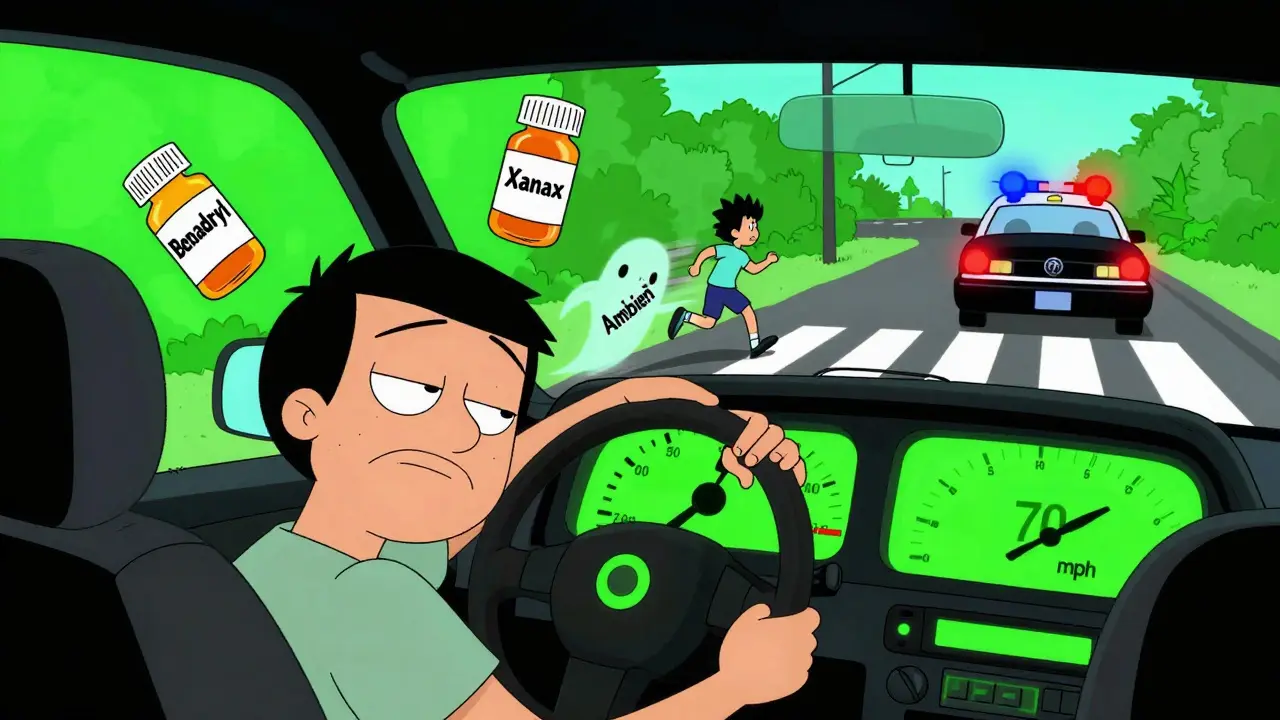
First-generation antihistamines like diphenhydramine-found in Benadryl, Tylenol PM, and many sleep aids-can impair your driving as much as a 0.10% blood alcohol concentration. That’s above the legal limit of 0.08% in every state. A 2021 NHTSA study showed people who took these meds were 70% more likely to cause a crash than those who didn’t.
Benzodiazepines-medications like alprazolam (Xanax) and diazepam (Valium)-slow brain processing by 25% to 40%. If you’re on these for anxiety or insomnia, your reaction time drops. Your vision blurs. Your coordination falters. Studies show these drugs increase crash risk by 40% to 60%. And if you mix them with alcohol? The risk spikes even higher.
Opioids like oxycodone and fentanyl don’t just dull pain-they dull your awareness. They cause droopy eyelids, constricted pupils, and delay reaction time by up to 300 milliseconds. That’s the difference between stopping in time… and hitting a child running into the street.
Even common pain relievers like ibuprofen and naproxen carry hidden dangers. Research from LeRoy and Morse found users had a 58% higher crash risk. Why? These drugs can cause dizziness, blurred vision, and fatigue-symptoms you might ignore until it’s too late.
Antidepressants, especially older tricyclic types and mirtazapine, also increase accident rates. A 2014 review showed a Standardized Incidence Ratio of 1.4, meaning users were 40% more likely to be in a crash. And if you’re on multiple meds? That’s when things get dangerous.
Poly-Drug Driving Is the Silent Epidemic
Most people don’t realize that combining medications-even ones prescribed by different doctors-can be deadly behind the wheel.
Dr. Robert Voas, a senior scientist at the Pacific Institute for Research and Evaluation, found that 22% of drivers tested at trauma centers had multiple drugs in their system. Not just one. Not just alcohol. But a mix: a painkiller, a sleep aid, an antidepressant, maybe a muscle relaxer. And here’s the scary part: these combinations don’t just add up-they multiply. The impairment isn’t 1+1=2. It’s 1+1=5.
Reddit user u/SafeDriver2023 shared a chilling story: Took one Tylenol PM before bed. Woke up at 7 a.m. Felt fine. Drove to work at 9 a.m. Failed a field sobriety test. Why? Diphenhydramine stays in your system for hours. You don’t feel sleepy, but your brain isn’t fully awake either.
That’s the problem. The body doesn’t warn you. The drug doesn’t scream. It just quietly dulls your reflexes, your focus, your judgment.
Legal Consequences Are Harsher Than You Realize
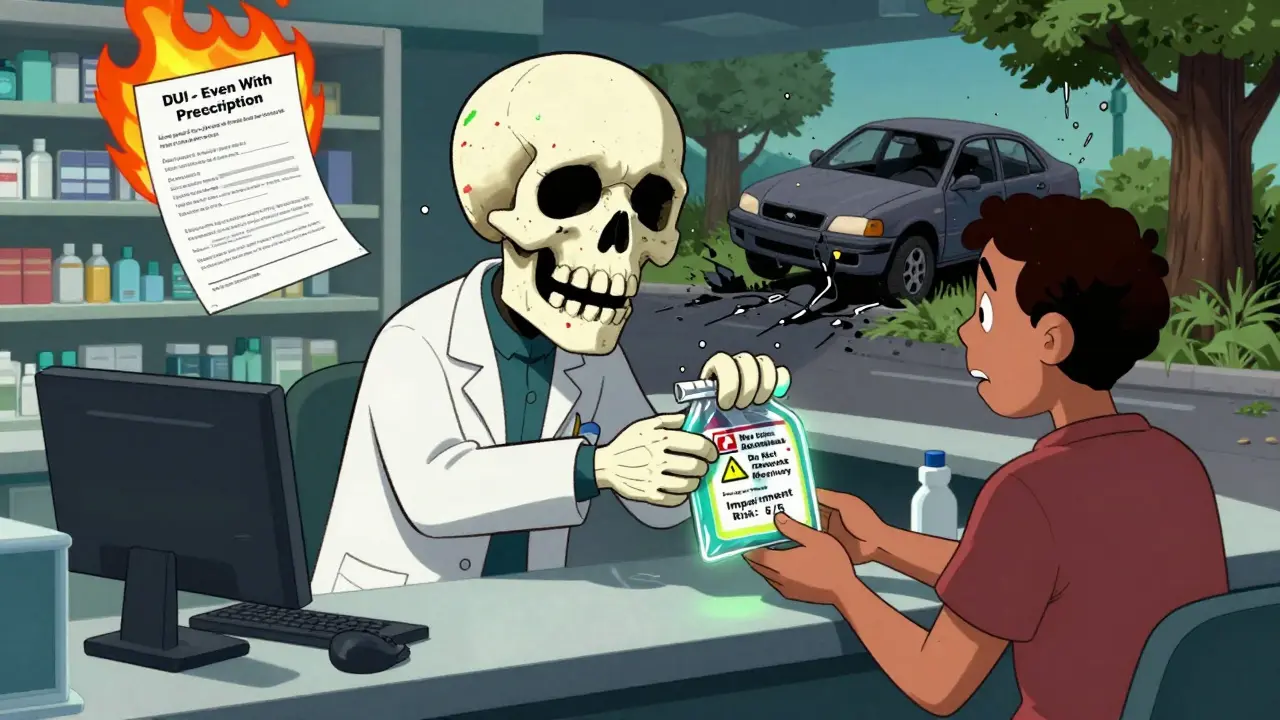
You can be arrested for driving under the influence of a prescription drug-even if you have a valid prescription.
All 50 states now include prescription medications in their DUI laws. Unlike alcohol, where there’s a clear 0.08% limit, the rules for drugs are messy. Only 28 states have set legal blood concentration limits for prescription drugs. In the rest, it’s up to the officer’s judgment: Did you drive poorly? Did you fail a field test? Did they find drugs in your system?
That means you could lose your license, face jail time, pay thousands in fines, and get a criminal record-even if you followed your doctor’s instructions.
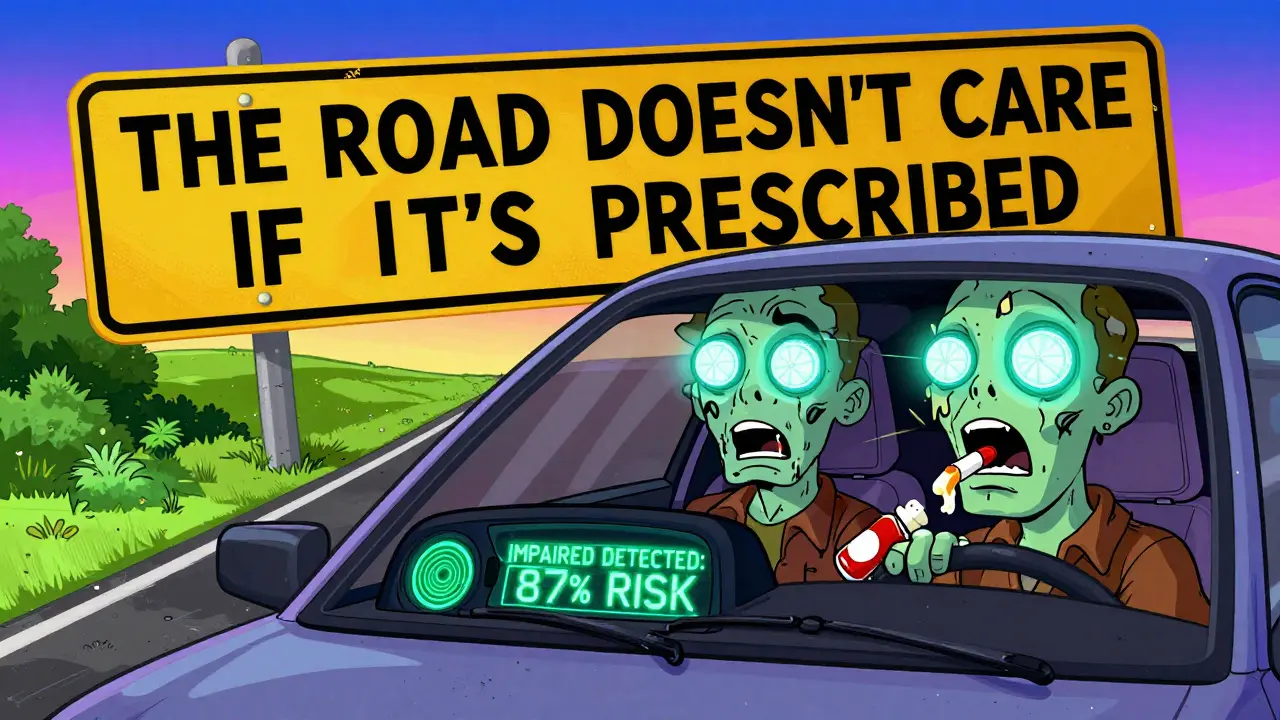
And it’s getting worse. The NHTSA’s Drug Evaluation and Classification Program has expanded to 47 states. Police are being trained to spot drug impairment. Saliva tests for 12 common prescription drugs are being rolled out. By 2027, new cars will start using eye-tracking and steering pattern analysis to detect impairment before you even start driving.
Why Your Doctor Probably Didn’t Warn You
Here’s the truth: most doctors don’t talk about driving risks when prescribing meds.
A 2022 AMA survey found that only 41% of physicians routinely discuss driving impairment during medication consultations. Pharmacists are better-89% now give driving warnings when dispensing, per the 2023 National Community Pharmacists Association report. But if you don’t ask, you won’t hear it.
Even the labels are vague. Most say “may cause drowsiness.” That’s it. No timeframe. No guidance. No warning that zolpidem (Ambien) can impair you for up to 11 hours after taking it.
A 2021 AAA study showed that 50% of drivers used potentially impairing medications without understanding the risks. And 70% of those who took three or more drugs still drove within two hours of taking them.
You’re not alone. But you’re not safe either.
What You Can Do Right Now
You don’t have to stop taking your meds. But you need to take control.
- Ask your pharmacist: “Does this affect my ability to drive?” Don’t assume they’ll tell you unless you ask.
- Check the label: Look for terms like “may cause drowsiness,” “avoid operating machinery,” or “use caution.” If it’s there, treat it like a red light.
- Wait it out: For first-gen antihistamines, wait at least 4-6 hours. For sleep meds like zolpidem, wait 8-12 hours. Don’t trust how you feel-trust the science.
- Use the Beers Criteria: If you’re over 65, ask your doctor if any of your meds are on this list. It identifies 30+ drugs that are too risky for older adults.
- Test yourself: Try the University of Iowa’s Driving Simulator Test. It asks you to complete 15 maneuvers. If you make more than 1.5 lane deviations, you’re not fit to drive.
- Track your meds: Keep a list of everything you take, including OTCs. Bring it to every appointment.
The Future Is Watching You-And It’s Not Just the Road
By 2027, most new cars will have sensors that monitor your eyes, your steering, even your heart rate. If you’re impaired, the car might beep, slow down, or even stop.
It’s not science fiction. It’s coming. And it’s being built because the numbers are rising. The AAA Foundation projects medication-related crashes will increase 24% by 2026-driven by aging populations and more prescriptions.
The FDA just started requiring “Driving Risk Scores” on all CNS-acting medications. They’ll rate impairment from 1 (minimal) to 5 (severe). That’s a start. But it won’t help if you don’t read it.
You’re Not Just Driving for Yourself
Every time you get behind the wheel on medication, you’re not just risking your life. You’re risking the lives of your kids, your neighbors, the person in the car next to you.
One study found that 85% of U.S. adults said they’d be terrified to ride with someone who’d taken multiple drugs. But 37% admitted they’d done it anyway.
That’s the disconnect. We know it’s dangerous. But we still do it.
It doesn’t have to be that way. You can take your meds. You can live your life. But you don’t have to drive while impaired.
Ask the question. Wait the hours. Check the label. Be honest with yourself.
Because the road doesn’t care if your prescription is legal. It only cares if you’re awake enough to see it coming.
Can I get a DUI for taking my prescribed medication?
Yes. Having a prescription doesn’t protect you from a DUI. All 50 states treat driving under the influence of any impairing drug-prescription or not-as illegal. If you’re impaired, you can be arrested, fined, jailed, or lose your license-even if you took your meds exactly as directed.
How long should I wait after taking Benadryl before driving?
Wait at least 4 to 6 hours after taking diphenhydramine (Benadryl). But even then, you may still be impaired. The drug can linger in your system, especially if you’re over 65 or take other meds. The safest choice is to avoid driving altogether after taking it.
Do over-the-counter cold medicines affect driving?
Yes. Many cold and allergy meds contain diphenhydramine or pseudoephedrine, both of which can cause drowsiness, dizziness, or blurred vision. Even products labeled "non-drowsy" can still affect you if you’re sensitive or taking multiple drugs. Always read the active ingredients.
Why don’t doctors warn patients about driving risks?
Many doctors don’t have enough time during appointments to cover all side effects. A 2022 AMA survey found only 41% of physicians routinely discuss driving risks with patients. Pharmacists are more likely to warn you, but you still need to ask. Don’t assume you’ll be told.
Is it safe to drive after taking a sleep aid like Ambien?
No. Zolpidem (Ambien) can impair your driving for up to 11 hours after taking it-even if you feel awake. The FDA recommends waiting at least 8 to 12 hours. Many people wake up feeling fine but are still impaired. Never drive the morning after taking a sleep aid unless you’ve tested your reaction time and waited the full recommended time.
What should I do if I’ve been pulled over for suspected drug-impaired driving?
Stay calm and polite. You’re not required to take a field sobriety test, but refusing may lead to automatic license suspension. Do not admit to taking medication unless asked directly. Ask for a lawyer. If you’re on prescribed medication, bring your pill bottles and prescription records. But remember: having a prescription doesn’t make you legally immune.
Sue Stone
January 23, 2026 AT 22:52Susannah Green
January 25, 2026 AT 11:28Stacy Thomes
January 25, 2026 AT 16:35Kerry Evans
January 25, 2026 AT 17:24Janet King
January 27, 2026 AT 14:00Dawson Taylor
January 29, 2026 AT 02:26charley lopez
January 29, 2026 AT 20:53Sallie Jane Barnes
January 31, 2026 AT 09:15Kerry Moore
January 31, 2026 AT 17:53Anna Pryde-Smith
February 2, 2026 AT 08:45