
Heart Failure Medication Safety Checker
This tool helps you understand what to monitor for each heart failure medication you're taking. Based on your inputs, it will show you specific monitoring needs and potential risks. Remember, this tool doesn't replace your doctor's advice but can help you have more informed conversations.
Important: Always follow your healthcare provider's instructions regarding your medications.
Heart failure isn’t just about a weak pump. It’s about a delicate balance-between fluids, salts, and drugs-that can shift in days, sometimes hours. The right medications can cut hospital visits and save lives, but only if they’re monitored properly. Too often, patients get prescribed the latest drugs but never get the follow-up they need. And that’s where things go wrong.
Four Pillars of Treatment-And Why Each Needs Its Own Watch List
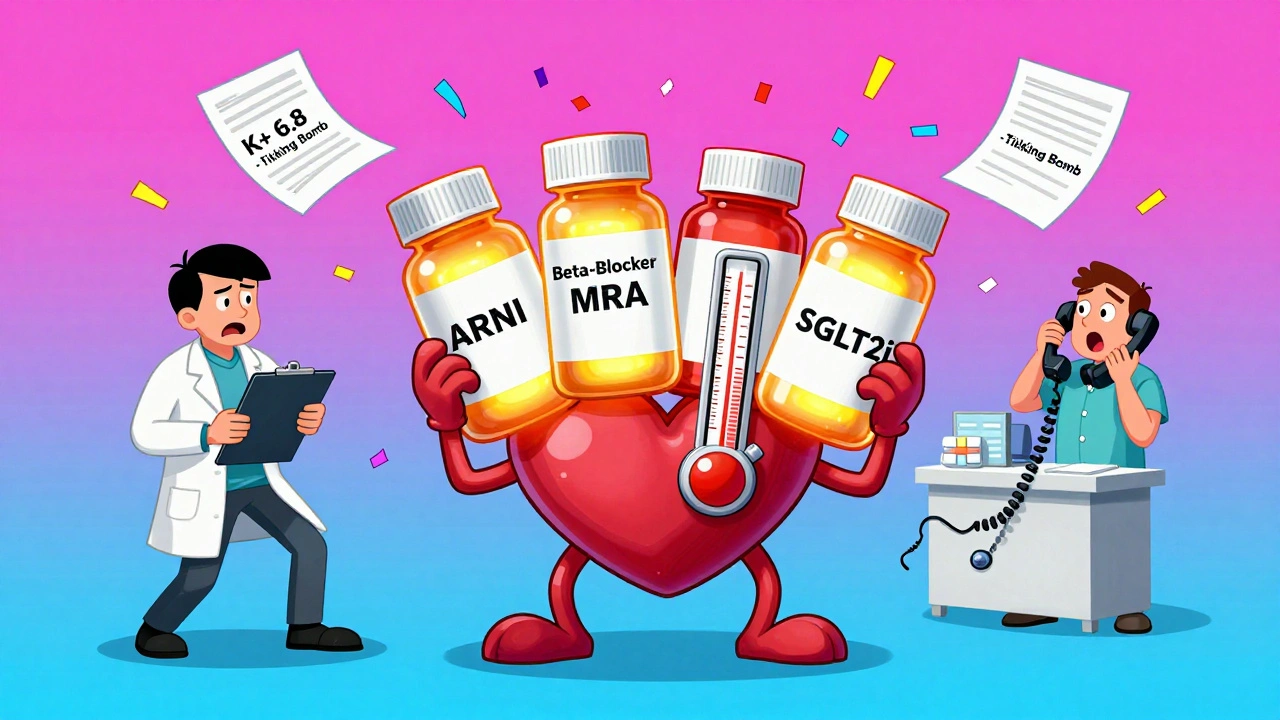
The current standard for heart failure with reduced ejection fraction (HFrEF) is built on four drug classes, known as GDMT: angiotensin receptor-neprilysin inhibitors (ARNIs), beta-blockers, mineralocorticoid receptor antagonists (MRAs), and sodium-glucose cotransporter-2 inhibitors (SGLT2i). Each one works differently, and each one needs its own monitoring plan.
Beta-blockers like carvedilol or bisoprolol slow your heart rate and reduce strain. But they don’t work unless you get them to the right dose. Many patients stay on low doses forever because doctors fear low blood pressure or fatigue. That’s a mistake. Target heart rate is 50-60 beats per minute. If you’re still over 70 after maxing out beta-blockers, ivabradine may be added-but only if you’re not already on a strong CYP3A4 inhibitor like clarithromycin. That combo can spike ivabradine levels by 3 times, raising the risk of slow heart rhythms.
MRAs-spironolactone and eplerenone-are cheap, effective, and dangerous if ignored. They reduce death by 30% in HFrEF. But they can turn your potassium sky-high. That’s not just a lab number-it’s a ticking time bomb. High potassium can cause sudden cardiac arrest. Guidelines say check potassium before starting, then again in 3-7 days. After that, every 3-6 months. Yet, 68% of eligible patients never even start MRAs because providers are scared of the follow-up. It’s not the drug-it’s the lack of a system to monitor it.
And here’s the twist: non-Caucasian patients are 75% more likely to develop dangerous hyperkalemia on MRAs than white patients. That’s not a footnote. It’s a red flag. If you’re Black, Indigenous, or of African descent, your potassium needs more frequent checks-not less.
ARNIs, like sacubitril-valsartan, replace older ACE inhibitors. They’re better at reducing death and hospitalizations. But they drop blood pressure hard. In the PARADIGM-HF trial, 14% of people on ARNIs had dizziness or fainting-compared to 9% on enalapril. So, check blood pressure within 1-2 weeks of starting or increasing the dose. Don’t wait for symptoms. If your systolic pressure falls below 90 mmHg, hold the dose. Don’t just push through it.
SGLT2 inhibitors-dapagliflozin, empagliflozin-are the new kids on the block. Originally for diabetes, they now work for nearly all types of heart failure, even when the heart pumps normally (HFpEF). They reduce hospitalizations by 30%. But they’re not harmless. Genital yeast infections happen in 12% of users-twice the rate of placebo. In women, it’s more common. In older adults, they can cause volume depletion. If you’re 75 or older, start low, watch for dizziness, and make sure you’re not dehydrated. And yes, even with normal blood sugar, you can get diabetic ketoacidosis. It’s rare-but real.
Special Populations Need Special Rules
Heart failure doesn’t look the same in everyone. Your age, sex, race, and other conditions change how drugs behave in your body.
Older adults (75+) process drugs slower. Their kidneys don’t filter as well. Their muscles shrink. That means lower doses. Ivabradine? Start at 2.5 mg twice daily, not 5 mg. SGLT2 inhibitors? Watch for dehydration. Beta-blockers? Don’t rush to target dose if you’re frail. The goal isn’t to hit a number-it’s to feel better without falling.
Women have higher blood levels of sacubitril-valsartan-30% higher than men. That means they’re more likely to get low blood pressure. They also get more genital infections from SGLT2 inhibitors. Yet, many studies still enroll mostly men. If you’re a woman, speak up. Ask: “Is this dose right for me?”
People with kidney disease are caught in a bind. MRAs help the heart, but they hurt the kidneys if potassium rises. SGLT2 inhibitors actually protect kidney function over time-but you still need to check creatinine and eGFR every 3 months. Don’t stop them just because your kidney number dipped a little. That’s often temporary.

Why Most Patients Don’t Get the Right Care
Here’s the ugly truth: only 23% of heart failure patients get all four GDMT drugs at the right doses. Why?
- Doctors don’t have time to titrate meds.
- Nurses don’t know which labs to order when.
- Patients forget to show up for follow-ups.
- Pharmacies don’t flag high potassium risks.
But solutions exist. In clinics that use pharmacist-led titration, target dose achievement jumped from 28% to 63% in six months. Pharmacists call patients, adjust doses, order labs, and coordinate with doctors. No extra appointments. Just better follow-through.
Another win: electronic alerts in electronic health records. If a patient gets an MRA, the system auto-flags: “Check potassium in 5 days.” That cut inappropriate MRA stops by 35%. Simple. Cheap. Life-saving.
And then there’s remote monitoring. Implantable devices that track lung pressure can cut hospitalizations by 30%. But only 1.2% of eligible patients have them. Why? Cost. Access. Lack of training. Still, for someone who’s been hospitalized twice in a year, it’s worth considering.
What’s Coming Next
The future of heart failure care isn’t just about more drugs-it’s about smarter monitoring.
Right now, researchers are testing patches that measure potassium continuously. No more blood draws. Just wear it for a week. Early results show 92% accuracy compared to lab tests. If approved, this could make MRA use safer for everyone.
AI tools are being trained to predict who’s about to get high potassium-83% accuracy, based on lab history, meds, and diet. That means you get warned before your potassium spikes.
And pharmacogenomics-testing your genes to see how you metabolize drugs-is moving from research to real clinics. Some people break down beta-blockers fast. Others hold onto them. That changes dosing. In the next five years, your heart failure plan might include a DNA test.
By 2030, 75% of heart failure patients will have personalized monitoring. Not one-size-fits-all. Not just “check labs every 6 months.” But real-time, adaptive care based on your body, your habits, your risks.

What You Can Do Today
If you or someone you love is on heart failure meds, here’s what to ask:
- “Are we on target doses for all four meds?”
- “When was my last potassium test? When’s the next one?”
- “Am I on a dose that’s right for my age or sex?”
- “Do I need a phone call from a pharmacist or a remote monitor?”
Don’t wait for your doctor to bring it up. Heart failure care has changed. Monitoring isn’t optional anymore. It’s the difference between staying home-and ending up back in the hospital.
Why do I need to check potassium so often on MRA drugs?
Mineralocorticoid receptor antagonists like spironolactone and eplerenone block hormones that make your body hold onto salt and water-but they also make your body hold onto potassium. Too much potassium can stop your heart. That’s why you need a blood test before starting, again in 3-7 days, and then every 3-6 months. If you’re older, Black, or have kidney disease, your risk is higher, so checks may need to be more frequent.
Can I stop my SGLT2 inhibitor if I get a yeast infection?
No-don’t stop without talking to your doctor. Genital yeast infections happen in about 1 in 8 people on SGLT2 inhibitors, especially women. They’re treatable with over-the-counter antifungals. Stopping the drug means losing its heart protection. Instead, ask your provider for an antifungal cream or pill, and keep taking the SGLT2 inhibitor unless you develop symptoms of ketoacidosis-like nausea, vomiting, or confusion.
Why isn’t my doctor increasing my beta-blocker dose?
Many doctors stay at low doses because they’re afraid of low blood pressure or fatigue. But research shows hitting target doses cuts death risk by 35%. If you’re not feeling worse and your blood pressure isn’t dangerously low, ask for a slow titration. Start by asking: “Can we try increasing my dose every 2-4 weeks?” Most patients tolerate it better than expected.
Do I need an implantable monitor if I’ve been hospitalized for heart failure?
If you’ve had a heart failure hospitalization in the past year, an implantable pulmonary artery pressure monitor could reduce your risk of another hospitalization by up to 37%. But it’s not for everyone. It’s expensive, requires surgery, and isn’t widely available. Talk to a heart failure specialist-not your general doctor-to see if you qualify. Right now, only 1 in 80 eligible patients get one.
Are SGLT2 inhibitors safe if I don’t have diabetes?
Yes. SGLT2 inhibitors like dapagliflozin and empagliflozin work for heart failure whether or not you have diabetes. They help your kidneys flush out salt and water, reduce heart strain, and improve survival. The FDA approved them for heart failure without diabetes in 2021. The risks-like yeast infections or rare ketoacidosis-are the same whether you’re diabetic or not. But the benefits are real for everyone with heart failure.
Final Thought
Heart failure meds aren’t like antibiotics-you don’t take them for a week and call it done. They’re long-term tools that need constant tuning. The drugs themselves are powerful. But without the right monitoring, they’re like a car with no dashboard. You might be moving-but you have no idea how fast, or if you’re about to run out of gas.
Lynn Steiner
December 3, 2025 AT 20:19Ugh, another doctor blog pretending they're saving lives. My uncle died on these 'life-saving' drugs because his potassium spiked and no one checked for months. System's broken, not the meds.
Jay Everett
December 5, 2025 AT 00:52Man, this post is a godsend. I’ve been screaming into the void for years about how we treat heart failure like it’s a light switch-on or off. But it’s a symphony. ARNIs? Beta-blockers? SGLT2i? They’re not just pills, they’re instruments. And if you don’t tune them, the whole damn orchestra collapses. I’ve seen patients crash because someone thought ‘stable’ meant ‘leave it alone.’ Nope. That’s how you turn a chronic condition into a funeral. The fact that 75% of non-Caucasian patients get hit harder by hyperkalemia? That’s not biology-it’s negligence dressed up as protocol. And don’t even get me started on how pharmacies don’t flag potassium risks. It’s like giving someone a loaded gun and saying ‘hope you remember to check the safety.’ We need pharmacists on the frontlines, not just sitting behind counters counting pills. And yeah, AI predicting potassium spikes? That’s not sci-fi-that’s 2025. I’m just glad someone finally wrote this down before another person dies because no one asked, ‘When was their last lab?’
Shannara Jenkins
December 5, 2025 AT 12:59This is exactly what my mom needed to hear. She’s 78, on all four meds, and her nurse finally started calling her every two weeks to check how she’s feeling. No more waiting until she’s dizzy and falls. We’re finally seeing progress. Thank you for writing this.
Steve Enck
December 5, 2025 AT 19:51The fundamental epistemological flaw in contemporary cardiology lies in its ontological reductionism: it conflates pharmacological intervention with therapeutic success, thereby obscuring the phenomenological lived experience of the patient. The GDMT paradigm, while statistically significant in RCTs, fails to account for the hermeneutic dimensions of adherence, socioeconomic determinants of lab compliance, and the alienation inherent in clinical governance structures. One cannot optimize a biomarker without first interrogating the power dynamics that render the patient a passive data point.
Jack Dao
December 5, 2025 AT 20:11Wow. Just wow. You actually wrote an article that doesn’t sound like it was drafted by a pharma rep? Who even are you? 😏
Elizabeth Grace
December 7, 2025 AT 11:28My sister got a yeast infection on SGLT2i and stopped it cold. Now she’s back in the hospital. I told her to just use Monistat and keep going-but she panicked. This needs to be louder. Like, billboards loud.
Paul Keller
December 9, 2025 AT 05:15It is an incontrovertible fact that the current paradigm of heart failure management is predicated upon a fragile and often neglected infrastructure of clinical follow-up. The data are unequivocal: pharmacists who engage in structured titration protocols achieve significantly higher rates of guideline-directed medical therapy attainment. Furthermore, the integration of electronic health record-based alerts has demonstrated a statistically significant reduction in inappropriate discontinuation of mineralocorticoid receptor antagonists. These are not speculative interventions-they are evidence-based, scalable, and cost-effective. The failure to implement them at scale is not a technical limitation; it is a moral failure. We possess the tools. We possess the knowledge. What we lack is the collective will to act.
मनोज कुमार
December 9, 2025 AT 20:55Alicia Marks
December 10, 2025 AT 09:21You got this. Keep asking questions. Your life matters more than any lab number.