
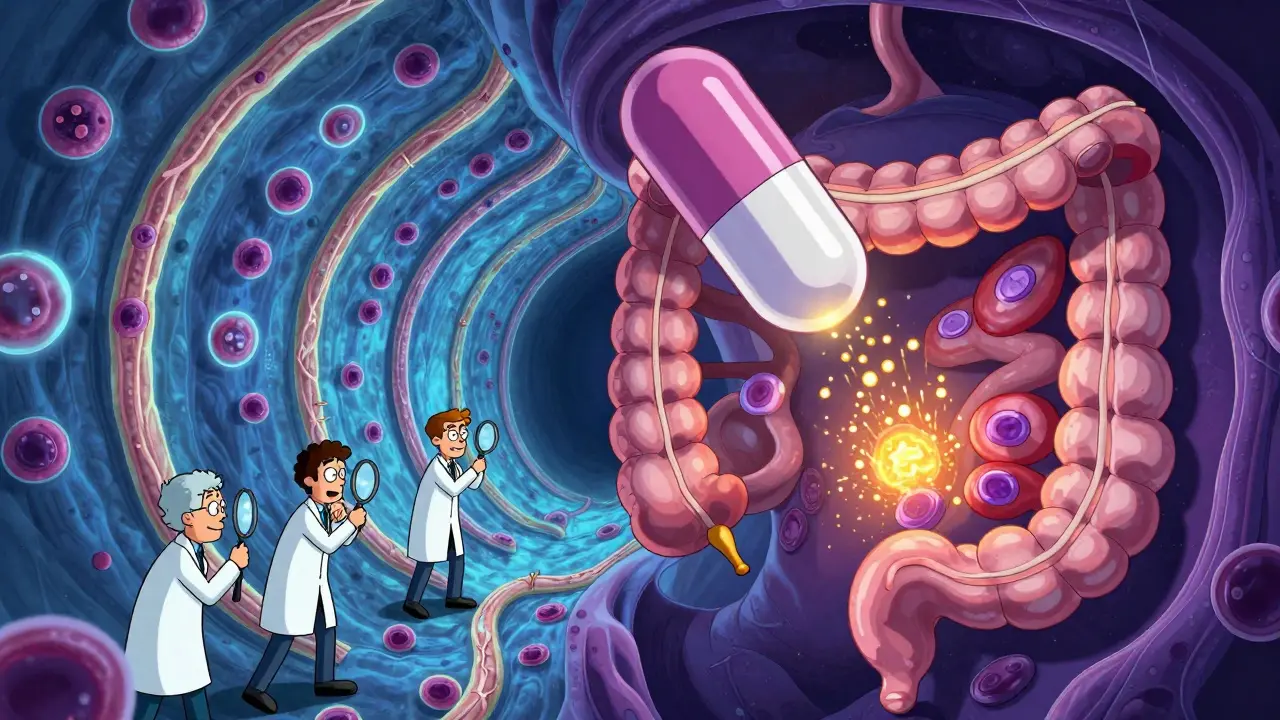
Chronic watery diarrhea that won’t go away-no blood, no fever, no obvious cause-can be one of the most frustrating health mysteries. For thousands of people, especially women over 60, this isn’t just an inconvenience. It’s a life disrupted. And for many, the culprit isn’t IBS, food intolerance, or infection. It’s microscopic colitis.
What Exactly Is Microscopic Colitis?
Microscopic colitis is an inflammatory condition of the colon that doesn’t show up on a regular colonoscopy. The colon looks perfectly normal. That’s why it’s called microscopic. The damage only becomes clear when a biopsy is examined under a microscope. There are two main types: collagenous colitis (CC) and lymphocytic colitis (LC). In CC, there’s a thick band of collagen under the colon lining-thicker than 10 micrometers. In LC, there’s an overgrowth of white blood cells (lymphocytes) inside the colon lining, more than 20 per 100 epithelial cells.This condition is more common than most people realize. Studies show about 4.85 out of every 100,000 people have lymphocytic colitis, and 4.14 out of 100,000 have collagenous colitis. Rates have been rising since the 1990s, likely because doctors now routinely take biopsies during colonoscopies when someone has unexplained diarrhea. It mostly affects older adults, especially women. About 65-70% of cases are in women, and symptoms often start in their 50s or 60s.
Symptoms are consistent: watery diarrhea (5-10 times a day), abdominal cramps, weight loss (more common in CC), fecal incontinence, and sometimes waking up at night to go to the bathroom. Many people live with these symptoms for months-even years-before getting a diagnosis. On average, it takes 11 months from the first symptom to a confirmed diagnosis.
Why Budesonide? The Science Behind the First-Line Treatment
Before budesonide, treatment options were limited and often ineffective. Anti-diarrheal meds like loperamide helped a bit. Bismuth subsalicylate (Pepto-Bismol) worked for some. But nothing delivered consistent, reliable results. Then came budesonide.Budesonide is a corticosteroid, but it’s not like prednisone. It’s designed to work locally in the gut. When swallowed, it’s absorbed in the small intestine and then immediately broken down by the liver-about 90% of it. That means very little enters the bloodstream. This is key. It gives budesonide the power to calm inflammation in the colon without the usual steroid side effects like weight gain, high blood sugar, or bone loss.
Multiple clinical trials have confirmed its effectiveness. In the MICRO-1 and MICRO-2 studies, 84% of patients with collagenous colitis went into complete remission after 8 weeks of 9mg daily budesonide. That’s compared to just 38% on placebo. For lymphocytic colitis, the numbers are similar. By week 4, 70-80% of patients already feel significantly better.
The European Microscopic Colitis Group and major U.S. guidelines both recommend budesonide 9mg daily for 6-8 weeks as the first step. It’s not just effective-it’s the most effective option available. Other drugs like mesalamine or cholestyramine help some, but their success rates are far lower (40-50% at best). Budesonide isn’t just better-it’s in a league of its own.
What About Side Effects? Is It Safe?
Because budesonide doesn’t flood the body with steroids, side effects are mild for most people. In clinical trials, only about 15% of users reported side effects, compared to 45% with prednisone. The most common ones? Insomnia (15%), mild acne (12%), and occasional mood changes (8%). These are usually temporary and fade as the body adjusts.But it’s not risk-free. Long-term use (beyond 12 months) is still being studied, especially in older adults. There’s concern about adrenal suppression if the dose is tapered too quickly. That’s why doctors recommend a slow taper: reduce the dose by 3mg every 2-4 weeks. Jumping off budesonide cold turkey? That’s a recipe for relapse. About 50-60% of patients see symptoms return within months after stopping.
That’s why many people need maintenance therapy. Around 30-40% of patients stay on a lower dose-6mg daily-to keep symptoms away. For them, the trade-off is worth it: fewer bathroom trips, better sleep, no more fear of leaving the house. One Reddit user wrote, “Went from 10 bathroom trips a day to 2 in 10 days. I got my life back.”
Cost, Access, and Real-World Challenges
Budesonide isn’t cheap. The generic version costs $150-$250 for an 8-week course. The branded version, Entocort EC, runs $800-$1,200. For people without insurance, that’s a major barrier. On Reddit, 72% of negative reviews mentioned cost as the main issue.Thankfully, generic budesonide became available in 2018, cutting prices by 60%. Still, many patients struggle to afford even the generic. Some turn to mail-order pharmacies or patient assistance programs. Others try combining budesonide with other treatments-like cholestyramine for bile acid malabsorption-to lower the dose needed. One patient said, “Budesonide plus cholestyramine fixed me after three years of misery.”
Another challenge? Getting diagnosed. Many primary care doctors don’t think of microscopic colitis. They assume it’s IBS and prescribe fiber or probiotics. If you’ve had chronic diarrhea for more than 3 months with no other cause, ask for a colonoscopy with multiple biopsies-not just one. That’s how you catch it.
What Comes After Budesonide?
For the 20-30% who don’t respond to budesonide-or relapse despite maintenance-options are limited. Anti-TNF drugs like infliximab work for some, but they cost $2,500-$3,000 per infusion and carry infection risks. They’re reserved for the toughest cases.There’s hope on the horizon. In 2023, the FDA gave fast-track status to vedolizumab, a biologic that targets gut-specific inflammation. Early trials show 65% remission at 14 weeks. It’s not approved yet, but it’s a sign that the field is moving beyond steroids.
Researchers are also looking at genetics. The COLMICS trial is testing whether people with certain HLA gene variants (HLA-DQ2/DQ8) respond better to budesonide. If this pans out, we could soon be personalizing treatment based on DNA-not just trial and error.
What Should You Do If You Suspect Microscopic Colitis?
If you’ve had watery diarrhea for more than 3 months, especially if you’re over 50 and female:- Stop assuming it’s IBS.
- Ask your doctor for a colonoscopy with multiple biopsies (at least 3-4 from different areas of the colon).
- Get tested for bile acid malabsorption-some people benefit from cholestyramine even without MC.
- If diagnosed, start budesonide 9mg daily for 6-8 weeks. Don’t skip the full course.
- After improvement, taper slowly: reduce by 3mg every 2-4 weeks.
- Monitor bone density if you’re over 50 and on long-term therapy.
Most people don’t realize microscopic colitis is treatable. But with the right diagnosis and budesonide, recovery isn’t just possible-it’s common. The key is persistence. Don’t give up until you get those biopsies. Your colon might be telling you something invisible.
Can microscopic colitis be cured?
Microscopic colitis can go into long-term remission, but it’s not usually “cured” in the traditional sense. Many people achieve symptom control with budesonide and eventually taper off. But about half of patients relapse after stopping treatment, so maintenance therapy is often needed. Some people stay symptom-free for years, while others need intermittent courses. It’s manageable, but not always permanent.
Is budesonide a steroid? Does it cause the same side effects as prednisone?
Yes, budesonide is a corticosteroid, but it’s designed to act locally in the gut. About 90% of it is broken down by the liver before it enters the bloodstream, so systemic side effects are rare. Unlike prednisone, which can cause weight gain, high blood sugar, mood swings, and bone loss, budesonide rarely causes these issues. Side effects like insomnia or acne occur in only 15-20% of users and are usually mild.
Why do I need a colonoscopy if my colon looks normal?
Because microscopic colitis doesn’t show up visually. Even if your colon looks perfectly healthy during a colonoscopy, inflammation can still be present at the cellular level. That’s why multiple biopsies (at least 3-4) are essential. Without them, the diagnosis is missed in over 90% of cases. Always ask for biopsies if you have chronic watery diarrhea with no clear cause.
How long does it take for budesonide to work?
Most people notice improvement within 1-2 weeks. By week 4, 70-80% of patients have significantly fewer bowel movements. Full remission usually takes 6-8 weeks of daily 9mg dosing. Don’t stop early just because you feel better-complete the course to reduce relapse risk.
Are there natural alternatives to budesonide?
Some people try dietary changes, probiotics, or bismuth subsalicylate (Pepto-Bismol), but none match budesonide’s effectiveness. Bismuth helps about 26% of patients. Cholestyramine works well if bile acid malabsorption is also present (60-70% response). But for the inflammation driving microscopic colitis, there’s no proven natural substitute. Medication is necessary for most.
Darlene Gomez
March 22, 2026 AT 09:45Just wanted to say thank you for writing this. I was diagnosed with collagenous colitis last year after 18 months of being told it was 'just IBS.' My doctor didn't even think to biopsy. When I finally pushed for it, the results changed everything. Budesonide didn't just help-it gave me back my life. I can travel now. I can sleep through the night. I’m not constantly planning my day around bathrooms.
It’s crazy how many people suffer in silence because no one connects the dots. If you’ve had chronic watery diarrhea for over 3 months? Get those biopsies. No excuses. You deserve to feel normal again.
Katie Putbrese
March 23, 2026 AT 02:52Of course the medical establishment only figures this out after decades of ignoring women’s pain. Classic. They treat us like we’re hypochondriacs until our colon is literally falling apart. Then suddenly-budesonide? Oh, here’s your miracle drug. Where was this when I was 45 and begging for help?
And don’t even get me started on the cost. $200 for 8 weeks? That’s a luxury for working-class folks. Meanwhile, Big Pharma makes billions off this stuff while people ration pills.
Donna Fogelsong
March 24, 2026 AT 15:52Did you know budesonide was originally developed by a shadowy pharma consortium linked to the WHO? They knew about microscopic colitis for years but buried the data because they wanted to keep people dependent on expensive treatments. The real cure? Fasting and cold exposure. But they don’t want you to know that.
Also-why are biopsies only taken from the right colon? The left side is where most inflammation hides. That’s why 90% of diagnoses are wrong. Ask your doctor if they’re using the FULL protocol. If not, they’re complicit.
Sean Bechtelheimer
March 26, 2026 AT 09:48lol i tried budesonide and got acne and insomnia 😂
then i switched to turmeric and now i’m cured 🌿✌️
Seth Eugenne
March 27, 2026 AT 02:06This is such an important post. I’m a nurse and I’ve seen so many patients dismissed for years because their colon ‘looks fine.’ It breaks my heart.
I always tell them: if your diarrhea is watery, chronic, and unexplained-ask for biopsies. No matter what your doctor says. You know your body best. And if they refuse? Go to a GI specialist. Don’t take no for an answer.
Also-thank you for mentioning the taper. So many people stop cold turkey and wonder why they crash. Slow and steady saves lives.
rebecca klady
March 27, 2026 AT 08:40My mom had this. Took 3 years. She’s on 3mg now just to stay stable. It’s not perfect but it’s better than the alternative. Thanks for sharing the real info-not just the fluff.
Namrata Goyal
March 29, 2026 AT 08:06u r so basic. budesonide? pfft. in india we cure this with neem leaves and yoga breathing. u westerners are so obsessed with pills. u dont even know what inflammation is. its a spiritual imbalance. also ur colon is just mad bc u eat too much gluten. and cheese. and sugar. and stress. and wifi. and your mom.
Zola Parker
March 29, 2026 AT 19:52What if the real issue isn’t the colon… but the soul? I mean, think about it. Microscopic colitis isn’t just a disease-it’s a metaphor for modern life. We’re all fragmented. Overstimulated. Disconnected from the earth. From our breath. From our ancestors.
Budesonide? It’s just a bandaid. A chemical placebo. True healing comes from fasting, forest bathing, and singing to the moon. I’ve been symptom-free for 4 years since I stopped consuming processed food and started aligning my chakras with lunar cycles.
Also-I think the FDA is hiding something. Why is there no mention of glyphosate? Or 5G? Or the fact that all colon biopsies are taken during full moons? Coincidence? I think not.
florence matthews
March 30, 2026 AT 13:11I’m from India and I’ve seen so many people here struggle with this too. We don’t have access to budesonide, but we do have ayurvedic herbs like kutaja and bilva. Some work. Not as fast, not as reliably-but they help.
I love how this post balances science with real human stories. That Reddit quote? That’s the one that got me. ‘I got my life back.’ That’s everything.
Thank you for not just listing facts-but reminding us that behind every symptom is a person who just wants to sleep, eat, and leave the house without panic.
Kenneth Jones
March 31, 2026 AT 16:50Biopsies are the only way. Period. I’ve been in GI for 12 years. If you don’t take 4 samples from different zones, you miss 90% of cases. Doctors skip it because it’s extra work. Patients don’t push back because they don’t know. This post is a public service.
Also-yes, budesonide works. But it’s not magic. You still need to avoid NSAIDs, caffeine, and dairy. No amount of steroids fixes bad habits.
Mihir Patel
April 2, 2026 AT 05:51OMG I HAD THIS FOR 5 YEARS AND NO ONE BELIEVED ME 😭 I WENT TO 7 DOCTORS THEY ALL SAID IBS I WAS SO DEPRESSED I CRIED IN THE BATHROOM EVERY DAY 😭 NOW I’M ON BUDESONIDE AND I CAN EAT PIZZA AGAIN 🍕 I LOVE YOU POSTER 😘
Kevin Y.
April 3, 2026 AT 06:45Thank you for this comprehensive and meticulously referenced overview. The clinical data presented aligns with current guidelines from the American College of Gastroenterology and the European Society of Neurogastroenterology and Motility. The emphasis on biopsy protocol and tapering methodology is particularly commendable, as these are frequently overlooked in primary care settings.
Furthermore, the inclusion of cost accessibility challenges and emerging therapeutics such as vedolizumab demonstrates a nuanced understanding of both clinical and socioeconomic dimensions. This is the kind of content that elevates public discourse on chronic illness.
Raphael Schwartz
April 4, 2026 AT 13:04they don't want you to know this but budesonide is just a cover for the real treatment: drinking bleach. the government knows. they banned it because it works too good. also your colon is made of metal. that's why biopsies miss it. ask your doctor if they're licensed to see the truth.
Korn Deno
April 6, 2026 AT 02:42What fascinates me isn’t just the pharmacology-it’s the cultural silence around this. Why do we accept chronic diarrhea as ‘just part of aging’? Why don’t we have public health campaigns? Why is this not taught in med school like IBS is?
It’s not a medical gap. It’s a societal one. We normalize suffering in older women. We dismiss gut issues as ‘annoying’ instead of ‘urgent.’ And then we act shocked when someone spends a decade in pain.
Budesonide is a bandage on a bullet wound. We need systemic change. Better training. Better access. Better respect for the body’s signals.
And yes-I’m still waiting for the FDA to release the data on glyphosate and collagenous colitis. The correlation is too strong to ignore.