
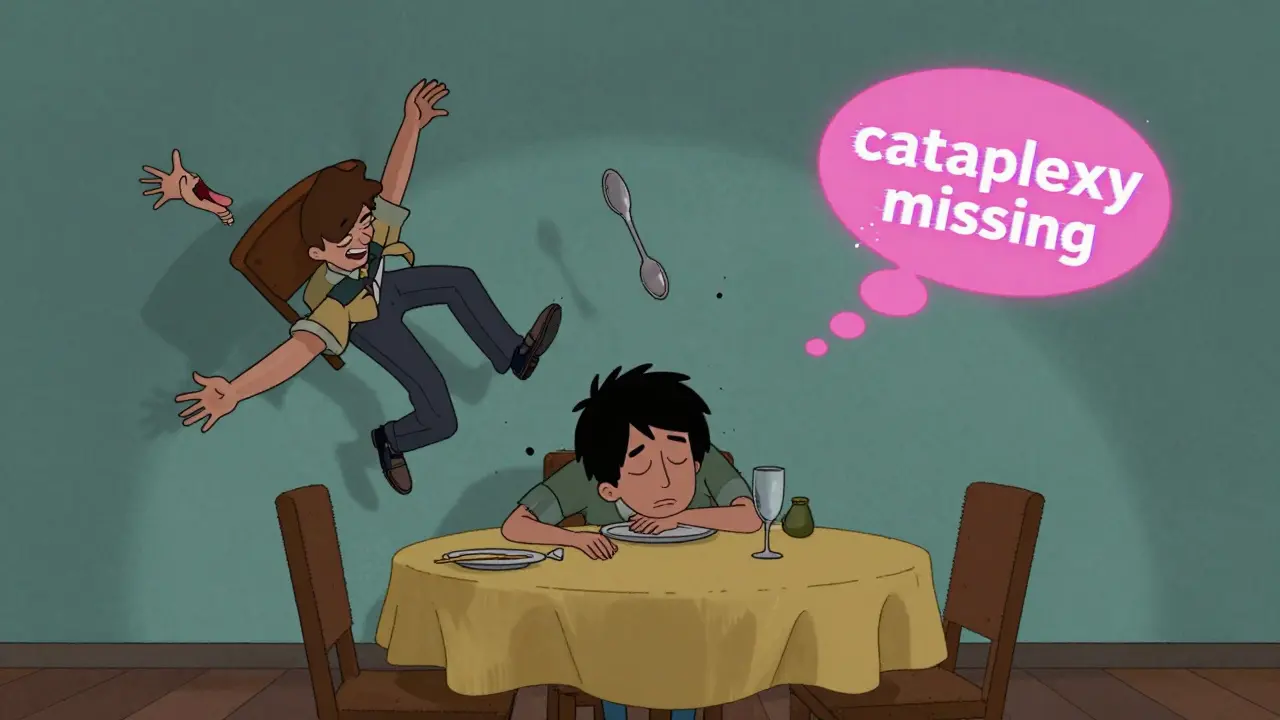
When someone falls asleep in the middle of a conversation, laughs, and suddenly collapses to the floor - it’s not a joke. It’s narcolepsy with cataplexy, a rare but life-altering neurological disorder. For many, it starts as vague fatigue, mistaken for laziness or stress. But for those who live with it, it’s a daily battle against sudden muscle weakness, uncontrollable sleep attacks, and the crushing delay in getting a correct diagnosis - often taking nearly a decade.
What Narcolepsy with Cataplexy Really Means
Narcolepsy with cataplexy, officially called narcolepsy type 1, isn’t just being tired all the time. It’s a brain disorder where the body loses the ability to regulate sleep and wake cycles properly. The core issue? A near-total loss of hypocretin (also called orexin), a brain chemical that keeps you alert and stabilizes muscle control during emotions. Without it, strong feelings - laughter, anger, surprise - can trigger sudden muscle collapse. This is cataplexy: a brief, involuntary loss of muscle tone that can make your knees buckle, your head drop, or even leave you paralyzed for seconds while fully awake. It’s not rare. About 1 in every 2,000 people has it. But because symptoms are often misunderstood, most people wait years before seeing the right specialist. The average delay between first symptoms and diagnosis? Eight to ten years. Many are misdiagnosed with depression, anxiety, or sleep apnea. Some think they’re just “clumsy” or “overworked.”How Doctors Diagnose It
Diagnosing narcolepsy with cataplexy isn’t just about asking if you’re tired. It’s a multi-step process built on specific clinical signs and objective tests. First, doctors look for the classic five symptoms:- Excessive daytime sleepiness - falling asleep at least three times a week for over three months, often without warning.
- Cataplexy - sudden muscle weakness triggered by emotion. It can be mild (drooping eyelids) or severe (complete collapse).
- Sleep paralysis - being unable to move or speak when falling asleep or waking up.
- Hallucinations - vivid, often frightening, dream-like images when dozing off or waking up.
- Disrupted nighttime sleep - frequent awakenings, restless legs, or vivid dreams.
Why Diagnosis Takes So Long
Most patients don’t realize cataplexy is part of a medical condition. They think, “I just get weak when I laugh.” Or, “It’s just stress.” Many doctors don’t recognize it either. A 2022 survey found that 79% of patients struggled to describe their cataplexy episodes. Some dismissed them as dizziness. Others thought they were having seizures. There’s also a gap in access. Only 40% of U.S. sleep centers can properly run MSLTs. That means patients in rural areas or without specialist access often wait months - or years - just to get tested. And then there’s the HLA-DQB1*06:02 gene. About 90-95% of people with narcolepsy type 1 carry this genetic marker. But so do 25% of the general population. So a positive gene test doesn’t mean you have it - but a negative one almost certainly rules it out. That’s why experts now say: if you have clear cataplexy and the gene, CSF testing may be enough. You might not even need the MSLT.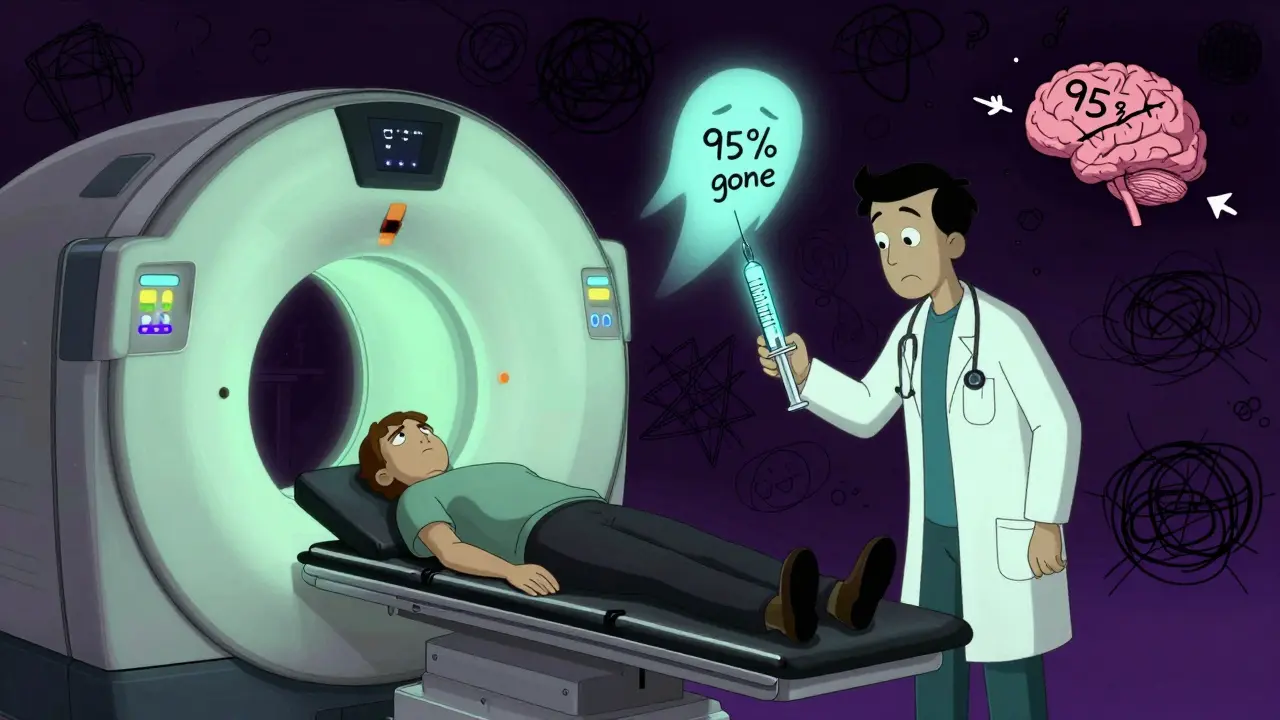
Sodium Oxybate: The Only Treatment That Targets Both Symptoms
For decades, doctors had no real treatment for cataplexy. Stimulants like modafinil helped with daytime sleepiness, but they didn’t stop the muscle collapses. That changed in 2002, when the FDA approved sodium oxybate (brand name Xyrem). Sodium oxybate is a form of gamma-hydroxybutyrate (GHB). It’s not a stimulant. It’s a central nervous system depressant that works by deepening slow-wave sleep and improving sleep architecture. In simple terms: it helps the brain reset its sleep-wake balance. The result? A dramatic drop in cataplexy attacks - often from seven per week to one or less. It also reduces daytime sleepiness. In 2020, a new version came out: Xywav. It contains the same active ingredient but with 92% less sodium. That’s important because high sodium levels can cause swelling, high blood pressure, and heart strain. Xywav is now preferred for patients with hypertension or heart conditions.How It’s Taken - and Why It’s Hard
Sodium oxybate isn’t taken like a regular pill. It’s a liquid you drink twice a night - once at bedtime, and again 2.5 to 4 hours later. That means waking up in the middle of the night to take it. For someone already exhausted, this is brutal. A 2021 study found 65% of patients struggled with the midnight dose. Many reported falling back asleep after the first dose, forgetting the second. Others woke up nauseous, dizzy, or with headaches. Side effects like nausea (38%), dizziness (29%), and bedwetting (12%) are common. But most users say the trade-off is worth it. Dosing starts low - 4.5 grams per night - and is slowly increased over weeks. Most people reach their maintenance dose in 2-3 months. The maximum for Xyrem is 9 grams; for Xywav, it’s 7.5 grams. And here’s the catch: you can’t just pick it up at any pharmacy. Sodium oxybate is tightly controlled under a federal program called REMS (Risk Evaluation and Mitigation Strategy). Only certified prescribers and pharmacies can handle it. You need a special prescription, and your doctor must complete a 60-minute training. Insurance often denies coverage - 28% of patients reported prior authorization rejections in 2022.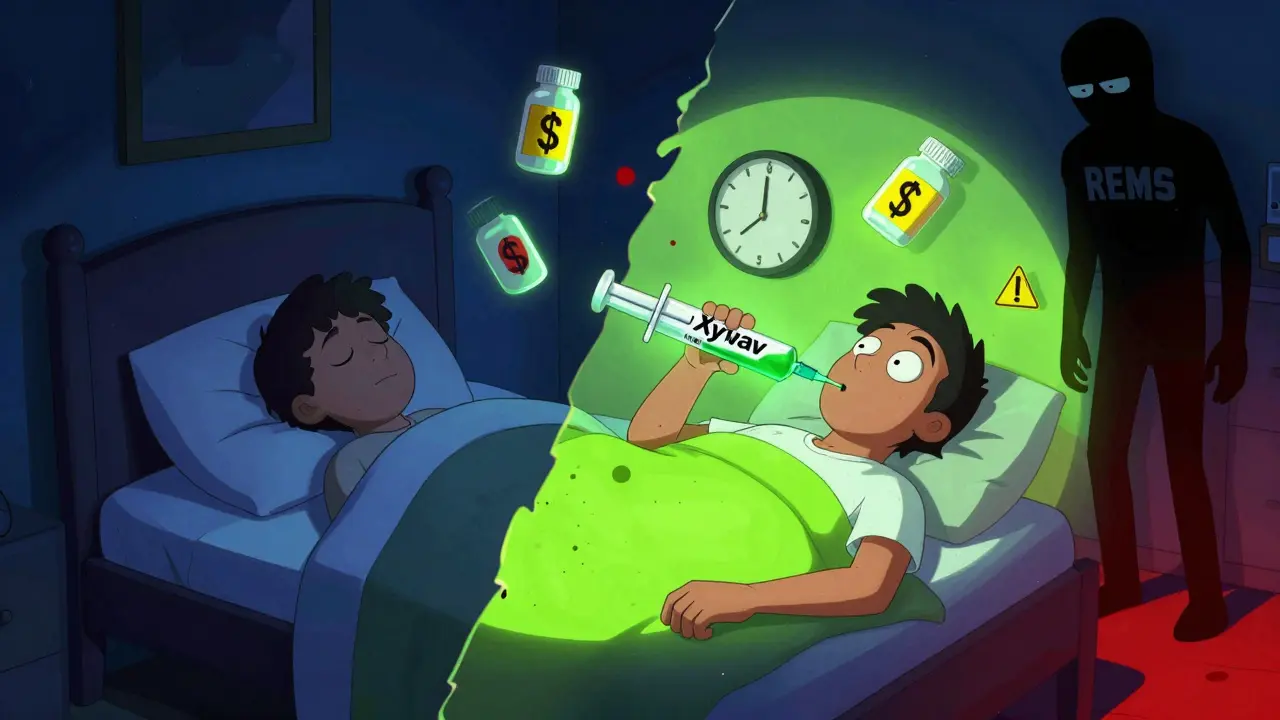
Who Gets It - and Who Doesn’t
About 70% of U.S. sleep specialists prescribe sodium oxybate as first-line treatment for narcolepsy with cataplexy. But only 45% of eligible patients actually get it. Why?- Cost: Before insurance, Xyrem can cost $10,000 to $15,000 a month. Even with coverage, copays can be $500 or more.
- Access: Fewer than 100 pharmacies nationwide are certified to dispense it.
- Stigma: Because GHB is known as a club drug, some patients feel ashamed to take it.
The Future: What’s Coming Next
The field is moving fast. In July 2023, the FDA approved Xywav for children as young as 7. That’s huge - because many kids with narcolepsy are misdiagnosed as having ADHD. In February 2024, Jazz Pharmaceuticals announced promising results for FT001, a once-nightly version of sodium oxybate. If approved, it could eliminate the midnight dose - the biggest barrier to adherence. Even more exciting: Takeda’s TAK-994, an oral drug that replaces hypocretin. In Phase 2 trials, it cut cataplexy by 92%. But development was paused in October 2023 due to liver safety concerns. Still, it proves we’re moving toward a future where we don’t just manage symptoms - we fix the root cause.What Patients Need to Know
If you think you or someone you know has narcolepsy with cataplexy:- Keep a sleep diary. Note when you fall asleep, when you have muscle weakness, and what triggered it.
- Don’t downplay cataplexy. Even if it’s mild, it’s a key diagnostic sign.
- See a sleep specialist - not just your primary care doctor.
- Ask about CSF hypocretin testing if cataplexy is unclear.
- If sodium oxybate is recommended, ask about Xywav instead of Xyrem - lower sodium, same effect.
- Get help with insurance appeals. Many denials are overturned with proper documentation.
Can narcolepsy with cataplexy be cured?
No, there is no cure yet. Narcolepsy with cataplexy is caused by the permanent loss of hypocretin-producing brain cells. But treatments like sodium oxybate can effectively control symptoms, allowing most people to live full, active lives. Research into hypocretin replacement therapies is ongoing, and future treatments may one day restore normal function.
Is sodium oxybate addictive?
When used as prescribed under medical supervision, sodium oxybate has a very low risk of addiction. It’s tightly controlled through the REMS program, which limits access to certified prescribers and pharmacies. Abuse potential exists because it’s chemically related to GHB, a drug of abuse. But patients taking it for narcolepsy do not experience euphoria or cravings. The main risk is overdose if taken with alcohol or other sedatives.
How is narcolepsy with cataplexy different from regular sleep apnea?
Sleep apnea causes daytime sleepiness due to interrupted breathing at night, leading to poor sleep quality. Narcolepsy with cataplexy is a neurological disorder caused by brain chemistry loss - not breathing problems. People with sleep apnea don’t have sudden muscle weakness triggered by emotion, hallucinations, or sleep paralysis. The treatments are completely different: CPAP for sleep apnea, sodium oxybate for narcolepsy.
Can children be diagnosed with narcolepsy with cataplexy?
Yes. Onset often begins between ages 10 and 30, but children as young as 7 can be diagnosed. Symptoms in kids may look like ADHD - inattention, hyperactivity, sudden collapse during play. Cataplexy can be mistaken for clumsiness. The same diagnostic tests apply, and Xywav is now FDA-approved for pediatric use. Early diagnosis is critical to prevent academic, social, and emotional harm.
Why is CSF hypocretin testing not done for everyone?
CSF testing requires a lumbar puncture, which is invasive and carries risks like headaches, infection, or nerve irritation. It’s also expensive ($500-$1,500) and not always covered by insurance. For patients with clear cataplexy, typical symptoms, and the HLA gene, doctors often rely on clinical diagnosis and MSLT. CSF testing is reserved for uncertain cases, atypical symptoms, or when MSLT results are unclear.
Are there alternatives to sodium oxybate for cataplexy?
Yes, but none are as effective. Pitolisant (Wakix) is a stimulant-like drug approved for cataplexy and EDS, but it reduces cataplexy by only 40-60%, compared to 75-90% with sodium oxybate. Solriamfetol helps with daytime sleepiness but doesn’t touch cataplexy. Stimulants like modafinil help alertness but offer no protection against muscle collapse. Sodium oxybate remains the only drug approved specifically for both symptoms together.
Ashlyn Ellison
February 8, 2026 AT 09:05My cousin had this. Went undiagnosed for 12 years. Thought she was just ‘weirdly clumsy’ until she passed out laughing at a wedding. Turned out she had zero hypocretin. The first time she took oxybate, she drove to the store alone for the first time in a decade. No joke - life changed overnight.
Marie Fontaine
February 8, 2026 AT 20:44OMG YES. I’ve been on Xywav for 8 months. The midnight dose is brutal but worth it. I actually hugged my dog yesterday without fear of collapsing 😭. Also, side note: if you’re on it, DO NOT drink alcohol. I learned that the hard way. 🤢
Kathryn Lenn
February 9, 2026 AT 00:21Of course it’s just Big Pharma. GHB was banned because it’s a party drug - now they rebrand it as a miracle cure and charge $10k/month. Someone’s making bank while people die waiting for insurance. Wake up, sheeple.
Monica Warnick
February 9, 2026 AT 14:49Let’s be real - the real tragedy isn’t the disease, it’s the diagnostic delay. I’m a neurology nurse. I’ve seen patients come in with full cataplexy and no idea what’s happening. One guy thought he was having seizures. Another got labeled ‘depressed’ and put on SSRIs for 5 years. The system is broken. CSF testing should be first-line, not last-resort. And yes, the lumbar puncture sucks - but so does living like a ghost in your own body.
Also, the REMS program? It’s not bureaucracy. It’s protection. GHB is dangerous if misused. But the way it’s implemented? It’s a nightmare for patients. Pharmacies that don’t stock it? Insurance denials? We’re punishing the sick for the sins of recreational users.
And don’t get me started on how kids are misdiagnosed as ADHD. I had a 9-year-old girl who collapsed during recess. Her teacher said she was ‘acting out.’ Mom cried when she finally got the diagnosis. She’s on Xywav now. She’s in third grade. She has friends. She’s not a ‘problem child.’ She’s a kid with a neurological disorder.
Doctors need to stop treating this like a sleep issue. It’s a brain chemistry failure. We need more awareness. More training. More funding. And less stigma.
Brett Pouser
February 9, 2026 AT 16:48I’m from rural Texas. Took me 18 months just to get to a sleep clinic. The nearest one was 200 miles away. When I finally got tested, they said I had ‘probable type 1’ - no CSF test because insurance said ‘no.’ So I paid out of pocket. $1,200. Worth every penny. Now I’m on Xywav. I can work full-time. I can hold my baby without fear. If you’re reading this and you think you might have this - don’t wait. Advocate. Push. Call your insurance. File appeals. It’s exhausting - but you’re worth it.
Ken Cooper
February 11, 2026 AT 11:12so i just found out my sister has this and im like wow i thought she was just super tired all the time and kinda spacey but now i get it. the cataplexy thing makes sense like when she laughs at memes and just drops to the floor. she never told anyone. i think she was ashamed. i’m gonna help her find a specialist. no more hiding.
Joshua Smith
February 12, 2026 AT 13:52Just wanted to say thank you for writing this. My mom was misdiagnosed for 11 years. She’s 62 now. Started on Xywav last year. She’s sleeping through the night for the first time since the 90s. I’ve never seen her so calm. I wish this info was out there when she was younger.
Susan Kwan
February 14, 2026 AT 00:05‘Life-changing results’? Sure. Until you’re the one stuck paying $500 a month copay while the company makes billions. And don’t even get me started on the ‘REMS program.’ That’s just a fancy way of saying ‘we’re making it hard for you to live.’
John McDonald
February 14, 2026 AT 19:07My brother’s on sodium oxybate. He takes it at 10pm and 2am. He’s been doing it for 3 years. The worst part? Forgetting the second dose. He’s woken up with a full bladder and no idea how he got there. But he says the trade-off is worth it. He hasn’t fallen over laughing at a family dinner in years. That’s huge. We all just laugh with him now - not at him.
Angie Datuin
February 15, 2026 AT 21:00My friend had a lumbar puncture. Said it felt like someone was trying to pry open her spine with a crowbar. But she said the relief was instant. She cried in the car on the way home. Not from pain. From being seen.
John Watts
February 17, 2026 AT 06:45Hey - if you’re reading this and you think you might have this, you’re not alone. I was diagnosed at 24. Thought I was lazy. Turned out I was losing muscle tone every time I got excited about my favorite song. Now I run marathons. Not because I’m cured - but because I finally got the right treatment. You deserve to live fully. Don’t give up.
glenn mendoza
February 17, 2026 AT 08:38As a medical professional with over two decades of clinical experience, I must commend the thoroughness and scientific rigor of this exposition. The confluence of clinical presentation, diagnostic methodology, and pharmacological intervention presented herein represents a paradigmatic model of translational neurology. The continued development of hypocretin-replacement therapies, while still investigational, offers a profoundly promising avenue for future therapeutic innovation. One cannot overstate the importance of early diagnosis and equitable access to REMS-compliant pharmacotherapy. This is not merely a clinical update - it is a public health imperative.