
Night Shift Medication Safety Calculator
Why Night Shifts Break Your Sleep
Your body isn’t designed to be awake at 3 a.m. and asleep at 9 a.m. That’s not a matter of willpower-it’s biology. When you work nights, your internal clock, called the circadian rhythm, gets thrown out of sync. This isn’t just feeling tired. It’s a medical condition called Shift Work Disorder. The American Academy of Sleep Medicine recognized it in 2014, and since then, studies have shown that between 2.3% and 84% of night workers suffer from it, depending on their job and schedule. In the U.S. alone, about 10 million people are affected.
Healthcare workers, truck drivers, factory staff, and emergency responders are hit hardest. Their bodies are stuck in a loop: try to sleep during daylight (when the sun is up and noise is everywhere), then fight to stay awake during the night (when your brain thinks it’s time to be alert). The result? Poor sleep quality, constant fatigue, and a higher chance of making mistakes-sometimes deadly ones.
The Danger of Fatigue on the Job
Fatigue isn’t just annoying. It’s dangerous. The National Safety Council found that workers who are sleep-deprived are 70% more likely to have a workplace accident. That’s not a small risk. In hospitals, a tired nurse might misread a dosage. In a truck cab, a drowsy driver might drift into another lane. In a factory, a worker might miss a safety check. These aren’t hypotheticals. The National Highway Traffic Safety Administration reports that drivers using prescription sleep meds are 4.5 times more likely to crash within two hours of taking them-and the risk lingers for up to eight hours.
And it’s not just accidents. Poor sleep affects decision-making, memory, and reaction time. A 2018 CDC study showed workers on opioids or benzodiazepines performed 32% worse on tests measuring coordination and alertness. That’s worse than being legally drunk in some cases.
What Medications Are Used-and Why They’re Risky
Most night shift workers turn to two types of drugs: one to help them sleep during the day, and another to stay awake at night.
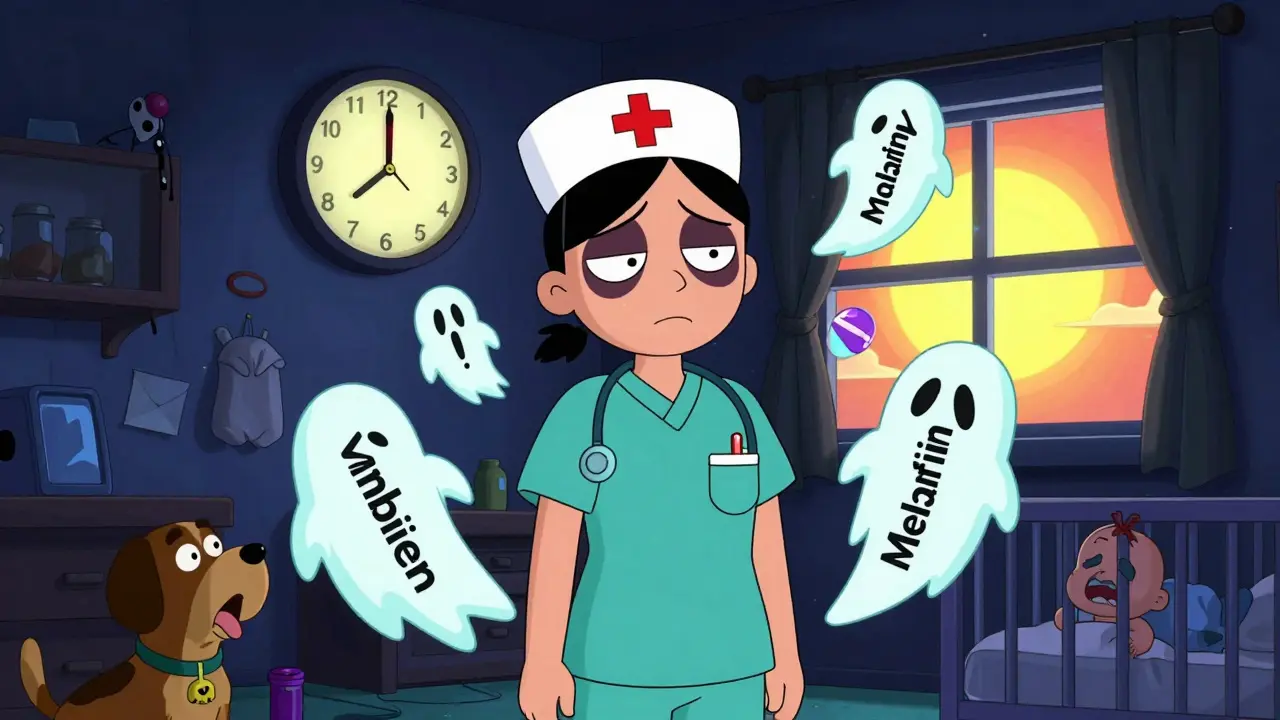
- For sleep: Zolpidem (Ambien), eszopiclone (Lunesta), zaleplon (Sonata), and melatonin are common. The FDA requires these to be taken with at least 7-8 hours of planned sleep time. But many workers don’t get that. They wake up early, kids are crying, the dog is barking. So they take the pill, then get up after 4 hours. That’s when things go wrong.
- For alertness: Modafinil (Provigil) and armodafinil (Nuvigil) are the only FDA-approved wakefulness drugs for shift work. They’re not stimulants like caffeine or Adderall. They work differently-targeting brain chemicals linked to wakefulness without the jitteriness or crash.
Here’s the problem: sleep meds don’t fix your rhythm. They just force sleep. Studies show they might increase total sleep time by 30-60 minutes, but they don’t improve sleep quality. You might sleep longer, but you still wake up feeling groggy. Worse, these drugs can cause sleepwalking, sleep-driving, and even sleep-eating. The FDA got so concerned they issued a Boxed Warning in 2023 after 66 reports of people driving or cooking while asleep-some ended in serious injury or death.
Modafinil helps with alertness. One study showed it improved performance by 34% on vigilance tests compared to placebo. But it doesn’t make you as sharp as you’d be after a full night’s sleep. And it doesn’t work forever. Many users report diminishing effects after 3-4 weeks of daily use. Plus, it’s expensive and often requires prior authorization from insurance.

Why Melatonin Isn’t the Magic Pill
Melatonin gets marketed as a natural sleep aid, and it’s the #1 over-the-counter sleep supplement in the U.S., with $800 million in annual sales. But it’s not a sleeping pill. It’s a signal. Your body naturally makes melatonin when it gets dark to tell your brain it’s time to sleep. For night shift workers, taking melatonin 3-4 hours before daytime sleep can help shift your internal clock.
But here’s the catch: it doesn’t make you fall asleep faster or sleep longer. A 2022 Cochrane Review found the evidence for melatonin improving daytime sleep after night shifts is low-quality. It might help a little with timing, but it won’t fix your energy levels during your shift. And it doesn’t replace the need for a dark, quiet room.
What You Should Never Do
There are dangerous habits that night shift workers pick up without realizing the risk:
- Combining sleep meds with alcohol. The FDA explicitly warns against this. Mixing alcohol with zolpidem or eszopiclone can slow your breathing to dangerous levels-or even stop it.
- Using antihistamines like Benadryl. These are common because they’re cheap and easy to buy. But they cause heavy drowsiness that lasts into your next shift. The FDA says 18% of users feel impaired the next day.
- Taking sleep meds too early or too late. If you take Ambien at 5 a.m. and have to be at work at 7 a.m., you’re not sleeping-you’re drugged. Residual drowsiness affects 32% of healthcare workers on these meds.
- Using benzodiazepines long-term. Drugs like lorazepam or alprazolam can become addictive after just 4-6 weeks. One in four users develops dependence.
A 2021 study of medical residents found 78% used mental shortcuts when prescribing sleep meds to night workers-often ignoring risks because they were rushed. That’s not just a personal mistake. It’s a system failure.
How to Use Medications Safely
If you’re going to use medication, do it right:
- Take wake-promoting meds like modafinil one hour before your shift. That’s when they peak in your bloodstream. Don’t take them after your shift-it’ll ruin your daytime sleep.
- Take sleep meds only if you can sleep 7-8 hours straight. No exceptions. Set alarms. Use blackout curtains. Tell your household you’re sleeping. Silence your phone.
- Take melatonin 3-4 hours before you want to sleep. Don’t take it right before bed. It won’t work.
- Never mix meds with alcohol or other sedatives. This isn’t a suggestion. It’s a life-or-death rule.
- Don’t use sleep meds for more than 3-4 weeks. They lose effectiveness. Dependence builds fast.
Doctors need to know your exact schedule. A 2022 study found medical residents received only 4.2 hours of formal training on sleep medication safety during their entire residency. That’s not enough. You have to advocate for yourself.

What Works Better Than Pills
Medications treat symptoms. They don’t fix the root problem: your body’s clock is out of phase with your schedule. The best long-term solution is to retrain your biology.
- Light exposure. Wear bright light goggles or sit under a 10,000-lux light box for 30-60 minutes during your night shift. It tells your brain it’s daytime. After your shift, wear blue-light-blocking glasses on your way home to prevent your body from thinking it’s morning.
- Sleep hygiene. Keep your bedroom dark, cool, and quiet. Use earplugs and white noise machines. Stick to the same sleep schedule-even on days off.
- Napping. A 20-minute nap before your shift can boost alertness. A 90-minute nap during a break can help reset your brain.
- Workplace programs. Hospitals and companies with formal fatigue management programs see fewer errors. Look for ones that offer light therapy devices, scheduled naps, and education on sleep safety.
73% of large employers now offer light therapy as an alternative to meds, according to SHRM’s 2023 report. That’s progress.
What’s Coming Next
Science is catching up. Researchers at Northwestern University predict that within five years, genetic testing will help doctors tailor medication timing to your personal chronotype-whether you’re naturally a night owl or early bird. The National Institute for Occupational Safety and Health is also developing new guidelines for doctors to follow when prescribing to shift workers, expected in mid-2024.
But here’s the hard truth: no pill can fix your circadian rhythm. The best outcome isn’t a perfect night’s sleep. It’s a safer, smarter way to work nights without relying on drugs that might hurt you more than help.
Final Advice: Don’t Go It Alone
If you’re a night shift worker, you’re not lazy. You’re fighting biology. But you don’t have to fight it alone. Talk to your doctor-not just about what pills to take, but about your whole schedule. Ask about light therapy. Ask about sleep hygiene. Ask if there’s a fatigue management program at your workplace.
And if you’re already using sleep meds? Don’t panic. But do this: write down when you take them, how long you sleep, and how you feel the next day. Track it for two weeks. You might be surprised how much your timing is off.
There’s no quick fix. But there is a better way. It’s not about taking more pills. It’s about working with your body-not against it.
Kunal Kaushik
February 4, 2026 AT 07:13Nathan King
February 4, 2026 AT 17:14Antwonette Robinson
February 4, 2026 AT 18:51caroline hernandez
February 5, 2026 AT 23:14Justin Fauth
February 6, 2026 AT 01:09Meenal Khurana
February 6, 2026 AT 14:36Joy Johnston
February 7, 2026 AT 04:51Shelby Price
February 8, 2026 AT 05:21Jesse Naidoo
February 8, 2026 AT 10:26Sherman Lee
February 8, 2026 AT 17:23Lorena Druetta
February 8, 2026 AT 22:03Zachary French
February 9, 2026 AT 15:20Daz Leonheart
February 10, 2026 AT 13:06