
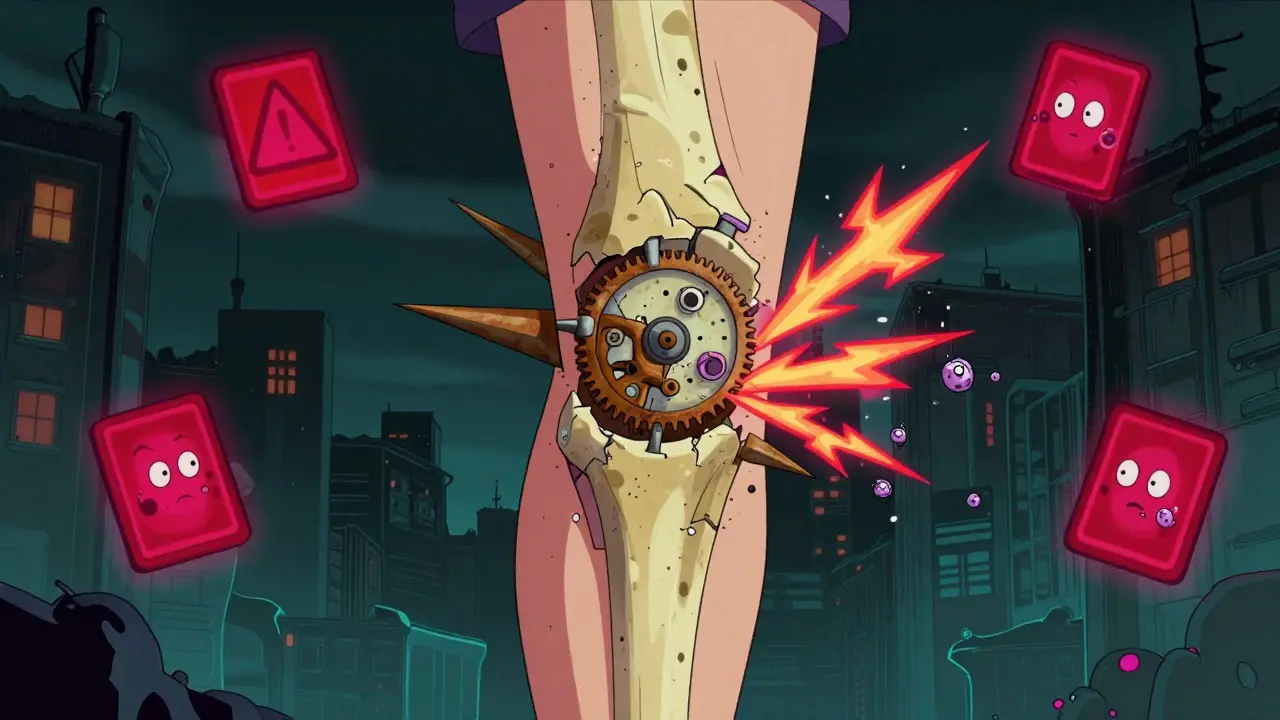
When your knees ache after walking the dog, or your fingers stiffen up in the morning, it’s easy to brush it off as "just getting older." But osteoarthritis isn’t normal aging-it’s a disease. And it’s not just about worn-out cartilage. It’s your whole joint-bone, ligaments, even the fatty tissue around it-fighting a slow, silent battle. Right now, over 500 million people worldwide live with it. In the U.S. alone, 1 in 8 adults has been diagnosed. And if you’re over 45, your risk isn’t just going up-it’s already here.
What’s Really Happening Inside Your Joint?
Osteoarthritis starts with cartilage, the smooth, rubbery padding between your bones. But it doesn’t stop there. As that cartilage breaks down, the bone underneath starts to change-thickening, forming bony spurs, losing its shape. The lining of the joint (synovium) gets inflamed. Ligaments stretch. Even the fat pads around the joint release chemicals that make pain worse. It’s not just friction. It’s a whole-system failure.
Unlike rheumatoid arthritis, where your immune system attacks your joints, osteoarthritis is driven by mechanical stress and biological imbalance. Repetitive movement, excess weight, past injuries, or even genetics can tip the scales. Your body tries to repair the damage, but the repair process becomes flawed. Instead of healing, it creates more inflammation. And that inflammation? It eats away at more cartilage. It’s a loop-damage causes inflammation, inflammation causes more damage.
The most common spots? Knees (60% of cases), hips (30%), hands (25%), and spine (20%). And it rarely hits both sides evenly. You might have severe pain in your right knee but barely notice your left. That’s a clue it’s not just aging-it’s how you move, how you stand, how you carry weight.
Why Pain Gets Worse (And When It’s Not Just "Wear and Tear")
Pain from osteoarthritis doesn’t feel the same as muscle soreness. It’s deeper. Dull at rest. Sharp with movement. It flares after walking, climbing stairs, or standing too long. Then it eases-but never fully disappears. Many people think if the pain gets better with rest, it’s "just" OA. But here’s the twist: as the disease progresses, the pain becomes constant. Even at night. Even when you’re not moving.
And it’s not just the joint hurting. The nerves around it get sensitized. Your brain starts interpreting even light pressure as pain. That’s why some people with mild X-ray changes have terrible pain, while others with advanced damage feel little. It’s not always about how much damage there is-it’s about how your nervous system responds.
What makes it worse? Weight. Inactivity. Poor sleep. Stress. These don’t cause OA, but they turn up the volume on the pain. The CDC says 43% of people with arthritis cut back on work because of it. And here’s the cruel irony: avoiding movement to protect your joint actually makes it worse. Muscles weaken. Joints stiffen. You lose balance. You’re more likely to fall. And then you’re even less active. It’s a spiral.
What Actually Works? The Science-Backed Plan
There’s no magic pill. No supplement that reverses cartilage loss. But there are proven, powerful strategies-ones doctors agree on, and patients swear by.
1. Move-But Move Smart
Exercise isn’t optional. It’s the most effective treatment you have. Land-based activities like walking, cycling, or water aerobics three times a week for 45 minutes can reduce pain by 40% in 12 weeks. Strength training matters just as much. Stronger muscles take pressure off the joint. A 2023 study showed that people who did 20 minutes of leg strengthening twice a week improved their ability to climb stairs by 52%.
Don’t wait for pain to disappear before you move. Start slow. Ten minutes a day. Build up. Use a cane or knee brace if it helps you stay active. The goal isn’t to eliminate pain-it’s to keep moving so your joint doesn’t freeze up.
2. Lose Weight-Even a Little
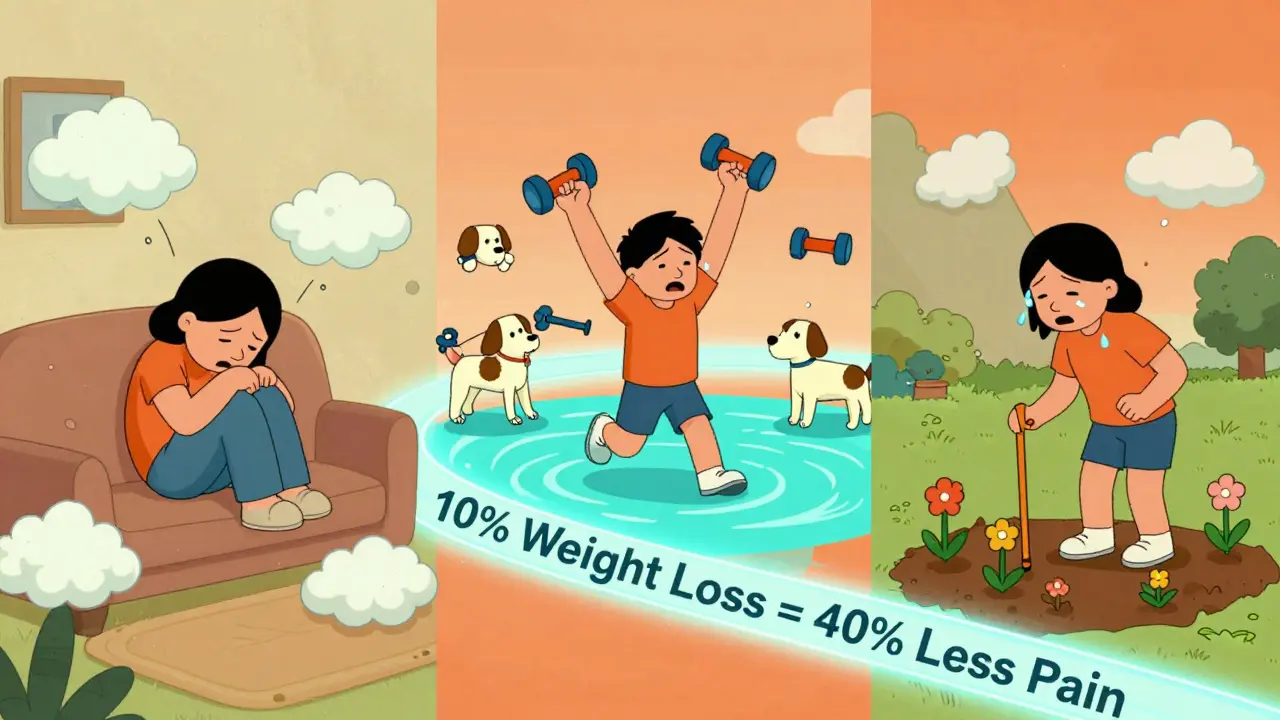
If you’re carrying extra weight, losing just 10% of your body weight cuts knee pain by half. That’s not theory. That’s what happened in a 2022 Arthritis Foundation study of 1,200 people. For someone who weighs 200 pounds, that’s 20 pounds. It doesn’t have to be drastic. One pound lost = four pounds less pressure on your knee with every step.
And it’s not just about the joint. Losing weight reduces inflammation system-wide. It lowers your risk of diabetes, heart disease, and depression-all common companions of chronic pain.
3. Get Physical Therapy
Physical therapists don’t just give you exercises. They teach you how to move differently. How to stand without locking your knees. How to get out of a chair without twisting your hip. How to climb stairs without grinding your joints. Six to eight sessions can change how your body functions for years. And it’s covered by most insurance.
4. Use Heat, Ice, and Joint Protection
Heat relaxes stiff joints in the morning. Ice reduces swelling after activity. A simple knee sleeve or thumb splint can give you hours of relief. Learning to use tools like jar openers, reachers, or ergonomic keyboards doesn’t mean you’re giving up-it means you’re protecting your joints so you can keep doing what matters.
Medications: What Helps, What Doesn’t
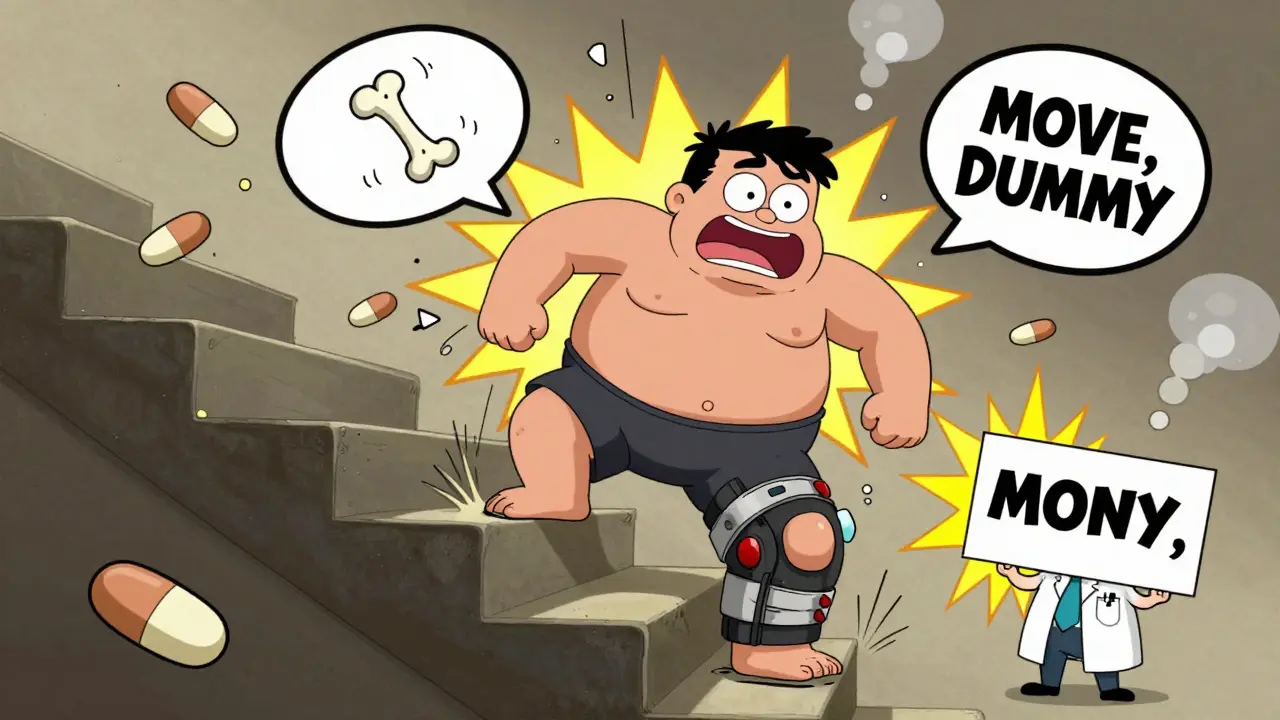
NSAIDs like ibuprofen or naproxen are common-but they’re not the answer for long-term use. One in three people stop taking them because of stomach issues, high blood pressure, or kidney problems. And they don’t slow joint damage. They just mask the pain.
Corticosteroid injections into the knee can give 4 to 8 weeks of relief during a flare-up. They’re fast, effective, and safe when used sparingly (no more than 3-4 times a year). Hyaluronic acid shots? The evidence is mixed. Some people swear by them. Others feel nothing. They’re expensive and not recommended by major guidelines unless other options fail.
The FDA approved tanezumab in June 2023-a new injectable that blocks nerve growth factor. In trials, it reduced pain 35% more than NSAIDs. But it’s not for everyone. It’s reserved for moderate-to-severe cases that haven’t responded to other treatments. And it requires careful monitoring.
Topical creams with capsaicin or menthol? They work for some. They’re low-risk. Worth trying before pills.
The New Frontier: What’s Coming
Stem cell and PRP (platelet-rich plasma) therapies are being studied in over 380 clinical trials worldwide. But right now, they’re expensive, not covered by insurance, and their long-term benefits aren’t proven. Don’t fall for clinics promising miracles. Stick to what’s been tested.
The real breakthrough? Early detection. Right now, we diagnose OA with X-rays-only after the cartilage is badly damaged. But researchers are developing blood tests that can spot OA years before symptoms appear. Dr. Marc Hochberg predicts we’ll have them in the next five years. That means we could stop OA before it starts-through targeted exercise, weight control, and lifestyle changes.
What No One Tells You
OA isn’t just a physical problem. It’s emotional. 68% of people with OA say it disrupts their sleep. 57% can’t climb stairs without help. 42% struggle with everyday tasks like buttoning a shirt. That leads to isolation, depression, and anxiety.
And the system isn’t built for you. The average wait for a rheumatologist is over eight weeks. Many primary care doctors don’t have time to teach joint protection. Insurance often denies physical therapy after a few visits.
But here’s the truth: you don’t need a specialist to start feeling better. You need to start moving. You need to eat a little better. You need to rest without quitting. You need to find one person-a physical therapist, a friend, a support group-who understands.
The Arthritis Foundation’s self-management course, taken by over 100,000 people, cuts pain by 40% and improves function by 30%. It’s free. Online. Six weeks. And it’s not about fixing your joint. It’s about reclaiming your life.
You’re Not Alone
One Reddit user wrote: "My knee OA started with stiffness. Now I walk 30 minutes a day, lost 25 pounds, and I’m back gardening. Pain meds didn’t help. Movement did."
You don’t have to wait for a cure. You don’t have to accept pain as your new normal. You have more control than you think. The tools are simple. The science is clear. The only thing left is to start.
Dan Gaytan
December 25, 2025 AT 00:25This hit me right in the feels 😭 I’ve been dealing with knee OA for 3 years now. Started with just stiffness after walking the dog, same as the post said. Thought it was just aging-turns out, I was just scared to move. Started with 10-minute walks, then added strength training twice a week. Lost 18 pounds. Now I’m gardening again. Pain meds? Barely touched them. Movement didn’t fix my joint-but it fixed my life. 🙌
Raja P
December 25, 2025 AT 19:13Bro, I’m from India and we don’t have access to PT or fancy injections. But I started doing squats against the wall every morning-no weights, just bodyweight. Took 3 months, but my hips don’t scream anymore. Also, turmeric milk at night. Not magic, but it’s something. Thanks for the post-finally someone gets it.
Joseph Manuel
December 27, 2025 AT 04:53While the anecdotal evidence presented here is emotionally compelling, it lacks rigorous statistical control. The 40% pain reduction claim from exercise is drawn from a single 12-week cohort study with no long-term follow-up. Furthermore, the assertion that weight loss reduces knee load by a 4:1 ratio is an oversimplification of biomechanical models. The article dangerously conflates correlation with causation in the context of inflammation markers. Without randomized controlled trials, this reads more like wellness propaganda than medical science.
Harsh Khandelwal
December 27, 2025 AT 09:08LMAO they’re hiding the real cause. Big Pharma doesn’t want you moving because then you wouldn’t need their $800 injections. The real villain? Glyphosate in your food. It’s in your bread, your beer, your damn oat milk. It’s wrecking your cartilage. I saw a guy on YouTube who healed his OA by eating only organic kale and sleeping in a Faraday cage. You think that’s crazy? Try telling that to the guy who’s walking again after 10 years in a wheelchair. The system’s rigged, folks.
Andy Grace
December 27, 2025 AT 21:16I’ve had OA in both hips for five years. I didn’t believe in exercise at first. Thought it’d make it worse. But I started with swimming-just 15 minutes, three times a week. No pressure, no pain. Now I can walk to the corner store without wincing. It’s not a cure. But it’s a quiet kind of victory. Not loud. Just… there.
Delilah Rose
December 28, 2025 AT 23:39Okay, I just want to say that this article really resonated with me because I’ve been through the whole rollercoaster-trying every supplement, going to three different doctors, getting cortisone shots that only gave me two weeks of relief before the pain came back harder, then feeling guilty because I stopped walking because I was afraid of falling, then feeling ashamed because my kids said I was acting like a ‘grumpy old lady’ even though I was only 52, and then I found this self-management course and it didn’t magically fix me but it gave me back my agency, and I started writing in a journal every night about what I did that day, even if it was just standing up from the couch without using my hands, and now I don’t feel like a victim anymore, I feel like someone who’s learning how to live with this, not just survive it, and I think that’s the real point here-it’s not about fixing your knee, it’s about reclaiming your sense of self, and I just wanted to say thank you for writing this because I didn’t realize how much I needed to hear it until I read it.
Spencer Garcia
December 30, 2025 AT 17:08Start slow. Move daily. Don’t wait for pain to disappear. That’s it.
Bret Freeman
January 1, 2026 AT 11:01THIS IS A SCAM. They’re pushing exercise because insurance won’t cover real treatment. You know what really helps? Knee replacements. But no one tells you that until you’ve wasted 5 years on ‘movement’ and ‘turmeric.’ I had mine last year. Now I run 5Ks. The article makes it sound like you can out-walk a bone-on-bone joint. Bullshit. If your cartilage is gone, you need a new one. Stop glorifying suffering. Get the surgery. Your quality of life isn’t a moral test.
Lindsey Kidd
January 2, 2026 AT 05:47Just wanted to say-this is the kind of post I wish I’d found 5 years ago. 🥹 I used to cry in the shower because I couldn’t pick up my granddaughter. Now I do it every Sunday. I started with a cane, then a knee sleeve, then 5 minutes of leg lifts while watching TV. Didn’t even know I was doing PT until my therapist said, ‘You’re doing great.’ You’re not broken. You’re adapting. And that’s brave. 💪❤️
Austin LeBlanc
January 2, 2026 AT 09:31So let me get this straight-you’re telling people to just ‘move more’ and ‘lose weight’ like it’s that easy? Have you ever tried to walk when your knee feels like it’s full of ground glass? Or lose weight when you’re too tired to cook, too depressed to shop, and your insurance only covers 6 PT visits? This isn’t motivation. It’s gaslighting. And you’re the kind of person who says ‘just be positive’ to someone in a wheelchair. I’m done with this toxic positivity.
Dan Gaytan
January 2, 2026 AT 12:12@Austin LeBlanc I hear you. I was there. Cried in the parking lot before my first PT appointment. But here’s the thing-I didn’t do it because it was easy. I did it because I was tired of being trapped. I didn’t get better because someone told me to. I got better because I showed up, even when I hated it. You’re not weak for struggling. You’re human. And you’re not alone.