
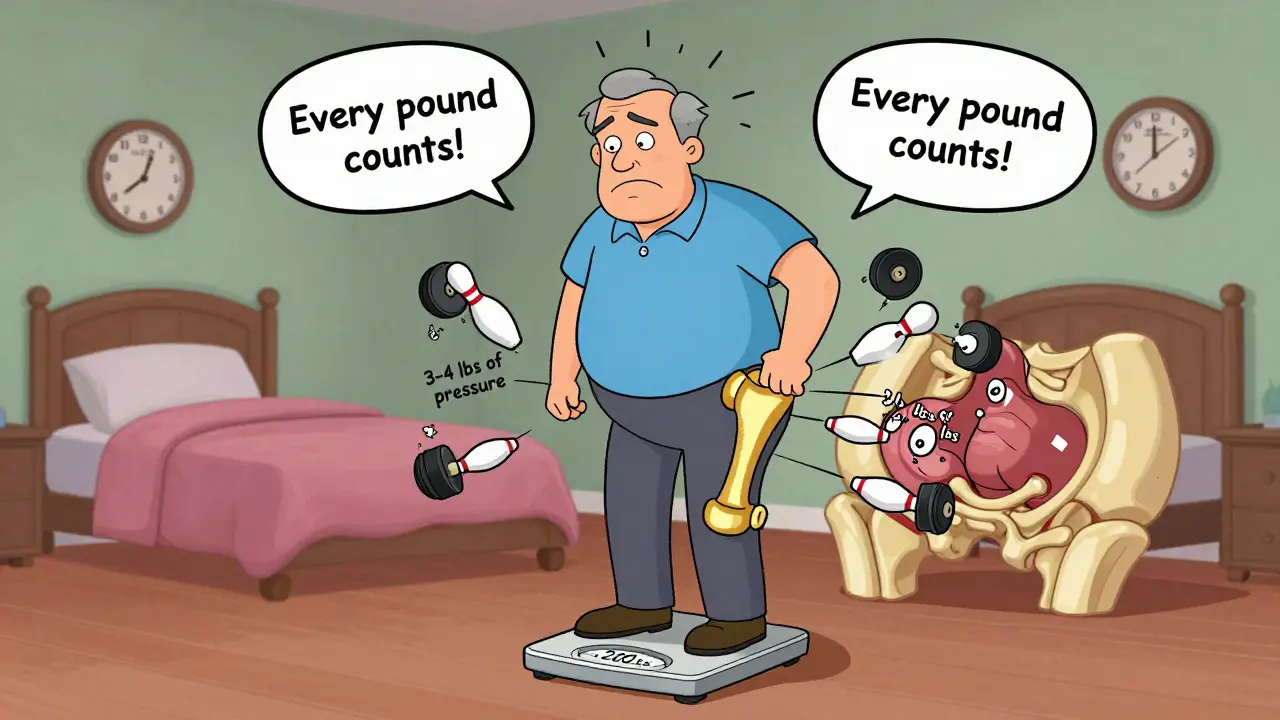
When your hip starts to ache after walking just a few blocks, or when getting out of bed feels like a chore, it’s not just aging-it could be osteoarthritis. Hip osteoarthritis is one of the most common causes of mobility loss in adults over 50, and it’s not just about worn-out cartilage. It’s about pressure. Every extra pound you carry adds stress to your hip joint. But here’s the thing: weight loss isn’t just a suggestion for people with hip OA-it’s one of the few treatments with real, measurable, long-term benefits.
Why Losing Weight Matters for Your Hip
Your hip joint is built to handle load, but not endless overload. When you have osteoarthritis, the smooth cartilage that cushions the bones starts to break down. Bone grinds on bone. Inflammation sets in. Pain follows. And while you can’t reverse the damage, you can slow it down. And one of the most powerful tools you have? Losing weight. A 2024 study published in Nature tracked 65-year-old adults with hip osteoarthritis and obesity. Those who lost more than 10% of their body weight saw a 31% improvement in their quality of life-more than any other symptom domain. Pain dropped. Movement got easier. Even daily tasks like climbing stairs or putting on shoes became less painful. That’s not a small change. That’s life-changing. And it’s not just about feeling better. Less weight means less mechanical stress on the joint. Every pound you lose reduces the force on your hip by 3 to 4 pounds during walking. That’s not theory-it’s physics. And over time, that reduction can help preserve what’s left of your cartilage, delay the need for surgery, and keep you active longer.How Much Weight Do You Actually Need to Lose?
You’ve probably heard that losing 5% of your body weight helps with arthritis. That’s true-for knees. But hips? The story’s different. The same Nature study found that 5% weight loss brought modest improvements. But the real gains? They started at 7% and exploded at 10%. People who hit 10% or more lost significantly more pain, gained more function, and reported better sleep and mood. In fact, the improvements in hip-related quality of life were nearly double those seen in people who lost only 5%. A 2023 review in the Journal of Metabolic Health backed this up. Groups losing 10% or 20% of their body weight saw nearly identical functional gains-meaning there’s no extra benefit to losing 20% over 10%. So the sweet spot? Aim for 10%. That’s about 15 to 20 pounds for someone who weighs 180 to 200 pounds. And here’s the kicker: you don’t need to be “skinny.” You just need to lose enough to take the pressure off. Even if you’re still overweight after that, your hip will thank you.Why Hip OA Is Different From Knee OA
Here’s where things get confusing. If you search for “weight loss and arthritis,” most articles talk about knees. And for good reason-knee osteoarthritis responds dramatically to weight loss. But hips? Not so much. A 2023 randomized trial published in PubMed compared two groups: one on a very-low-calorie diet plus exercise, and another doing only exercise. After six months, both groups had the same level of hip pain. The diet group had lost more weight, but their pain didn’t drop faster. That led NEJM Journal Watch to claim, bluntly, “Osteoarthritis of the Hips Is Unaffected by Weight Loss.” But wait-there’s more. That same study followed participants for a full year. At 12 months, the weight-loss group showed clear improvements in pain, function, and overall hip condition. The benefits were just delayed. Why? Because the hip joint isn’t just a weight-bearing joint-it’s a ball-and-socket joint with deep stability. It doesn’t flex and twist like the knee. So the immediate mechanical relief from weight loss isn’t as obvious. But over time, reduced inflammation, better muscle support, and improved metabolism all add up. Think of it like this: losing weight for your knee is like turning down the volume on a loud speaker. For your hip, it’s like removing the dust from inside the speaker. The effect isn’t instant, but it’s deeper.
What Actually Works: Diet, Exercise, and Structure
Losing weight isn’t about willpower. It’s about systems. And the most effective programs for hip OA aren’t fad diets-they’re structured, supported, and long-term. The Osteoarthritis Healthy Weight For Life (OAHWFL) program, developed in Australia and New Zealand, is one of the few proven models. It’s not a quick fix. It’s 18 weeks of guided nutrition, daily movement, and weekly check-ins-mostly done via telehealth. Participants lost an average of 7-10% of their body weight. Those who completed the program saw a 30%+ improvement in daily function. What made it work? Three things:- Low-carb, high-protein eating: Reduces inflammation and keeps you full longer.
- Targeted exercise: Not running. Not jumping. But strength training for glutes, quads, and core-muscles that stabilize the hip.
- Consistent support: Weekly calls with a coach. No judgment. Just accountability.
What to Avoid
Not all weight loss plans are created equal. And some can actually make hip OA worse. Avoid:- Extreme calorie restriction: Crash diets can lead to muscle loss, which weakens joint support.
- High-impact exercise: Running, jumping, or high-intensity interval training can flare up hip pain. Stick to walking, cycling, swimming, or elliptical machines.
- Skipping protein: You need enough protein to keep muscle mass while losing fat. Aim for 1.2-1.6 grams per kilogram of body weight.
- Waiting for pain to disappear before starting: You don’t need to be pain-free to begin. Start slow. Move within your limits. Progress comes with consistency, not perfection.
When Medications or Surgery Might Be Needed
Weight loss isn’t magic. And it’s not a cure. But it’s the most effective non-surgical tool we have. The American College of Rheumatology conditionally recommends weight loss for anyone with hip OA who has overweight or obesity. But if you’ve tried for six months and haven’t lost 5-10%, it’s time to rethink your approach. FDA-approved weight-loss medications like semaglutide or tirzepatide are options-but only if your BMI is over 30, and only after lifestyle changes have failed. These aren’t shortcuts. They’re tools to help you get over the hump. Once you start losing weight, you’ll still need to keep it off with diet and movement. Surgery-like hip replacement-is highly effective. But it’s not the first step. And it’s not risk-free. Recovery takes months. Implants wear out. And if you’re still overweight after surgery, you’re more likely to need a second one sooner. Losing weight now gives you more time. More mobility. More choices.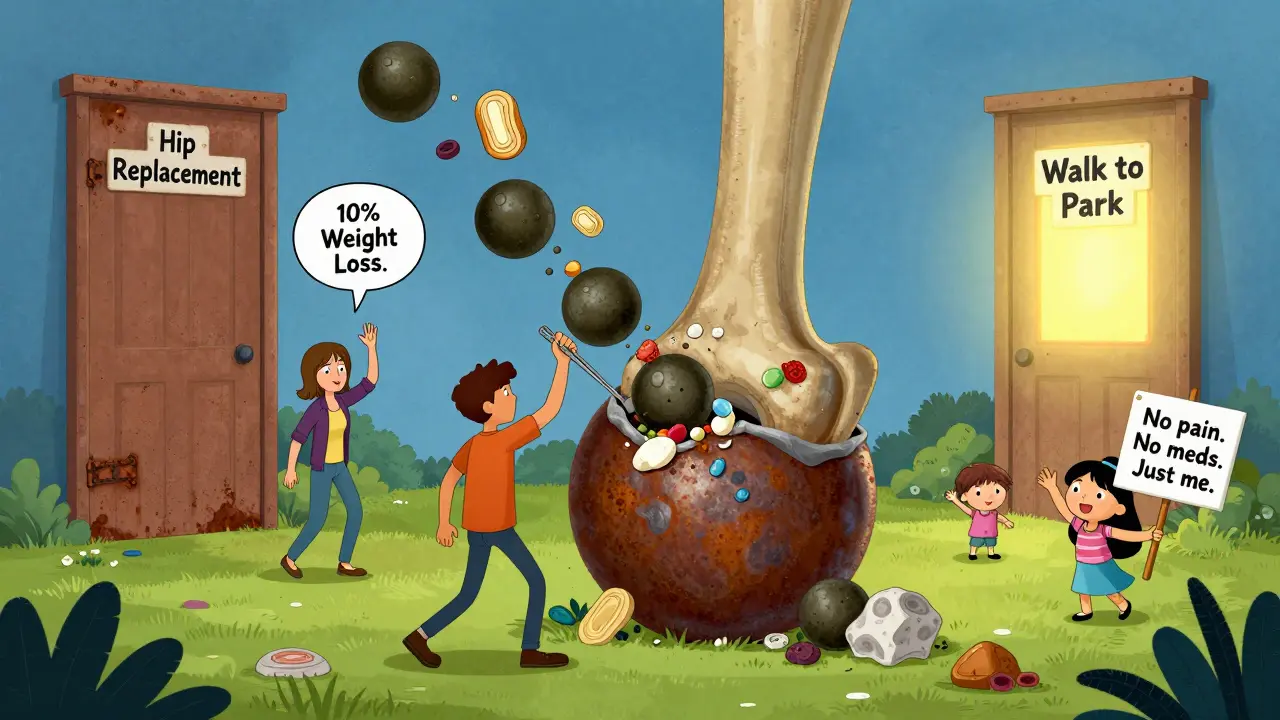
Real-Life Progress: What It Looks Like
Meet Maria, 62, from Melbourne. She had hip pain for three years. Walking to the mailbox hurt. Getting into the car was a struggle. Her BMI was 34. She joined a local program based on the OAHWFL model. She didn’t count calories. She ate more eggs, chicken, vegetables, and legumes. She swapped soda for sparkling water. She did 20 minutes of seated leg lifts and standing balance exercises every morning. She met with her coach every week. After 16 weeks, she lost 12% of her body weight. Her HOOS score-the measure of hip function-jumped from 42 to 76. She started walking to the park. She went on a weekend trip with her grandchildren. She didn’t need painkillers anymore. Her story isn’t unique. It’s repeatable.What You Can Do Today
You don’t need a program. You don’t need a gym membership. You just need to start. Here’s your simple plan:- Track your food for three days. Use a free app like MyFitnessPal. Don’t change anything yet-just see where the calories hide.
- Swap one sugary drink a day for water, tea, or sparkling water. That’s 150-200 fewer calories.
- Add one 10-minute walk after lunch. No goal. Just move.
- Do two 15-minute strength sessions this week: seated leg extensions, standing calf raises, and wall squats (only go as low as pain allows).
- Set a 10% weight loss goal. Not “lose weight.” Not “get fit.” Just 10%. That’s your target.
It’s Not About Looking Different. It’s About Moving Freely.
Hip osteoarthritis doesn’t have to mean retirement from life. It doesn’t mean giving up walking, playing with grandkids, or traveling. It means changing how you move-and how you treat your body. Weight loss isn’t a punishment. It’s protection. Every pound you lose is a pound taken off your hip. And over time, that adds up to more years of movement, less pain, and more freedom. You don’t need to be a fitness expert. You don’t need to run a marathon. You just need to care enough to start. And then keep going.Can weight loss really help hip osteoarthritis, or is it just for knee OA?
Yes, weight loss helps hip osteoarthritis-but the benefits are different than with knee OA. While knee pain often improves quickly with weight loss, hip improvements take longer to show up-usually after 6 to 12 months. Studies show that losing 10% or more of your body weight leads to significant improvements in pain, function, and quality of life for hip OA. It’s not instant, but it’s real.
How much weight should I aim to lose for hip OA relief?
Aim for at least 7-10% of your total body weight. For someone weighing 200 pounds, that’s 14-20 pounds. Research shows that losing 5% gives modest relief, but 10% or more leads to major improvements in pain, mobility, and daily function. Losing more than 10% doesn’t add much extra benefit, so 10% is the sweet spot.
What kind of diet works best for hip osteoarthritis?
A low-carb, high-protein diet works well. It reduces inflammation and helps you stay full longer. Focus on lean meats, fish, eggs, legumes, leafy greens, nuts, and healthy fats like olive oil. Avoid sugary drinks, refined carbs, and processed snacks. You don’t need to go keto-just cut out the junk and eat more whole foods.
What exercises are safe for someone with hip OA?
Low-impact activities are best: walking, cycling, swimming, and using an elliptical machine. Strength training for the hips and core is critical-try seated leg lifts, standing calf raises, wall squats (shallow), and glute bridges. Avoid high-impact activities like running, jumping, or deep lunges. Always move within pain-free limits.
Can I lose weight without going to a program or hiring a coach?
Absolutely. Many people succeed on their own. Start by tracking your food for a few days, swap one sugary drink for water daily, add a 10-minute walk after meals, and do two 15-minute strength sessions per week. Focus on losing 10% of your body weight over 4-6 months. Consistency matters more than intensity.
Are weight-loss medications an option for hip OA?
Yes, but only as a last resort. Medications like semaglutide or tirzepatide are approved for people with BMI over 30 who haven’t succeeded with lifestyle changes after 6 months. They’re not a quick fix-they’re tools to help jumpstart weight loss. You still need to maintain the changes with diet and movement long-term.
Will losing weight delay or prevent hip replacement surgery?
Yes. Losing 10% or more of your body weight can significantly delay the need for hip replacement by reducing joint stress and inflammation. Even if you eventually need surgery, being at a healthier weight improves surgical outcomes, speeds recovery, and reduces the risk of complications. Many surgeons require patients to lose weight before approving surgery.
Dayanara Villafuerte
January 18, 2026 AT 03:00Naomi Keyes
January 19, 2026 AT 17:16Selina Warren
January 20, 2026 AT 09:10Danny Gray
January 21, 2026 AT 14:08rachel bellet
January 22, 2026 AT 22:41Max Sinclair
January 24, 2026 AT 01:58Joni O
January 24, 2026 AT 13:42Nishant Sonuley
January 26, 2026 AT 04:33Andrew Qu
January 27, 2026 AT 23:04Pat Dean
January 28, 2026 AT 12:42Ryan Otto
January 29, 2026 AT 09:35Jodi Harding
January 29, 2026 AT 16:18