
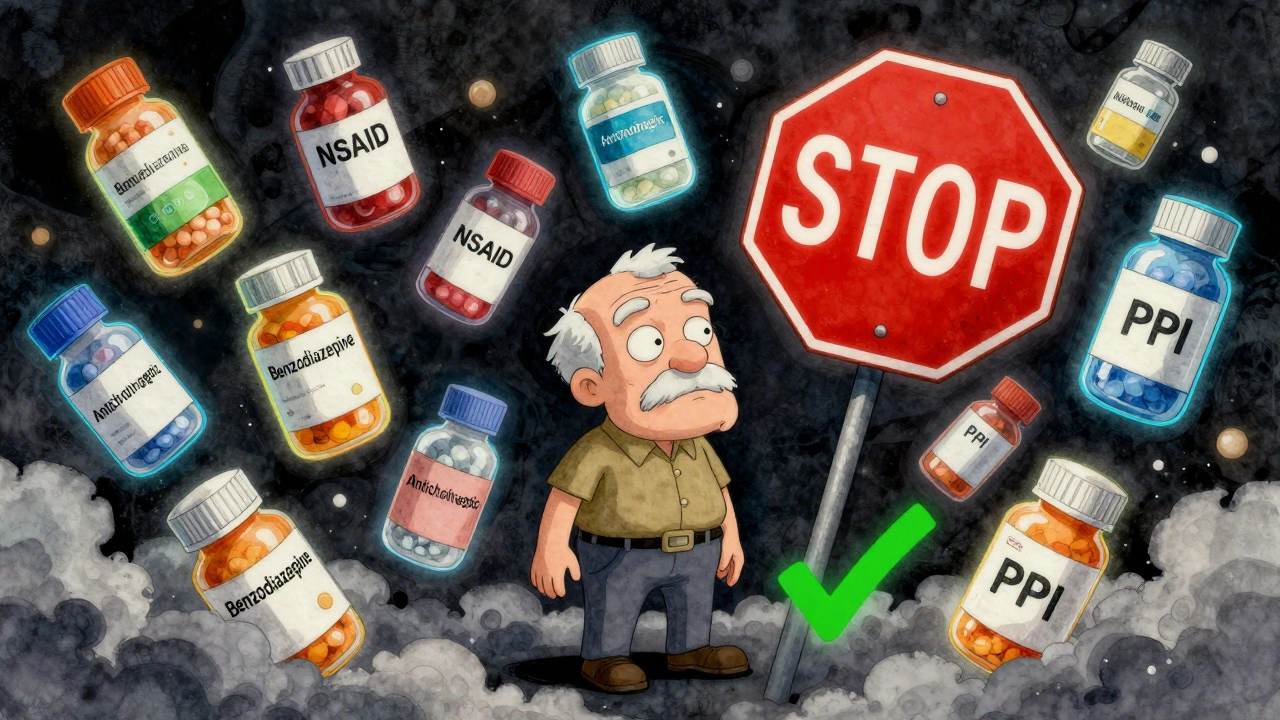
More than 40% of adults over 65 are taking five or more medications every day. That’s not just common-it’s dangerous. For many older adults, a daily pill routine includes blood pressure pills, diabetes meds, painkillers, sleep aids, heart medications, and supplements, all prescribed by different doctors. No one is checking if they all work together-or if they’re doing more harm than good. This isn’t just about taking too many pills. It’s about safety, quality of life, and whether the meds are still helping at all.
What Is Polypharmacy, Really?
Polypharmacy isn’t just having five or more medications. It’s when the number of drugs starts to outweigh the benefits. The term became widely used after the American Geriatrics Society released the Beers Criteria in 2004, a list of medications that are risky for older adults. Since then, research has shown that for many seniors, the real problem isn’t the number of pills-it’s that some of them are outdated, unnecessary, or even harmful.Think about it: someone gets prescribed a sleeping pill after a hospital stay, then a painkiller for back pain, then an antacid for stomach upset from the painkiller, then a medication for the constipation caused by the antacid. Each step makes sense in isolation-but together, they create a cascade of side effects. By the time they’re seeing a geriatric specialist, they might be on 12 medications, none of which were ever reviewed as a whole.
Older bodies don’t process drugs the same way. Liver function drops by 30-50% after age 80. Kidneys clear drugs more slowly-about 1% less per year after age 40. That means even normal doses can build up to toxic levels. A medication that’s safe for a 40-year-old might be dangerous for a 75-year-old. And many of these drugs aren’t even meant for long-term use.
Why This Happens: The System Isn’t Broken-It’s Fragmented
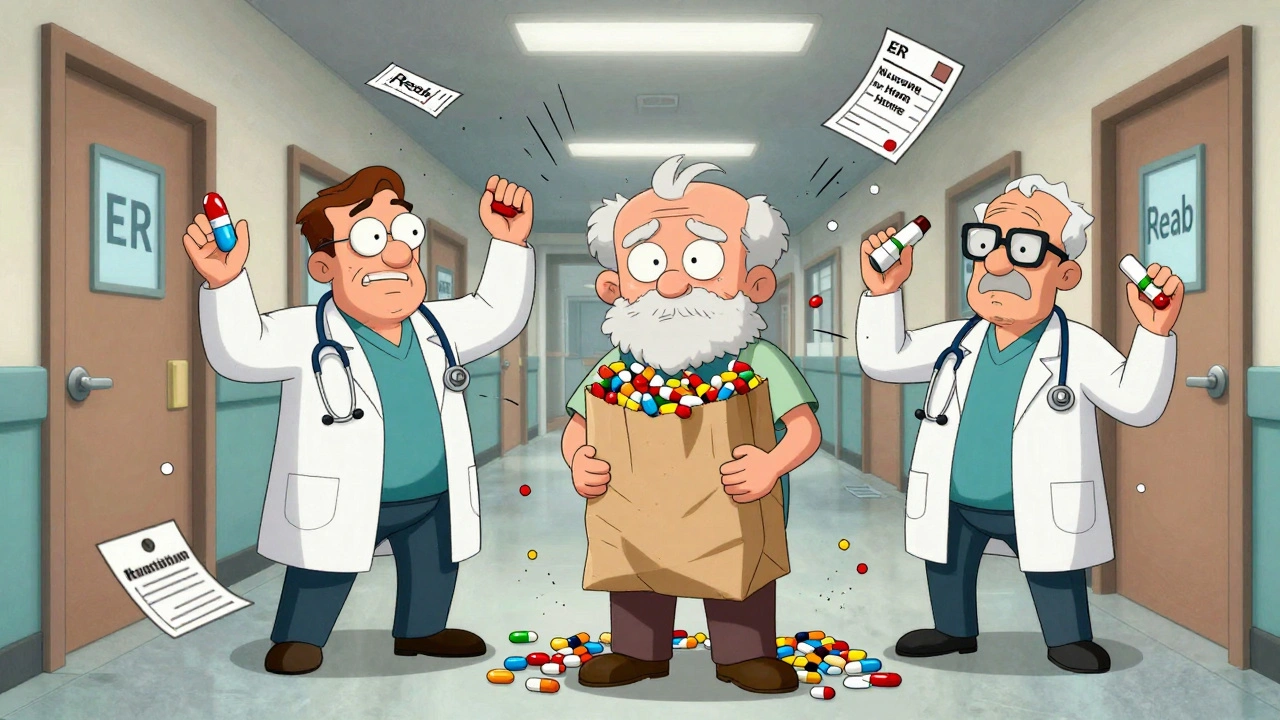
Most seniors don’t have one doctor. They have a cardiologist, a rheumatologist, a neurologist, a primary care physician, and maybe a pain specialist. Each one focuses on their own area. The cardiologist adds a blood thinner. The rheumatologist prescribes an NSAID for arthritis. The neurologist gives a sleep aid. No one asks: "What happens when all these drugs are taken together?"Transitions of care make it worse. A patient goes from hospital to rehab, then to a nursing home, then back home. Each time, new meds are added-but old ones aren’t taken away. One study found that 50% of post-discharge complications in seniors are due to medication errors during these transitions. A man might come home with six new prescriptions, but no one tells him to stop the muscle relaxant he was on in the hospital-or the antipsychotic he was given for confusion, even though he’s no longer confused.
Patients themselves often don’t know what they’re taking or why. A Johns Hopkins study found only 55% of seniors can correctly name the purpose of every medication they take. Many don’t realize their "memory pill" is actually an anticholinergic linked to higher dementia risk. Others skip doses because they can’t afford them-25% of seniors report skipping meds due to cost, according to AARP.
The Most Dangerous Medications for Seniors
Not all medications are created equal when it comes to risk. The American Geriatrics Society’s Beers Criteria (2019 update) identifies 56 high-risk drugs for older adults. Here are the top three that cause the most harm:- Benzodiazepines (like diazepam, lorazepam): Used for anxiety or sleep. But they increase fall risk by 50%. Falls are the leading cause of injury and death in seniors.
- NSAIDs (like ibuprofen, naproxen): Common for joint pain. But they raise the risk of stomach bleeding by 2.5 times and can damage kidneys-already weakened by age.
- Anticholinergics (like diphenhydramine, oxybutynin): Found in sleep aids, allergy meds, and overactive bladder drugs. Long-term use is linked to a 1.5-fold increase in dementia risk over seven years.
Even opioids, prescribed for chronic pain, triple the risk of falls in older adults. And proton pump inhibitors (PPIs)-often taken for years for heartburn-can increase fracture risk by 26% after long-term use. These aren’t rare cases. They’re routine.
Deprescribing: The Missing Step in Care
The solution isn’t adding more meds. It’s removing the ones that shouldn’t be there. That’s called deprescribing. It’s not stopping everything. It’s carefully reviewing each drug and asking: "Is this still helping? Is the risk worth it?"Studies show deprescribing works. A Duke Health review found it reduces adverse drug events by 22% and hospital admissions by 17%. One program, UCI Health’s HAPS, found an average of 4.2 inappropriate medications per patient-and when they were stopped, patients reported a 37% improvement in daily functioning and energy levels.
Deprescribing doesn’t happen by accident. It needs a plan:
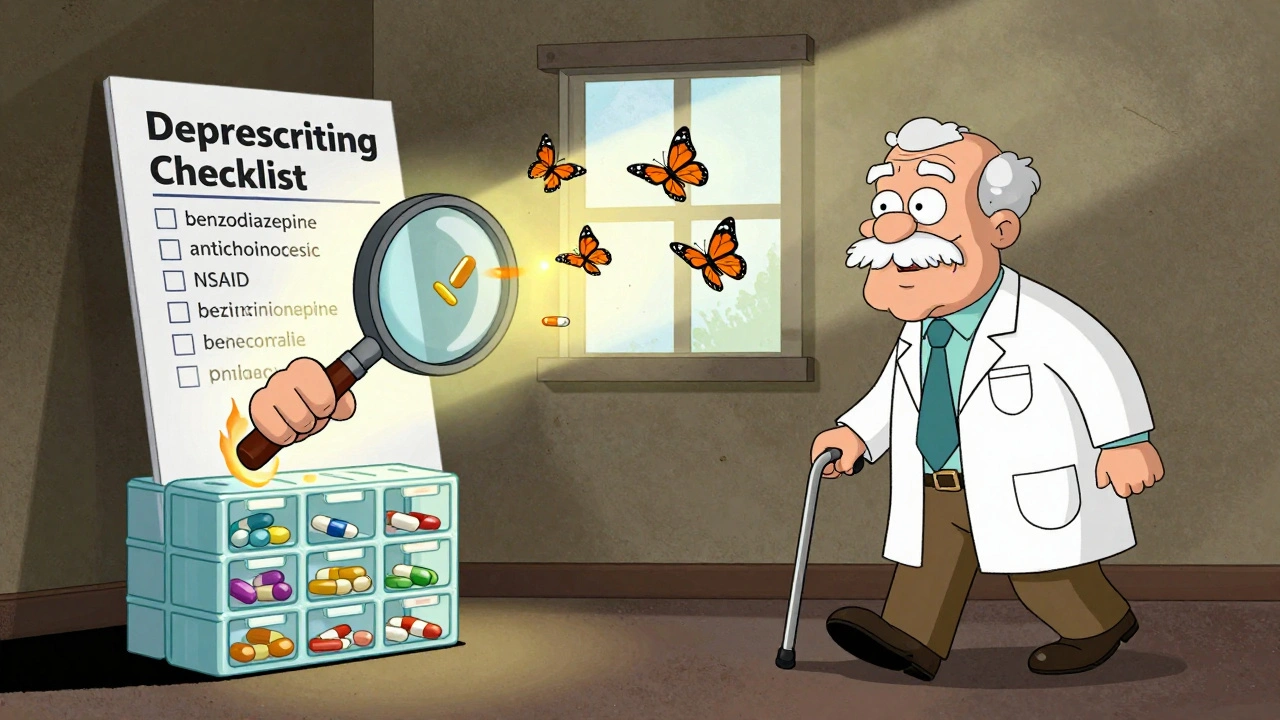
- Do a brown bag review. Bring every pill, capsule, patch, and supplement to your doctor. Include OTC meds and herbal products. On average, this uncovers 2.8 unnecessary or duplicate medications.
- Use STOPP/START criteria. These are clinical tools that help doctors identify Potentially Inappropriate Medications (STOPP) and missed necessary ones (START). On average, older adults have 3.2 inappropriate meds on their list.
- Start with the highest-risk drugs. Taper off benzodiazepines, anticholinergics, and NSAIDs first. Don’t rush-slow reduction prevents withdrawal symptoms.
- Involve the patient. If a senior doesn’t understand why a med is being stopped, they’ll just keep taking it. Talk about goals: "Do you want to sleep better? Walk without falling? Avoid hospital trips?"
- Use a pharmacist. Pharmacist-led medication reviews reduce hospital readmissions by 24% in Medicare patients, according to CMS data.
Who Should Be on the Team?
Managing polypharmacy isn’t a one-person job. It needs a team:- Primary care doctor - leads the review and coordinates care.
- Pharmacist - checks for interactions, identifies duplicates, advises on dosing.
- Nurse or care coordinator - helps with scheduling, tracking refills, monitoring side effects.
- The patient and family - they know what’s really happening at home. Are they swallowing pills? Are they confused? Are they skipping doses because of cost?
Teams that include all these players achieve 32% better medication optimization than doctors working alone. That’s not a small gain. That’s life-changing.
Technology Can Help-But It’s Not a Fix
Electronic health records should flag dangerous drug interactions. But here’s the catch: current systems have a 78% false alarm rate. That means doctors see 100 warnings, and 78 of them aren’t real. So they start ignoring them.New tools are emerging. The FDA-approved MedWise platform uses genetic data to predict how a person will react to specific drugs. In a 2022 JAMA trial, it cut adverse events by 41%. But it’s not widely available yet.
Meanwhile, the Centers for Medicare & Medicaid Services launched a $15 million initiative in January 2023 to help health systems build standardized deprescribing protocols. That’s a step forward. But only 15% of Medicare Part D beneficiaries get the mandatory medication reviews they’re entitled to.
What You Can Do Right Now
You don’t need to wait for a new system. Here’s what you can do today:- Ask your doctor: "Which of my medications can I stop?" Don’t be afraid to say: "I’m tired of taking so many pills. Are they still helping?"
- Bring your meds to every appointment. Use a pill organizer or just a bag. Don’t rely on memory.
- Check for duplicates. Is there a generic and a brand name? Is the same drug in two different pills? (Like acetaminophen in both a painkiller and a cold med.)
- Ask about cost. If a pill is too expensive, ask for a cheaper alternative or a sample. Never skip doses to save money-that’s riskier than taking the med.
- Know the purpose of each pill. Write it down. If you can’t name why you’re taking it, you shouldn’t be taking it.
One man came to his doctor with 15 medications. He couldn’t walk without a cane. He was always tired. After a review, 7 were stopped-mostly sleep aids, anticholinergics, and NSAIDs. Within six weeks, he was walking without the cane. His energy returned. He didn’t need more pills. He needed fewer.
The Future: From Quantity to Quality
The future of senior care isn’t about more pills. It’s about smarter ones. Researchers are moving away from counting medications and toward measuring whether each one improves quality of life. The National Institute on Aging is funding 12 studies totaling $42 million to build personalized medication plans based on biology, not just age.Geropharmacogenomics-the study of how genes affect drug response in older adults-could cut adverse events by half in people who get tested. But until then, the best tool we have is simple: review, question, remove.
Medications aren’t always the answer. Sometimes, the best treatment is stopping something that was never meant to last.
Is polypharmacy always harmful?
No. Polypharmacy becomes harmful when medications are unnecessary, overlapping, or risky for the individual. Some seniors need five or more drugs to manage serious conditions like heart failure, diabetes, or kidney disease. The issue isn’t the number-it’s whether each drug is still needed, safe, and aligned with the person’s goals. A well-managed regimen of multiple medications is different from a chaotic pile of pills with no oversight.
Can I stop my meds on my own if I feel better?
Never stop a medication without talking to your doctor first. Some drugs, like blood pressure or seizure medications, can cause serious rebound effects if stopped suddenly. Even if you feel fine, the medication might be keeping you that way. Deprescribing should be planned, gradual, and monitored. Your doctor can help you safely reduce or stop drugs that are no longer needed.
What’s the difference between a drug interaction and a side effect?
A side effect happens when a single drug causes an unwanted reaction-like dizziness from a blood pressure pill. A drug interaction occurs when two or more drugs affect each other’s action. For example, taking an NSAID with a blood thinner can increase bleeding risk. Interactions are harder to spot because they involve combinations, not just one pill. That’s why reviewing all meds together is so important.
Are over-the-counter meds and supplements safe for seniors?
Not always. Many seniors think OTC drugs and supplements are harmless. But that’s not true. Diphenhydramine (in Benadryl and sleep aids) is an anticholinergic linked to dementia. St. John’s Wort can interfere with blood thinners and antidepressants. Even common vitamins like vitamin K can affect warfarin. Always tell your doctor about everything you take-even gummies and herbal teas.
How often should a senior have a medication review?
At least once a year-but more often after hospital stays, nursing home transfers, or if new symptoms appear. Medicare requires a medication review for all Part D beneficiaries, but only 15% actually get one. If you’re on five or more meds, ask for a review every six months. That’s not too often-it’s essential.
If you’re caring for an older adult, don’t assume their meds are fine just because they’ve been taking them for years. Ask questions. Bring the bag. Push for a review. One less pill can mean one more day of independence.
Olivia Hand
December 7, 2025 AT 06:06I used to manage my mom’s meds for years. She had 14 pills a day. We did the brown bag thing - turned out three were duplicates, two were for conditions she no longer had, and one was a sleep aid she’d been taking since 2012 because the doctor said ‘try it.’ She didn’t even remember asking for it.
After we stopped the anticholinergic and the NSAID, she started walking to the mailbox again. No new prescriptions. Just fewer pills. I wish more doctors treated deprescribing like a real treatment, not an afterthought.
Desmond Khoo
December 8, 2025 AT 07:45THIS. 🙌 My grandma went from needing a walker to dancing at her 85th birthday party after they cut her down to 4 meds. She said she felt like she woke up from a fog. Pharmacist did the review - not the doctor. Why is that not standard??
Also, if you’re on more than 5 meds, you deserve a free coffee with a geriatric pharmacist. No joke. We need this system NOW.
Louis Llaine
December 9, 2025 AT 04:32Wow. Another article about how doctors are evil and pills are the devil. Next they’ll say oxygen is dangerous if you breathe it too much.
My uncle’s on 8 meds. He’s 87. Alive. Functional. Happy. You want to take his meds away? Fine. Then explain why he’s still here and half the people in this thread are dead by 70.
It’s not polypharmacy. It’s people who don’t like old people living.
Jane Quitain
December 9, 2025 AT 13:42OMG I’m crying rn 😭 my dad’s on 11 meds and he forgets half of them and I’ve been too scared to ask if any can be cut because I don’t want to seem like I’m giving up on him… but reading this made me feel like I can actually DO something. I’m bringing his meds to his next appt. I’m doing the brown bag. I’m not waiting anymore.
thank you for this. really.
Kyle Oksten
December 10, 2025 AT 19:54There’s a deeper philosophical issue here: medicine has become a tool of control, not care. We treat aging as a disease to be managed with pharmacology rather than a natural process to be supported.
Deprescribing isn’t just clinical - it’s ethical. It’s saying: ‘Your body knows how to live. We just stopped listening.’
And yet, the system rewards prescribing, not pausing. That’s not a medical failure. It’s a moral one.
Sam Mathew Cheriyan
December 11, 2025 AT 18:34lol so now the gov wants us to stop taking meds? next they’ll say coffee causes cancer and water is a big pharma scam.
my cousin’s grandma took 12 pills and lived to 98. she’s fine. the real problem? doctors are lazy and want to push pills so they can bill more. but the real enemy? the FDA and WHO pushing this ‘deprescribing’ nonsense to save money. they don’t care if you live - they care if you cost less.
Ernie Blevins
December 13, 2025 AT 06:49Everyone’s acting like this is some revolutionary idea. It’s not. It’s just the same thing we’ve been doing for 20 years - but now they’re slapping a fancy name on it.
People die from polypharmacy? Yeah. But they also die from not taking their meds. You think stopping a blood thinner because some article says it’s risky is smart? Nah. You’re just replacing one danger with another.
Stop pretending this is simple. It’s not. It’s messy. And people like you make it worse by oversimplifying.
Stacy here
December 14, 2025 AT 21:00THEY KNOW. THEY ALL KNOW. Big Pharma, the AMA, the FDA - they’re all in on it. Why do you think they made anticholinergics so cheap and easy to prescribe? Because they want you dependent. Because they want you confused. Because when you’re on 12 pills, you don’t ask questions.
And now they’re pushing ‘de-prescribing’ like it’s a solution? It’s a distraction. The real fix? Ban all drug ads. Cut the pharmaceutical lobbying. Let doctors be healers again, not sales reps.
I’ve seen it. My aunt went from a zombie to a person in 3 weeks. But the system? It’s rigged. And they don’t want you to know.
Helen Maples
December 15, 2025 AT 10:40Every single point in this post is backed by data - and yet, most clinicians still don’t do medication reviews. Why? Because it takes time. And time costs money.
But here’s the truth: not doing it costs more. Hospitalizations. ER visits. Falls. Dementia progression.
Stop treating deprescribing as optional. It’s standard of care. If your doctor won’t do it, find one who will. Or bring in a pharmacist. Or demand it through Medicare. This isn’t advocacy - it’s survival.
Ashley Farmer
December 15, 2025 AT 12:45I work with seniors every day. I’ve held hands while they cried because they didn’t know why they were taking half their pills.
One woman told me, ‘I just take them because my daughter says I have to.’ She didn’t even know what half of them were for.
This isn’t about pills. It’s about dignity. We owe our elders more than a pill organizer. We owe them understanding.
Bring the bag. Ask the questions. Don’t wait for permission.
David Brooks
December 17, 2025 AT 11:57My grandpa went from 11 meds to 4. He started singing again. He remembered my name. He walked to the park without stopping. I cried when he said, ‘I feel like myself again.’
That’s not magic. That’s medicine done right.
Stop thinking ‘more pills = better care.’ Sometimes, the best medicine is silence. The silence of a pill that’s finally gone.
Jennifer Anderson
December 17, 2025 AT 21:18i just took my dad to the dr today and brought his whole pill box. turns out he was taking 2 different blood pressure meds that did the same thing. and one was for his back pain that he stopped feeling 3 years ago. the dr was like ‘oh wow we missed this.’
so yeah. bring the bag. it’s not weird. it’s smart. i’m gonna do it every 6 months now. no more guessing.
Sadie Nastor
December 19, 2025 AT 06:22thank you for writing this. i’ve been scared to say anything to my mom because i didn’t want to upset her… but reading this made me feel like it’s okay to ask. i’m gonna make a list of her meds tonight. write down what each one is for. and then we’ll go slow.
she’s not a project. she’s my mom. and she deserves to feel like herself again.
❤️
Olivia Hand
December 19, 2025 AT 19:45Replying to @Jane Quitain - you’re not alone. I did the same thing. Took my mom’s meds to her PCP. The doctor looked at the list and said, ‘I had no idea she was on this many.’ Then he called the cardiologist and neurologist right there on speakerphone. We stopped three meds that day.
It’s not rebellion. It’s responsibility. And it’s the most loving thing you can do.