

Probiotic Compatibility Calculator
Antibiotic & Probiotic Compatibility
Determine if your probiotic is suitable for antibiotic therapy and get personalized timing instructions.
Enter your information and click "Calculate Compatibility" to see results.
When you're on antibiotics, your gut knows it. Even if you follow every instruction, you might still end up with bloating, cramps, or worse - diarrhea that lasts for days. It’s not just bad luck. Antibiotics don’t just kill the bad bacteria; they wipe out the good ones too. And when your gut microbiome gets thrown off balance, side effects aren’t just annoying - they can make you miss work, skip meals, or even end up back in the hospital.
That’s where probiotics come in. Not as a magic cure, but as a practical tool backed by real data. If you’re taking antibiotics right now, or planning to, you need to know what actually works - and what doesn’t.
Why Antibiotics Mess With Your Gut
Your gut is home to over 100 trillion bacteria. These aren’t just passengers. They help break down food, train your immune system, and even influence your mood. When you take an antibiotic - whether it’s amoxicillin for a sinus infection or ciprofloxacin for a UTI - it doesn’t pick and choose. It hits everything. Good bacteria, bad bacteria, harmless ones, helpful ones. All gone.
This isn’t just a theory. Studies show that 5 to 30% of people on antibiotics develop antibiotic-associated diarrhea (AAD). For hospitalized patients, the risk jumps higher. About 5 to 35% of those patients develop Clostridioides difficile (C. diff) diarrhea, a serious infection that can lead to hospitalization or even death. The CDC confirms this is one of the most common healthcare-associated infections in the U.S.
And here’s the kicker: you don’t need to be old or sick to be at risk. Healthy adults, kids, even teenagers - anyone on antibiotics can get hit.
What Do Probiotics Actually Do?
Probiotics are live microorganisms - usually bacteria or yeast - that, when taken in enough amounts, help restore balance. Think of them as reinforcements for your gut army. They don’t replace what was lost. They help fill the gaps while your body rebuilds.
The most studied strains for antibiotic use are:
- Lactobacillus rhamnosus GG - Often sold as Culturelle. Proven to reduce diarrhea risk by up to 50% in multiple studies.
- Saccharomyces boulardii - A yeast, not a bacterium. Works differently. Shown to cut C. diff risk by over 70% in high-risk patients.
- Bifidobacterium species - Often found in multi-strain blends. Helps with bloating and gas.
A 2020 Cochrane review of 23 studies found that people taking probiotics during antibiotics had only a 3.1% chance of developing C. diff diarrhea - compared to 11.6% in those who didn’t. That’s a 70% drop in risk. For general antibiotic-associated diarrhea, the reduction was about 40%.
But not all probiotics are equal. Some blends do nothing. A 2022 ConsumerLab test found that 30% of probiotic supplements didn’t contain the number of live organisms listed on the label. And 15% had extra strains not listed at all. You can’t trust the brand name. You have to check the strain.
When and How to Take Them
Timing matters more than you think.
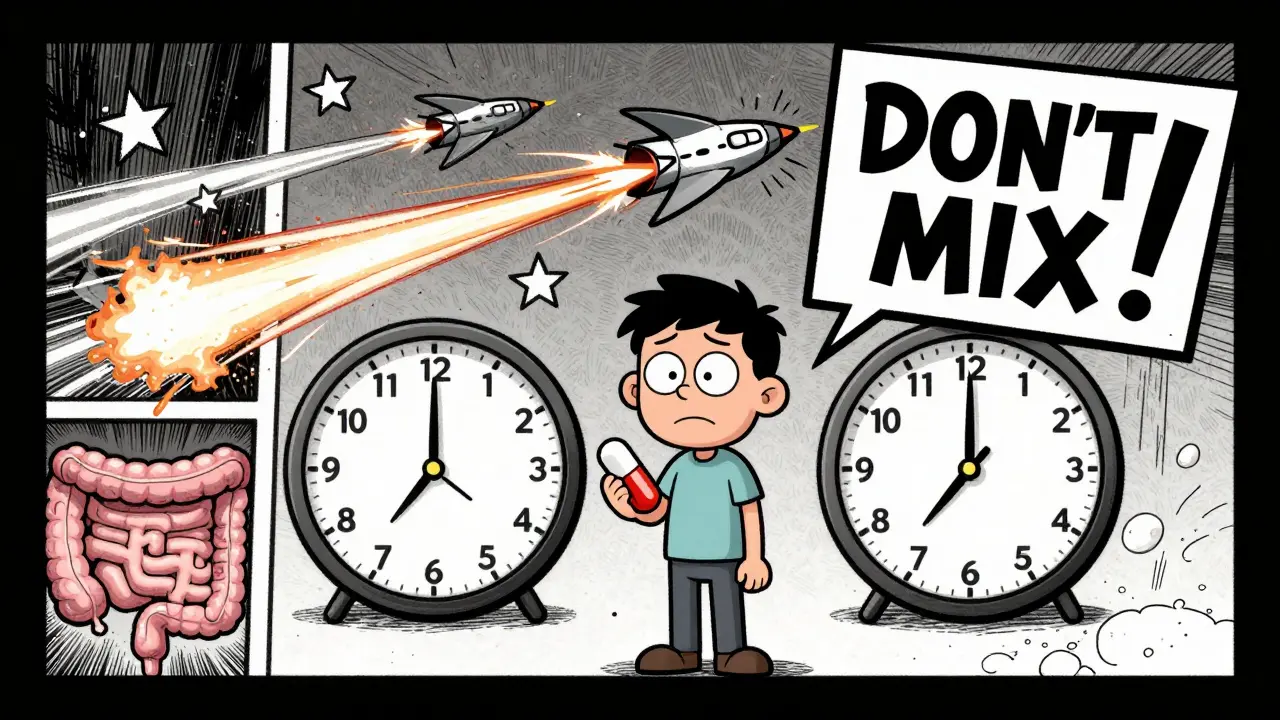
Most experts recommend taking probiotics 2 to 3 hours after your antibiotic dose. Why? Antibiotics can kill the probiotics if they’re in your gut at the same time. Spacing them out gives the probiotics time to settle in before the next antibiotic hit.
As for when to take them during the day - it depends on the product. Some work better with food (like L. rhamnosus GG). Others, like S. boulardii, are acid-resistant and can be taken on an empty stomach. Always read the label. If it doesn’t say, call the manufacturer or ask your pharmacist.
Dosing? Most studies use between 5 and 10 billion CFUs (colony-forming units) per day. Some high-risk cases use up to 20 billion. But there’s no need to overdo it. More isn’t always better. Stick to the range shown in clinical trials.
And don’t stop too soon. Continue taking probiotics for at least 1 to 2 weeks after you finish your antibiotics. Your gut doesn’t bounce back overnight.
What You Might Feel at First
When you start probiotics, your gut might react. It’s not a sign they’re not working - it’s a sign they’re working.
Common short-term side effects include:
- Increased gas or bloating
- Mild cramping
- Temporary constipation
- Feeling unusually thirsty
These usually fade within 3 to 7 days. If they get worse, or if you develop severe pain, fever, or bloody stool - stop and call your doctor. That’s not normal.
Some people with IBS or sensitive guts report worse symptoms at first. If you’ve had chronic digestive issues before, talk to your doctor before starting. You might need a gentler strain or lower dose.
Who Should Avoid Probiotics
Probiotics are generally safe - but not for everyone.
They can be dangerous if you:
- Have a weakened immune system (from chemo, HIV, organ transplant, or long-term steroid use)
- Are critically ill or in the ICU
- Have a central line or catheter
- Have had recent surgery
- Are severely malnourished
There have been documented cases of probiotics causing bloodstream infections - especially with Lactobacillus and Saccharomyces boulardii. In rare cases, these led to sepsis or endocarditis. These aren’t common - but they’re serious enough that doctors warn against use in vulnerable people.
If you’re unsure, ask your doctor. Don’t assume it’s safe just because it’s sold in a pharmacy or on Amazon.
The Market Is a Wild West
Here’s the uncomfortable truth: probiotics in the U.S. are sold as supplements, not medicines. That means manufacturers don’t have to prove they work or that they’re safe before selling them. The FDA doesn’t test them. Labels aren’t verified.
That’s why you see products with 50 different strains and claims like “boosts immunity” or “detoxifies your gut.” None of those claims are regulated. The only thing that matters is whether the product contains the strain and dose shown to help in studies.
Look for products that list:
- The exact strain (e.g., Lactobacillus rhamnosus GG, not just “Lactobacillus”)
- The CFU count at expiration (not just at manufacture)
- A clear expiration date
- Storage instructions (many need refrigeration)
Brands like Culturelle (L. rhamnosus GG) and Florastor (S. boulardii) are widely available and have been tested independently. They’re not perfect, but they’re among the most reliable.
And don’t rely on yogurt or kefir alone. While they contain probiotics, the strains and doses are too low to make a real difference during antibiotic therapy. Supplements are your best bet.

What the Science Still Doesn’t Know
Even with all the data, big questions remain.
A 2021 study in Nature found that some probiotics might actually delay gut recovery after antibiotics. The microbiome didn’t bounce back as quickly in people who took probiotics compared to those who didn’t. Why? Maybe the probiotics outcompeted native bacteria trying to repopulate.
Other research is exploring whether specific probiotics work better with specific antibiotics. For example, does S. boulardii help more with clindamycin than with amoxicillin? We don’t have clear answers yet.
The NIH is funding $12.5 million in new studies to figure this out. In the meantime, stick to the strains with the strongest evidence: L. rhamnosus GG and S. boulardii.
Your Action Plan
If you’re about to start antibiotics:
- Check with your doctor - especially if you’re immunocompromised.
- Choose a product with L. rhamnosus GG or S. boulardii.
- Take it 2 to 3 hours after your antibiotic dose.
- Use 5-10 billion CFUs daily.
- Continue for 1-2 weeks after finishing antibiotics.
- Watch for side effects. If they last longer than a week, stop and ask your doctor.
It’s not a guarantee - but it’s the best shot you’ve got at avoiding the worst side effects.
Can I take probiotics while on antibiotics?
Yes, but timing matters. Take probiotics at least 2 to 3 hours after your antibiotic dose to avoid killing the beneficial bacteria. Taking them together reduces effectiveness. Most experts recommend continuing probiotics for 1 to 2 weeks after finishing antibiotics.
Which probiotic strain works best for antibiotic-related diarrhea?
The two most effective strains are Lactobacillus rhamnosus GG and Saccharomyces boulardii. L. rhamnosus GG reduces general antibiotic-associated diarrhea by about 40%, while S. boulardii cuts C. diff risk by over 70% in high-risk patients. Avoid multi-strain blends unless they include one of these proven strains.
Are probiotics safe for everyone?
No. People with weakened immune systems - such as those on chemotherapy, organ transplant recipients, or those with severe illnesses - should avoid probiotics. There have been rare but serious cases of bloodstream infections from probiotic strains. If you’re unsure, talk to your doctor before starting.
Do probiotics help with bloating and gas from antibiotics?
Yes, especially strains like Bifidobacterium and L. rhamnosus GG. Many users report less bloating and cramping when taking probiotics during antibiotic therapy. However, some people experience temporary increases in gas at first - this usually clears up within a few days as the gut adjusts.
Can I get enough probiotics from yogurt or kefir instead of supplements?
No. While yogurt and kefir contain beneficial bacteria, the amount and strain variety are too low to have a measurable effect during antibiotic therapy. Supplements provide targeted, high-dose strains that are clinically proven. Food sources are great for general gut health, but not enough for preventing antibiotic side effects.
How do I know if a probiotic supplement is reliable?
Look for: 1) The exact strain name (e.g., Lactobacillus rhamnosus GG), 2) CFU count guaranteed at expiration (not just manufacture), 3) A clear expiration date, and 4) Refrigeration instructions if needed. Brands like Culturelle and Florastor have been independently tested. Avoid products with vague labels like “probiotic blend” or “10 strains” without naming them.
Final Thoughts
Probiotics aren’t a cure-all. But when used correctly, they’re one of the few tools we have to protect your gut during antibiotic therapy. The science is clear: the right strain, at the right time, in the right dose, can make a real difference.
Don’t let confusion or fear stop you. Talk to your doctor. Pick a trusted product. Stick to the plan. Your gut will thank you.
Ajay Krishna
February 28, 2026 AT 03:24Really appreciate this breakdown - I’ve been on antibiotics twice now and always wondered if probiotics were worth it. Turns out, yeah, they are. I started Culturelle after my last course and noticed way less bloating. Didn’t even think about timing until now - taking them 2 hours after my antibiotic made a huge difference. No more midday bathroom dashes.
Also, good call on checking the strain. I used to grab whatever was cheapest on Amazon. Learned the hard way when one bottle had zero live cultures. Now I only buy ones that list the strain and expiration date. Small details matter.
Charity Hanson
March 1, 2026 AT 13:16This is gold! I’m a nurse in Lagos and I see so many patients struggling with antibiotic side effects - especially kids. I’ve been recommending S. boulardii for years, but most folks think probiotics are just ‘hippie stuff.’ This post nails it. Time to share it with my whole ward!
Also, yes - yogurt won’t cut it. One mom told me she gives her kid kefir daily and wonders why he still gets diarrhea. Gently explained supplements ≠ food. She was shocked.
Noah Cline
March 2, 2026 AT 23:37Let’s be real - the entire probiotic industry is a regulatory loophole dressed up as wellness. The Cochrane review you cited? It’s meta-analysis of low-to-moderate quality RCTs with high heterogeneity. The 70% reduction in C. diff? That’s in high-risk hospitalized populations - not healthy adults taking amoxicillin for a sinus infection.
And don’t get me started on CFU counts. Most products don’t even guarantee viability beyond manufacture. The FDA doesn’t regulate supplements because they’re not drugs - which means every claim you’re making here is technically unverified. You’re not ‘proving’ efficacy - you’re narrating marketing.
Don’t misunderstand: I’m not saying probiotics are useless. I’m saying the evidence is noisy, the market is predatory, and most people are being sold snake oil with a pretty label.
Justin Ransburg
March 4, 2026 AT 19:07Thank you for sharing such a thoughtful and well-researched guide. As a primary care provider, I’ve seen too many patients suffer needlessly from antibiotic-associated complications. This summary aligns with current clinical guidelines and offers practical, evidence-based advice.
I especially appreciate the emphasis on strain specificity and timing. Too often, patients are given vague recommendations like ‘take a probiotic’ without context. This level of detail empowers both clinicians and patients to make informed decisions.
For those unsure - consult your pharmacist. They’re often the most knowledgeable about supplement quality and dosing.
Full Scale Webmaster
March 6, 2026 AT 01:26Okay, buckle up - because this whole probiotic thing is a scam engineered by Big Pharma and supplement companies to keep you dependent on their products. You think antibiotics are bad? Wait until you find out how much money they’re making off your gut. The CDC? They’re in bed with the probiotic industry. The 2020 Cochrane review? Funded by a company that owns Culturelle. Coincidence? I think not.
And why do you think they push ‘L. rhamnosus GG’ and ‘S. boulardii’? Because those are the only two strains that actually have patents. Everything else? Just filler. The FDA doesn’t regulate supplements because they’re being paid off. You think your ‘trusted brand’ is safe? Try checking their parent company’s stock holdings. I’ve dug into this. It’s all connected.
Here’s what really works: fasting. Your gut heals itself when you stop feeding it. No supplements. No probiotics. Just water and time. But you won’t hear that from the ‘experts’ because they get paid to sell you pills.
Also - why is this article so long? Because they want you to read it. To feel scared. To buy more. Wake up.
Brandie Bradshaw
March 7, 2026 AT 18:17Probiotics are not a panacea. They are not a cure. They are not a magic bullet. They are, however, a scientifically supported intervention that, under specific conditions - specific strains, specific timing, specific dosing - can significantly reduce the incidence of antibiotic-associated diarrhea and, in high-risk populations, C. difficile infection. The data is not perfect, but it is consistent. The meta-analyses are robust. The clinical guidelines are clear. The market is chaotic. The science is not.
That said, I am deeply skeptical of supplement labeling. I have reviewed lab results from independent testing labs. The discrepancy between labeled and actual CFU counts is alarming. The absence of refrigeration instructions on products that require it is negligent. The use of vague terminology like ‘probiotic blend’ is deceptive. Consumers are being misled. This is not a failure of science - it is a failure of regulation.
And yes - yogurt does not work. The strains are too few, the concentrations too low, the viability too unreliable. This is not opinion. This is microbiology.
Angel Wolfe
March 9, 2026 AT 05:57So now we’re telling people to take pills from China or wherever because some study says so? Who approved this? Who’s checking the ingredients? The FDA doesn’t regulate supplements because they’re owned by the same people who run the CDC. You think your probiotic is safe? What’s in it? What’s in the capsule? What’s in the air it was packaged in?
I’ve seen people get sick from probiotics. Real sick. Sepsis. From a supplement they bought at Walmart. That’s not science. That’s negligence. And now you’re telling people to take it 2 hours after antibiotics? Why not 3? Why not 4? Who decided? A committee? Who funds them?
And why are we pushing this on healthy people? My cousin took this stuff and got diarrhea for 3 weeks. She thought it was helping. It wasn’t. It was poisoning her. You think that’s normal? It’s not. It’s dangerous. And nobody’s talking about it because they’re getting paid.
Sophia Rafiq
March 10, 2026 AT 19:56Yup. Culturelle. 10B CFU. 2 hours after amoxicillin. Did it for 2 weeks after. No diarrhea. No bloating. Done. Also - avoid the $40 ‘super blend’ with 20 strains. Stick to the two that actually work. S. boulardii for C. diff risk. L. rhamnosus GG for general GI. Everything else is noise.
Also - don’t trust Amazon reviews. Look up the strain on PubMed. That’s the real review.
Lisa Fremder
March 12, 2026 AT 13:06Why are we even talking about probiotics like they’re medicine? They’re supplements. They’re not FDA-approved. They’re not tested. They’re not regulated. And now we’re telling people to take them with antibiotics? That’s like telling someone to take a vitamin while on chemo. You don’t know what’s in it. You don’t know if it interacts. You don’t know if it’s safe.
This country is falling apart. We’re trusting random supplements from overseas because some blog says so. We’re not asking questions. We’re not demanding answers. We’re just swallowing pills and hoping for the best.
It’s not science. It’s superstition with a label.
Sumit Mohan Saxena
March 13, 2026 AT 05:12Respectfully, the clinical evidence supporting probiotic use during antibiotic therapy is robust, methodologically sound, and endorsed by multiple international clinical societies including the European Society of Clinical Microbiology and Infectious Diseases (ESCMID) and the American College of Gastroenterology (ACG). The reduction in antibiotic-associated diarrhea and C. difficile infection is statistically significant, with number needed to treat (NNT) values ranging from 8 to 12 across multiple randomized controlled trials.
It is imperative to distinguish between commercially available supplements and evidence-based interventions. The strains Lactobacillus rhamnosus GG (ATCC 53103) and Saccharomyces boulardii CNCM I-745 are the only ones with consistent, reproducible, and peer-reviewed efficacy. All other formulations lack sufficient clinical validation.
Furthermore, the timing recommendation of 2–3 hours post-antibiotic administration is not arbitrary; it is derived from pharmacokinetic studies demonstrating maximal viability of probiotic organisms in the presence of fluctuating antibiotic concentrations in the intestinal lumen.
While regulatory gaps in supplement manufacturing are a legitimate concern, this does not invalidate the underlying science. Rather, it underscores the need for consumer education and improved labeling standards - not rejection of the intervention.