
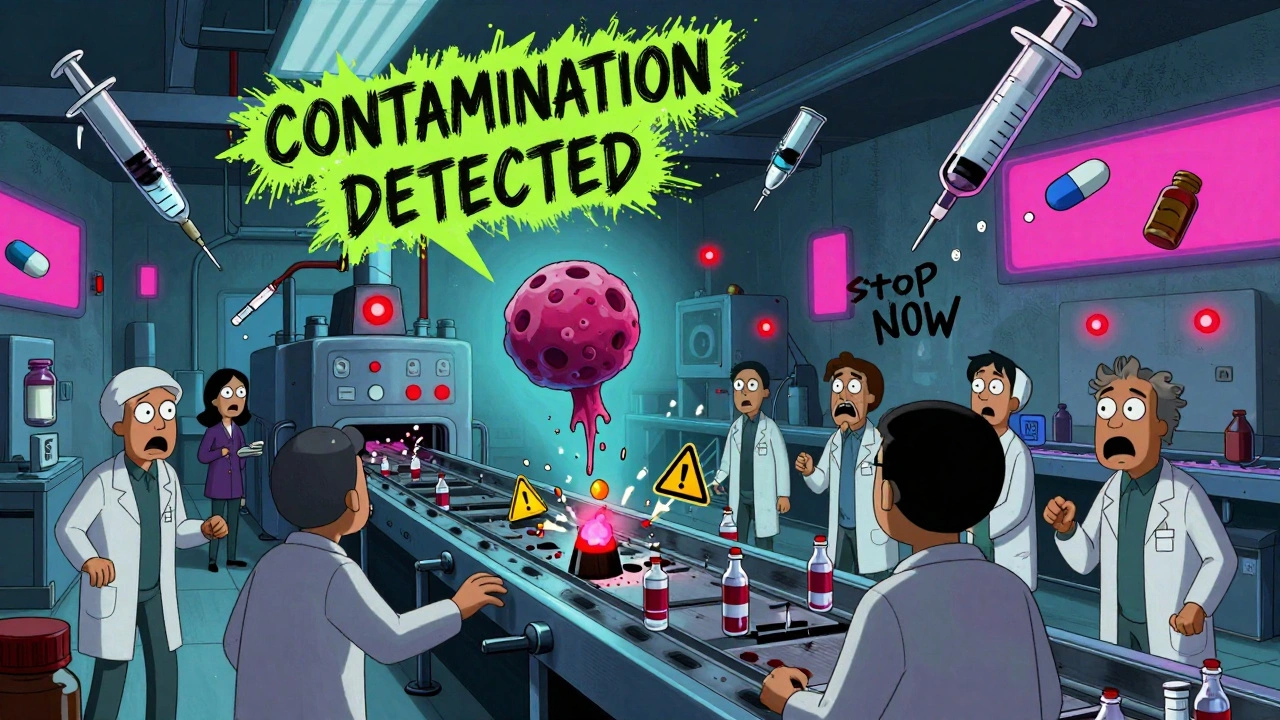
When a drug production line stops, it’s not just a delay-it’s a life-or-death moment. A single quality problem can shut down an entire facility, leaving hospitals without critical medicines, patients without their prescriptions, and pharmacies empty. These aren’t minor hiccups. They’re systemic failures that ripple across the healthcare system. In 2023, the FDA reported over 300 drug shortages in the U.S. alone, and nearly half were directly tied to quality issues that forced manufacturers to halt production. This isn’t about occasional mistakes. It’s about what happens when a tiny flaw-like a speck of contamination, a mislabeled batch, or a sensor that didn’t trigger-triggers a full stop.
Why Quality Problems Force Production to Halt
In pharmaceutical manufacturing, quality isn’t negotiable. Unlike making cars or smartphones, where a defective unit might be recalled later, a contaminated pill or an under-dosed injection can kill. That’s why regulators like the FDA and EMA require manufacturers to stop production immediately when a quality deviation is detected. There’s no gray area. Even if the batch looks fine, if a sensor reads a temperature spike during sterilization, or if a vial’s seal doesn’t meet specs, the line shuts down. No exceptions. The cost of letting a bad batch out the door? Up to 200 times higher than stopping it early. Boeing found that fixing a defect after delivery costs 200 times more than catching it on the line. In pharma, that math is even starker. A single recall can cost hundreds of millions and destroy trust in a brand for years. So manufacturers don’t wait. They stop.Common Quality Issues That Shut Down Drug Lines
Not all quality problems are the same. Some are obvious. Others hide in plain sight. Here’s what actually causes production halts in drug manufacturing:- Contamination: Microbial, chemical, or particulate contamination is the #1 reason for shutdowns. Even a single fungal spore in a sterile injectable can trigger a full recall.
- Incorrect labeling: A misprinted label on a vial of insulin or chemotherapy can lead to fatal dosing errors. If the system flags a mismatch between the batch number and the label, the line stops.
- Impurity levels: If active ingredients exceed or fall below allowed limits-even by 0.1%-the batch is rejected. These thresholds are set by pharmacopeias and are non-negotiable.
- Equipment failure: A pump that delivers the wrong flow rate, a mixer that doesn’t homogenize properly, or a lyophilizer that fails to maintain vacuum can ruin entire batches.
- Supply chain failures: If a raw material from a supplier doesn’t meet specs, production halts until a qualified replacement arrives. This isn’t just about quality-it’s about traceability.
According to a 2023 analysis of 1,200 FDA inspection reports, 68% of production halts in pharma were caused by deviations in process controls, not random accidents. These are preventable-but only if systems are built to catch them early.
How Long Do These Halts Last?
In automotive plants, a quality stop might last an hour. In pharma, it’s different. The average quality-related halt in drug manufacturing lasts 4.7 hours. Why so long? Because every step must be documented, reviewed, and approved by quality assurance teams. You can’t just restart the line. You need:- Containment: Isolate the affected batch within 30 minutes.
- Root cause analysis: Use tools like the 5 Whys or Fishbone diagrams to find the source.
- Corrective action: Fix the process, retrain staff, recalibrate equipment.
- Verification: Run test batches until they meet all specs-often over multiple cycles.
And that’s just the internal process. If the issue affects multiple batches or suppliers, the FDA may require a formal investigation. That adds days-or weeks-to the timeline. In one case, a small manufacturer halted production for 11 days after a single vial of a blood thinner showed a foreign particle. The delay cost $1.8 million in lost revenue and delayed treatment for over 500 patients.
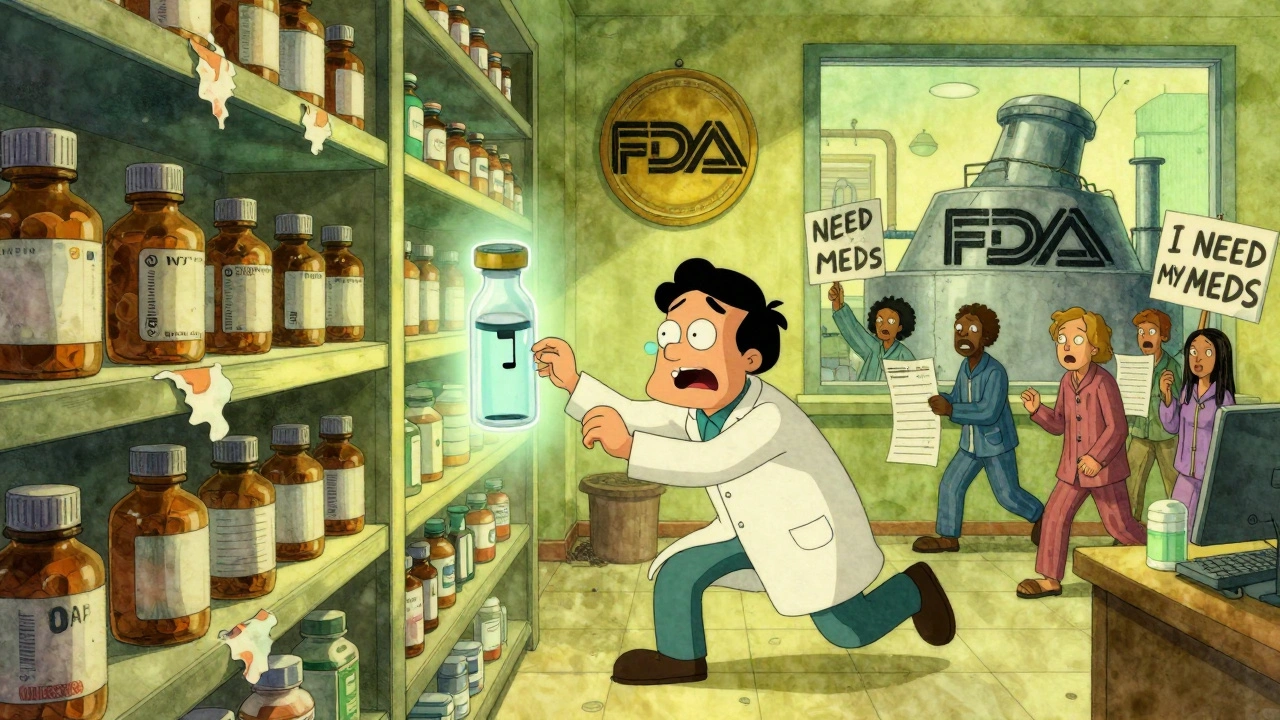
The Ripple Effect: Who Pays the Price?
When a drug stops being made, the impact doesn’t stop at the factory gate.- Hospitals scramble to find alternatives, sometimes using less effective or more toxic drugs.
- Patients face delays in treatment, especially for cancer, epilepsy, or heart conditions where timing is critical.
- Pharmacists spend hours calling distributors, switching prescriptions, and explaining shortages to frustrated customers.
- Insurance companies pay more for substitute drugs or emergency shipments.
A 2023 study in the Journal of the American Pharmacists Association found that 72% of patients on long-term medications experienced treatment interruptions due to shortages. For those on injectable biologics, delays of more than 72 hours increased hospitalization risk by 34%.
Why Some Companies Handle This Better
Not all manufacturers suffer the same way. Those with modern systems avoid unnecessary halts-and respond faster when they happen.Siemens’ electronics plant reduced quality halts by 61% using real-time sensors that flagged deviations before they became batch failures. Johnson & Johnson cut material-related halts by 52% using blockchain to track raw materials from source to final product. At BMW’s Spartanburg plant, AI predicted quality issues 48 hours before they occurred, reducing stops by 39%.
These aren’t sci-fi fantasies. They’re real tools available today:
- Digital work instructions: Reduce human error by 40% and cut halt resolution time by 53% compared to paper-based systems.
- Manufacturing Execution Systems (MES): Integrate quality data in real time, so problems are caught before the line runs.
- Process Failure Mode Effects Analysis (PFMEA): Proactively identifies where things could go wrong-and builds safeguards.
Facilities using these tools resolve quality issues 42% faster than those relying on manual checks. And they have fewer repeat halts.
The Human Factor: Empowering Workers to Stop the Line
One of the most effective tools isn’t software-it’s culture. In 2022, a major U.S. drugmaker implemented a “stop-work authority” policy: any line worker, from operator to technician, can halt production if they see a quality issue. No manager approval needed.The result? Customer returns dropped 37% in 18 months. Workers felt trusted. Problems were caught earlier. And fewer batches made it to the final stage with hidden flaws.
But this only works if the system supports it. If workers are punished for stopping the line-or if management ignores their reports-it backfires. In one case, a Midwest supplier had 22 unnecessary halts a month because workers were afraid to speak up. After training and cultural changes, halts dropped to 4 per month-and quality improved across the board.
What’s Changing by 2026?
The industry is moving fast. By 2026, Gartner predicts AI will initiate and resolve 60% of quality-related halts without human input. That sounds scary-but it’s not about replacing people. It’s about letting humans focus on complex decisions while machines handle repetitive monitoring.Siemens’ “Zero Quality Halt” initiative aims to cut unnecessary stops by 90% by 2027. The Industrial Internet Consortium is finalizing a new Quality Data Standard to make it easier for systems to talk to each other. And the FDA is pushing for real-time data submission from manufacturers-so problems are flagged before they become shortages.
But there’s a risk. A 2023 MIT study found that when automation was overused at an electronics plant, minor defects increased by 27% because machines couldn’t interpret subtle human cues. The best systems combine AI with human judgment. Not one or the other.
What Can Be Done?
If you’re a patient, a pharmacist, or a provider, you can’t fix the factory. But you can demand better:- Ask about alternatives: If your drug is on shortage, ask your doctor if a generic or similar drug is available.
- Report shortages: Use the FDA’s Drug Shortage Portal to report gaps in your pharmacy’s supply.
- Support transparency: Push for public reporting of production halts-not just final shortages.
For manufacturers, the path is clear: invest in predictive systems, empower frontline workers, and treat quality halts not as failures-but as vital safety checks.
Production halts aren’t the enemy. Ignoring them is.
Why do drug manufacturers halt production for small quality issues?
Drug manufacturers halt production for even minor quality issues because the consequences of a defective product can be fatal. Unlike other industries, pharmaceuticals are consumed directly by patients. A contaminated pill, incorrect dosage, or mislabeled vial can lead to serious harm or death. Regulators like the FDA require immediate stops to prevent defective products from reaching the market. The cost of a recall or lawsuit is far higher than the cost of stopping production early.
How long does a typical drug production halt last?
The average quality-related production halt in pharmaceutical manufacturing lasts about 4.7 hours. This is longer than in other industries because every step must be documented, investigated, and approved by quality assurance teams. The process includes containing the affected batch, identifying the root cause, fixing the issue, and verifying the fix with test runs. If the problem involves suppliers or regulatory review, it can take days or weeks.
Are drug shortages always caused by quality problems?
No, but quality problems are one of the leading causes. Other reasons include raw material shortages, equipment breakdowns, regulatory inspections, and natural disasters. However, according to FDA data, nearly half of all drug shortages in recent years were triggered by quality issues that forced manufacturers to stop production. These are often the most difficult to resolve quickly because they require deep investigations and regulatory approval before restarting.
Can AI help prevent drug production halts?
Yes. AI-powered systems can predict quality issues before they happen by analyzing sensor data from production equipment. For example, BMW’s Spartanburg plant reduced quality halts by 39% using AI to detect subtle changes in temperature, pressure, or vibration. These systems don’t replace humans-they flag anomalies so teams can act early. Companies using AI for predictive quality see up to 47% fewer unplanned stops.
What can patients do when their medication is on shortage?
Patients should talk to their doctor or pharmacist about alternatives. Many shortages have generic equivalents or similar drugs that work just as well. It’s also important to report shortages to the FDA’s Drug Shortage Portal. This helps regulators track patterns and pressure manufacturers to resolve issues faster. Don’t stop taking medication without consulting a professional-some substitutions require careful monitoring.
Ali Bradshaw
December 5, 2025 AT 00:45Been in pharma QA for 12 years. The thing nobody talks about? Most halts are caused by overzealous SOPs, not actual danger. We once shut down a line because a worker wore a slightly frayed sleeve cuff near a sterile fill station. No contamination. No risk. Just a rulebook that forgot humans exist.
Fix the culture, not just the sensors.
Lynette Myles
December 6, 2025 AT 17:48They’re lying. The FDA takes bribes from big pharma to keep shortages quiet. That’s why you never hear about the 2,000+ halts they bury each year. They want you dependent on their patented drugs. Check the 2021 whistleblower filings.
Lucy Kavanagh
December 7, 2025 AT 22:55US pharma is a joke. In the UK we don’t have these problems because we regulate properly. No one here would let a vial with a 0.1% impurity get past the first check. You Americans think ‘innovation’ means cutting corners. Wake up.
Stephanie Bodde
December 9, 2025 AT 21:48This hit me hard. My mom’s chemo was delayed 11 days last year. She cried because she thought she was being forgotten.
❤️ We need to demand better. No more silence.
Deborah Jacobs
December 11, 2025 AT 06:22It’s like watching a symphony where one out-of-tune violin makes the whole orchestra stop. But here, the violinist is a nurse who noticed a flickering light near the autoclave. The conductor? A 60-year-old QA manager who still uses clipboards.
AI doesn’t replace humanity-it gives humanity the power to speak without fear.
Stephanie Fiero
December 13, 2025 AT 04:21Stop saying ‘quality halts are safety checks’ like it’s some noble sacrifice. It’s corporate cowardice. They’d rather lose 500 patients than risk a $200M fine. Call it what it is: profit over people.
And yes I’m angry. You should be too.
Krishan Patel
December 13, 2025 AT 22:22Let me be clear: this is not about quality. It is about control. The FDA and multinational conglomerates use these halts to eliminate small manufacturers who cannot afford the compliance theater. Global supply chains are being weaponized under the guise of safety. This is economic fascism dressed in lab coats.
Philip Kristy Wijaya
December 15, 2025 AT 11:43Interesting how you frame this as a systemic failure when the real issue is the absence of market competition. If you had 20 manufacturers for every critical drug instead of 3 monopolized by Big Pharma, shortages would vanish. But no one wants to talk about antitrust because the regulators are on the payroll
And yes I know this is controversial
Jennifer Patrician
December 17, 2025 AT 07:44AI predicting halts? Yeah right. The same AI that ‘predicts’ your grocery cravings is now deciding if your insulin is safe? What happens when the algorithm glitches and says ‘all batches are fine’? You think they’ll recall a million vials because a machine made a mistake? No. They’ll just blame the patient.
luke newton
December 18, 2025 AT 13:50How dare you glorify these halts as ‘vital safety checks’? You’re romanticizing bureaucracy. Every time a line stops, a child misses their seizure med. Every time a manager approves a ‘risk assessment’ instead of a fix, someone dies quietly in a hospital bed. This isn’t science. It’s a performance for shareholders.
And you call that ethics?
Jimmy Jude
December 19, 2025 AT 21:11What if the real problem isn’t the halts-but our collective surrender to them? We accept drug shortages like we accept traffic jams. We’ve normalized suffering because we’re too tired to fight. We’ve turned medicine into a commodity and forgotten it’s a covenant.
When was the last time you wrote your congressperson? Not like, literally-when?
ashlie perry
December 21, 2025 AT 08:58They’re hiding the real numbers. The FDA only reports 300 shortages but I know a guy at a warehouse in Ohio who said they had 17 different drugs pulled last month alone and nobody filed a report. It’s all smoke and mirrors. And the vials? They get dumped into black market channels. That’s why you see fake insulin on Instagram now.
Carole Nkosi
December 23, 2025 AT 04:47You talk about AI and sensors like they’re saviors. But what about the workers? The ones who’ve been doing this for 30 years and see patterns no machine can detect? You automate their intuition away and then wonder why the system breaks. Technology without wisdom is just noise.
Mark Curry
December 24, 2025 AT 11:22I used to work in a small lab that made generics. We had zero halts for 3 years. Why? We listened. A tech noticed a weird smell in the solvent line. We checked. It was a tiny leak. Fixed it. No drama. No shutdown. Just someone paying attention.
Simple stuff works if you let people do it.
Mellissa Landrum
December 25, 2025 AT 04:16Big Pharma owns the FDA. The ‘quality issues’ are made up so they can charge more for the same drug. You think they want you healthy? No. They want you dependent. Check the stock prices after every shortage announcement. Boom. Always up. Coincidence? Nah.