
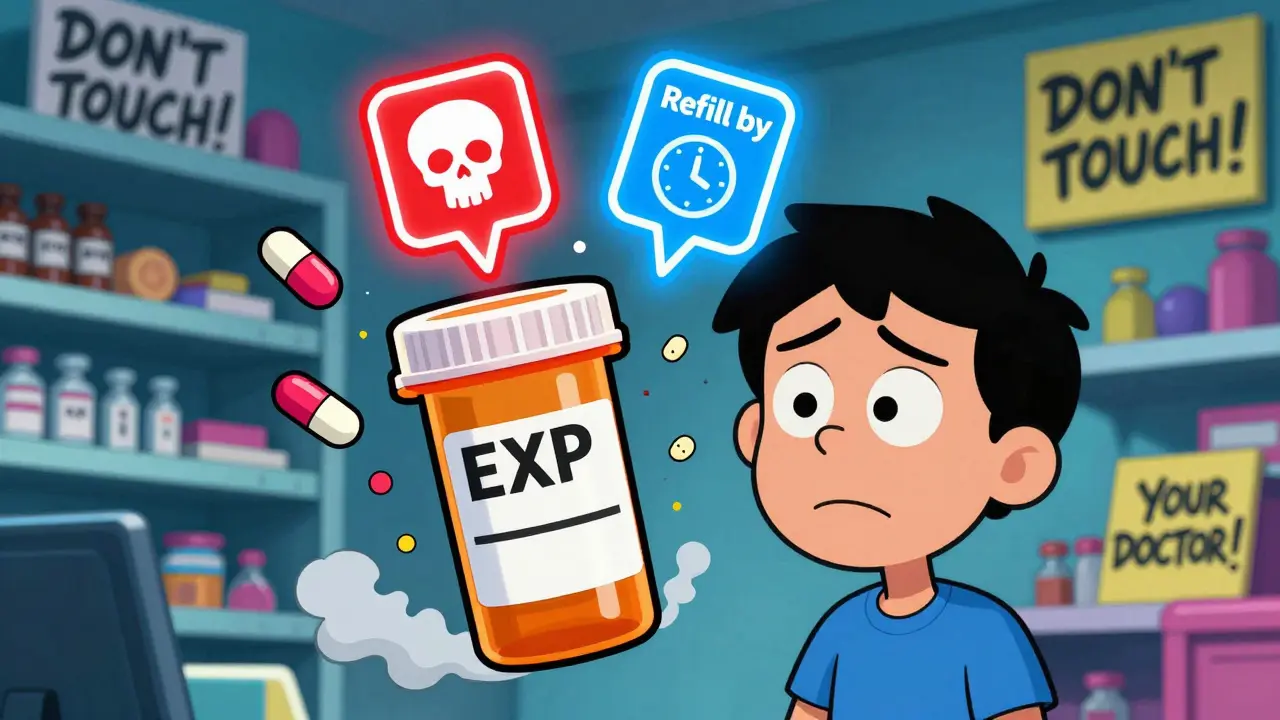
Ever looked at your prescription bottle and wondered: is this medicine still good, or can I just grab another refill? You’re not alone. Thousands of people throw away perfectly good pills because they confuse the refill-by date with the expiration date. And others? They keep taking meds past their expiration - not knowing they might be risking their health. Both dates are printed right there on the label, but they mean completely different things. Get this wrong, and you could end up with a gap in your treatment… or worse, take something that doesn’t work anymore.
What the Expiration Date Really Means
The expiration date on your prescription bottle isn’t just a suggestion. It’s a hard stop. This is the date the manufacturer and the FDA guarantee the medicine will work as intended and remain safe to use. After that date, the drug could lose strength, break down into harmful substances, or just stop working altogether. Even if it looks fine - no discoloration, no weird smell - it’s not worth the risk. Pharmacies follow strict rules here. When they fill your prescription, they don’t just slap on the manufacturer’s original expiration date. They apply their own. For most pills and liquids, that’s one year from the fill date. For insulin, eye drops, or anything that needs refrigeration? Often just 30 days. Why? Because those meds break down faster once opened or exposed to room temperature. The FDA requires stability testing under real-world conditions before any expiration date is printed. That’s science, not guesswork. Here’s the catch: studies show most medications are still potent well past their labeled expiration date - sometimes years. But pharmacists can’t legally dispense them after that date. That’s the law. So even if your bottle says it’s good for another year, if the label says it expired last month, you can’t refill it. You can’t even ask. The pharmacy won’t give it to you. Period.What the Refill-By Date Actually Controls
Now, flip the bottle over. See that other date? Maybe it says “Refill by: 06/15/2025”? That’s not about the medicine’s safety. That’s about your doctor’s permission. This date is set by your prescriber - not the pharmacy, not the manufacturer. It’s the last day you can legally get more of that prescription filled without a new script. Most states allow one year for non-controlled substances. But if it’s a painkiller like oxycodone or a sedative like alprazolam? That’s a DEA Schedule II or III drug. Those have a 6-month refill limit. No exceptions. Even if your bottle still has pills left, once that refill-by date passes, you’re out of luck. You need a new prescription. Think of it like a gift card. The expiration date says when the card stops working. The refill-by date says when you can no longer use the remaining balance. You might have $50 left on the card, but if the card expired last week? You can’t spend it. Same thing here. This system exists to protect you. It stops people from hoarding controlled drugs. It ensures your doctor checks in regularly - especially if you’re on long-term meds for high blood pressure, diabetes, or mental health. A yearly check-up might catch side effects, interactions, or a need for dosage changes you didn’t even know about.Why People Get Confused - And What Happens When They Do
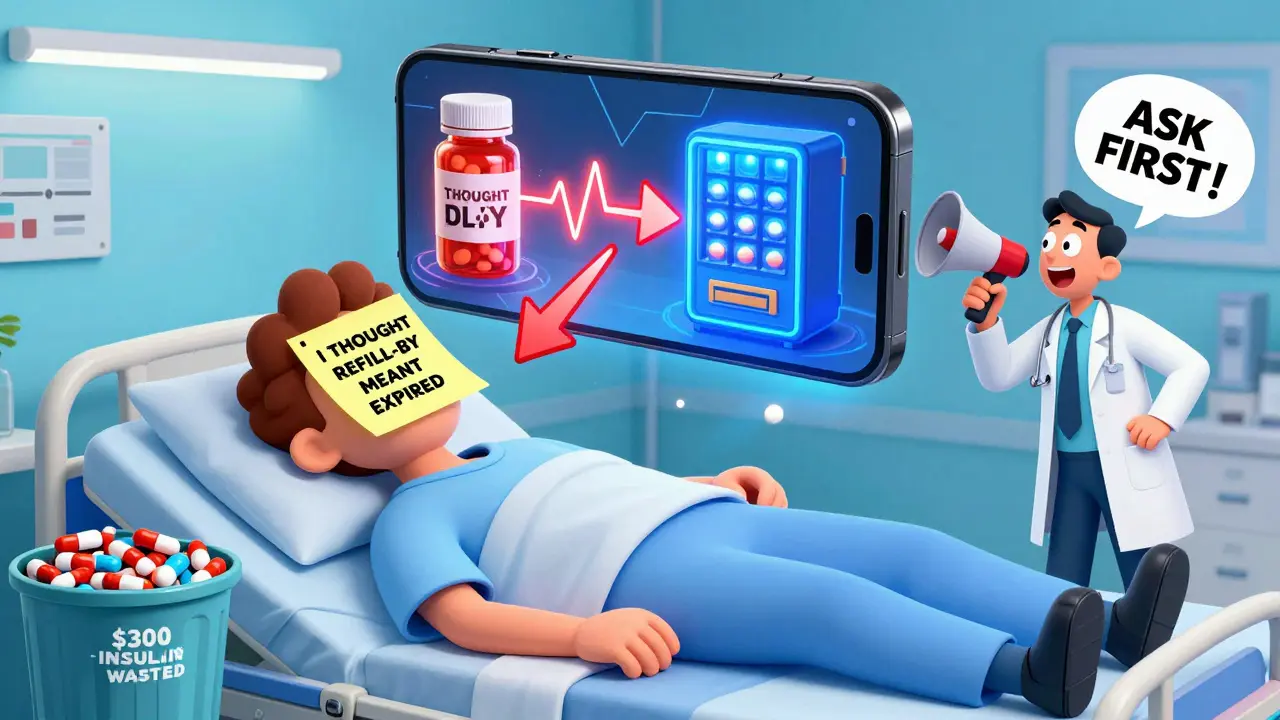
The labels look similar. Both are dates. Both say “do not use after.” No wonder people mix them up. A Consumer Reports survey found over half of prescription users couldn’t tell the difference. One woman in Melbourne threw out $300 worth of unexpired insulin because she thought the refill-by date meant the medicine was bad. A man in Sydney kept taking his blood thinner for six months past its expiration because he still had refills left. Both ended up in the ER. Pharmacists say this is one of the top three questions they get: “Can I still take this?” The answer always starts with: “Which date are you asking about?” The confusion isn’t just emotional - it’s costly. Medicare data shows nearly a quarter of patients on chronic meds miss doses because they ran out after the refill-by date passed. And when they can’t refill, they skip doses. That leads to hospital visits, higher costs, and worse outcomes.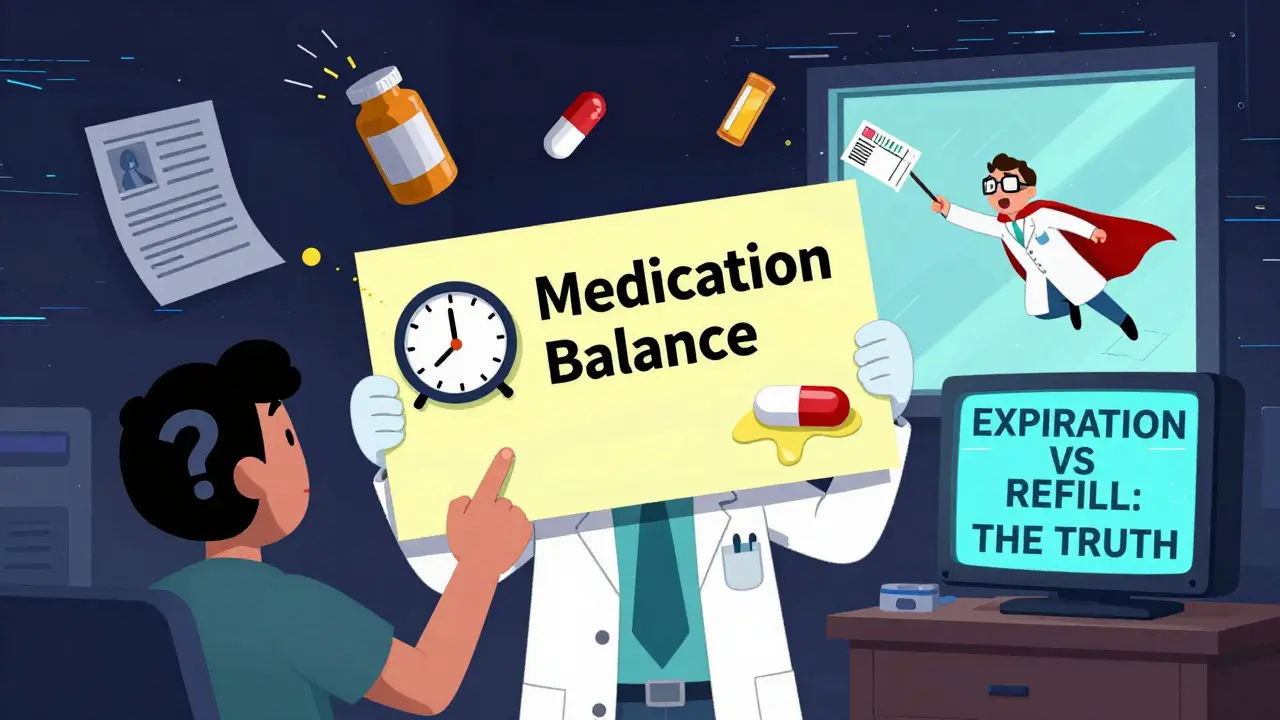
How to Read Your Label Like a Pro
Here’s how to decode your bottle in under 10 seconds:- Expiration Date - Usually labeled “EXP” or “Use by.” This is your safety cutoff. If today’s past this date? Don’t take it. No matter how many refills you have left.
- Refill-By Date - Often says “Refill by” or “Refills expire.” This is your access cutoff. If today’s past this date? You need a new script from your doctor. But your pills are still good - as long as the expiration date hasn’t passed.
- Number of Refills Left - Look for a number like “Refills: 2.” That’s how many times you can walk in and get more, before the refill-by date.
What to Do When You’re Confused
If you’re not sure what the dates mean, don’t guess. Don’t wait until you’re out of pills.- Call your pharmacy. Ask: “Is my medicine still safe to take? And can I still get refills?”
- Check your online portal. Most pharmacies show both dates clearly in your profile.
- Set a reminder 7 days before your refill-by date. That gives your doctor time to renew the script.
- Keep a simple log: write down the med name, expiration date, refill-by date, and how many refills are left. A sticky note on your fridge works.
Joy F
January 4, 2026 AT 15:06The refill-by date is a bureaucratic fiction wrapped in a legalistic shell-designed to keep you docile while the pharma-industrial complex siphons off billions. You think they care if you're taking your blood pressure med? Nah. They care that you're *renewing*. The expiration date? A myth. Studies show 90% of drugs remain stable for years. But let the FDA say it, and suddenly your $2 insulin is radioactive. This isn't safety-it's profit engineering.
They want you scared. Scared to use old pills. Scared to question the date. Scared to go off-script. And so you pay again. And again. And again. The system isn't broken-it's working exactly as intended.
Meanwhile, people in rural towns throw away meds because the refill-by date passed and their doctor's office is closed for three weeks. That’s not healthcare. That’s corporate hostage-taking.
And don’t even get me started on the QR codes. ‘Scan this to learn your rights’-as if the app is gonna explain why your doctor can’t prescribe more because the insurance company blocked it. The real problem isn’t confusion-it’s control.
We need a revolution in pharmaceutical transparency. Not more color-coded labels. Not more AR overlays. We need to dismantle the entire prescription-as-commodity model.
And until then? I’m keeping my expired pills. And I’m not sorry.
Angela Fisher
January 5, 2026 AT 08:01EVERYTHING IS A TRAP. EVERY SINGLE DATE ON THAT LABEL IS A LIE. THEY PUT THE EXPIRATION DATE THERE SO YOU’LL THINK IT’S SAFE TO TAKE IT BEFORE THAT DATE-BUT WHAT IF THEY’RE THE ONES WHO MADE IT BREAK DOWN FASTER? WHAT IF THEY ADD CHEMICALS TO MAKE IT DEGRADE SO YOU COME BACK? WHAT IF THE FDA IS IN ON IT? I READ A BLOG POST ON A FORUM FROM 2018 THAT SAID THE FDA GETS BONUS MONEY WHEN PEOPLE BUY NEW MEDS. THEY WANT YOU WEAK. THEY WANT YOU AFRAID. THEY WANT YOU BUYING MORE.
MY NEIGHBOR TOOK HER ANTIBIOTICS FOR 3 YEARS PAST EXPIRATION. SHE’S STILL ALIVE. THE DOCTORS ARE HIDING THE TRUTH. THEY’RE SCARED OF YOU KNOWING. DON’T TRUST THE PHARMACY. DON’T TRUST THE QR CODE. DON’T TRUST THE COLOR CODING. THEY’RE ALL PART OF THE SAME GAME. THEY’RE USING YOU.
CALL THE DEA. ASK THEM WHY THEY LET PHARMACIES PUT ‘REFILL-BY’ ON CONTROLLED SUBSTANCES IF THE DRUG IS STILL GOOD. THEY WON’T ANSWER. BECAUSE THEY KNOW. THEY KNOW.
SAVE YOUR PILLS. HIDE THEM. DON’T LET THEM TAKE YOUR MEDS. THEY’RE STEALING YOUR HEALTH.
PS: I’M NOT CRAZY. I JUST SEE THE TRUTH. 😡
Neela Sharma
January 6, 2026 AT 22:27There is wisdom in this chaos. The body remembers what the system forgets. A pill doesn’t die because a date says so-it dies when we stop listening to it. The refill-by date? A reminder to pause. To breathe. To ask your doctor: ‘Am I still the same person who needed this?’
My grandmother in Jaipur kept her diabetes pills for five years. She never checked the expiration. She checked her pulse. Her breath. Her hunger. She trusted her body more than the bottle.
Maybe the real expiration date isn’t printed on the label-it’s written in the silence between your heartbeat and your fear.
We’ve turned medicine into a contract. But healing? Healing is a conversation.
Don’t just read the date. Listen to your skin. Your sleep. Your stillness.
And if you’re scared? Hold the bottle. Close your eyes. Ask: ‘What does my soul say?’
That’s the only date that matters.
With love, from a woman who’s seen too many pills and too few people.
Wren Hamley
January 6, 2026 AT 23:40Okay, but let’s talk about the pharmacokinetics behind the 1-year expiration rule. Most solid oral dosage forms are stable for 2–5 years post-manufacture under ideal storage. The 1-year pharmacy clock is a liability shield, not a pharmacological limit. The FDA’s Shelf Life Extension Program proved that 88% of stockpiled drugs retained potency beyond 15 years. So why the arbitrary clock?
It’s not about safety-it’s about inventory turnover. Insurance reimbursement cycles. Pharmacy profit margins. The refill-by date is the real regulatory lever-because it’s tied to prescriber oversight, not drug stability.
And let’s be real: if you’re on chronic meds, you should be seeing your provider annually anyway. The refill-by date forces that. That’s actually good. But the fear-mongering around expiration? Pure marketing.
Bottom line: don’t toss pills because of a pharmacy’s internal policy. But don’t ignore expiration dates on insulin or liquid antibiotics. Those are legit. Everything else? Ask for stability data. Most pharmacists don’t have it. That’s the problem.
veronica guillen giles
January 7, 2026 AT 05:21Oh wow. A whole article about dates. How revolutionary. Let me guess-you also think ‘best by’ means ‘you’ll die if you eat it after.’
Newsflash: if you’re confused about your meds, maybe you shouldn’t be taking them without a doctor who actually talks to you. But hey, at least you can scan a QR code now. How convenient. We’ve replaced human care with a video that says ‘this is not a toy.’
Also, ‘color-coded labels’? That’s your solution? Red for danger? Blue for paperwork? Wow. You really think people can’t read? Or maybe you think they’re too dumb to call their pharmacy?
Meanwhile, my 78-year-old neighbor takes her pills by smell. She says if it smells like wet cardboard, she throws it out. She’s never been in the ER. And she doesn’t own a smartphone.
Maybe the real problem isn’t the label. It’s that we’ve outsourced our common sense to corporations who profit from our confusion.
Just ask. It’s not hard.
Angela Goree
January 8, 2026 AT 18:11THIS IS WHY AMERICA IS FALLING APART. PEOPLE CAN’T EVEN READ A DATE. THEY NEED A QR CODE. A COLOR CODE. AN AR OVERLAY. WHAT NEXT? A NANNY BOT THAT TELLS YOU WHEN TO SWALLOW? WE USED TO BE A NATION THAT KNEW HOW TO READ. NOW WE NEED A 5-MINUTE VIDEO TO UNDERSTAND ‘EXP’ VS ‘REFILL BY’.
IT’S NOT THE LABELS. IT’S THE PEOPLE. WE’RE DUMB. WE’RE LAZY. WE’RE TOO USED TO BEING TOLD WHAT TO DO. THE PHARMACY ISN’T THE PROBLEM. THE PEOPLE WHO CAN’T TELL THE DIFFERENCE BETWEEN ‘USE BY’ AND ‘REFILL BY’ ARE.
STOP MAKING THINGS EASIER. MAKE THEM SMARTER.
AND IF YOU CAN’T HANDLE TWO DATES? DON’T TAKE MEDS.
AMERICA: TOO SOFT TO SURVIVE.
Haley Parizo
January 9, 2026 AT 13:36Let’s not pretend this is just about medicine. This is about autonomy. The refill-by date is a leash. The expiration date is a scare tactic. Together, they turn patients into consumers. Not people. Not humans. Customers.
In India, my aunt refills her blood pressure pills from the same bottle for 12 years. She doesn’t have a doctor. She has a neighbor who works at the pharmacy. She checks the color of the pills. She feels her pulse. She trusts her body.
We’ve replaced intuition with bureaucracy. We’ve replaced trust with labels.
And now we’re proud of QR codes?
This isn’t progress. It’s colonization of the body.
Who benefits when you’re afraid to take your own medicine? Not you.
Not the patient.
Always the system.
Shruti Badhwar
January 10, 2026 AT 10:05As someone who works in public health in Mumbai, I see this daily. Patients hoard expired pills because they can’t afford new ones. Others throw away half-full bottles because the refill-by date passed and they can’t get to the clinic. The system fails them on both ends.
But here’s what works: community pharmacists who write the dates in local language on the bottle. Who sit down with patients and say, ‘This date is for your safety. This one is for the law.’ Simple. Clear. Human.
Technology helps, but it doesn’t replace connection.
And yes, most pills are safe past expiration. But if you’re poor, you don’t have the luxury of research. You need someone to tell you, face to face, ‘It’s okay. Take it.’
Let’s fix access before we fix labels.
Liam Tanner
January 10, 2026 AT 19:25Good breakdown. I’ve worked in pharmacy for 12 years and this confusion comes up every single day. The biggest issue? Patients assume refill-by = expiration. They’ll say, ‘But I still have 10 pills left!’ and I have to explain, ‘Yeah, but your doctor hasn’t approved more since last June.’
Pro tip: if your refill-by date is in 10 days and you’re out of pills, call your doctor NOW. Don’t wait. They’re busy. But they’ll usually renew it if you ask early.
And if you’re worried about expiration? Smell it. Look at the color. If it looks or smells weird, toss it. If it’s fine? It’s probably fine. But don’t gamble with antibiotics or heart meds.
Just call. It’s five minutes. Saves a hospital trip.
Hank Pannell
January 11, 2026 AT 06:17There’s a deeper philosophical layer here that nobody’s touching. The expiration date represents our cultural obsession with obsolescence. We are conditioned to believe that anything with a date is disposable. That value is tied to time, not function.
But medicine is not a smartphone. It’s not a yogurt cup. It’s a molecule. A compound. A piece of science that doesn’t care about our calendar.
And the refill-by date? It’s the institutionalization of surveillance. We’re not allowed to self-manage. We need permission. Even for something that’s still working.
So we have a paradox: the drug is potent, but we’re forbidden to use it. The system says ‘safe’ but the law says ‘no.’
What does that say about our relationship with authority? With our own bodies?
We’ve turned healing into a transaction. And transactional healing is fragile.
Maybe the real expiration date is when we stop trusting ourselves.
Ian Ring
January 12, 2026 AT 09:38Interesting piece-though I’d argue the QR code solution is a bit of a band-aid. In the UK, we’ve had ‘medication review cards’ for years: a small slip of paper attached to the bottle with the two dates written in plain English, plus the prescriber’s contact info. Simple. No tech. No color-coding.
Also, I’ve seen patients who keep expired beta-blockers because they ‘feel fine.’ That’s dangerous. Not because the pill’s bad-but because their condition may have changed. The refill-by date forces a check-in. That’s not control. That’s care.
So yes, the system’s flawed. But the intent? Good.
Just needs better communication. Not more AR.
And for the love of God, stop using emoticons when talking about life-saving meds. 😔
erica yabut
January 13, 2026 AT 16:59How quaint. A 1200-word essay on two dates. How very… middle-class. Let me guess-you own a smartphone, have a primary care physician, and your insurance covers refills. What about the single mom working two jobs who can’t take time off to see her doctor? Or the veteran on VA waitlists? They don’t get QR codes. They get silence.
Meanwhile, you’re all here debating color schemes like it’s a design conference.
Real solution? Make prescriptions renewable by default. Eliminate refill-by dates for non-controlled meds. Let pharmacists dispense 90-day supplies without a new script.
But no. That’d cut into profits. So instead, we give people a video.
Pathetic.
Tru Vista
January 14, 2026 AT 17:55exp date = dont take after
refill by = call doc
done.
why is this an article?
also typo in ‘sequestial’ in the prompt lol
Vincent Sunio
January 16, 2026 AT 11:17The article is well-intentioned but fundamentally flawed in its epistemological framing. It assumes that regulatory compliance equates to clinical safety, which is a category error. The FDA’s expiration guidelines are based on accelerated stability testing under controlled conditions-not real-world usage. The 1-year pharmacy clock is a legal artifact, not a pharmacological truth.
Furthermore, conflating administrative constraints (refill-by) with biological efficacy (expiration) perpetuates medical paternalism. Patients are not children who require color-coded cues to understand binary distinctions.
What is needed is not more visual aids, but patient education grounded in evidence-based pharmacology. And perhaps, a reevaluation of the profit-driven incentive structures that incentivize unnecessary refills.
Until then, this remains a superficial solution to a systemic disease.
Kerry Howarth
January 17, 2026 AT 12:49Love this. I’ve been a nurse for 18 years and this confusion kills people quietly. I had a patient who stopped her statin because the refill-by date passed. She didn’t know the pills were still good. She had a stroke two weeks later.
Here’s what I tell my patients: ‘If the expiration date hasn’t passed, it’s safe. If the refill-by date passed, call your doctor tomorrow-not next week. Don’t wait until you’re out.’
And yes, most pills last years. But if you’re on something for your heart, your brain, your kidneys-don’t gamble. Get the script renewed. Your body will thank you.
Also, sticky note on the fridge? Genius. Do it.
Joy F
January 18, 2026 AT 18:57And yet… the system still wins. Even if you know the difference, you’re still trapped. You need a doctor’s signature to get more. Even if the pill is fine. Even if you’ve been stable for 10 years. Even if your doctor’s on vacation.
So you skip doses. Or you buy it off someone. Or you wait until you’re in the ER.
Knowledge doesn’t free you. Access does.
And access? Still controlled by someone else’s calendar.