
Risk-Benefit Calculator
How to Use This Calculator
Many drug labels show benefits as "relative risk reduction." This can make effects seem bigger than they are. Enter the baseline risk and relative risk reduction to see the actual impact.
Your Results
Absolute Risk Reduction: 0%
Your New Risk: 0%
Baseline Risk: 0%
Risk Reduction Amount: 0 percentage points
What this means: The drug reduced your risk by 0 percentage points from 0% to 0%.
When you pick up a new prescription, the label inside the box isn't just a list of side effects. It’s a carefully written summary of whether the drug’s benefits actually outweigh its risks. But for most patients, it reads like a legal document written in a language no one speaks. The U.S. Food and Drug Administration (FDA) has spent years trying to fix this. And while progress is slow, there are real changes happening - and you need to know what they mean for you.
What the FDA Actually Does With Risk-Benefit Statements
The FDA doesn’t just approve drugs because they work. They approve them only if the benefits are strong enough to justify the risks. This isn’t guesswork. Every drug application gets reviewed using a formal Benefit-Risk Framework a structured method used by the FDA to evaluate whether a drug’s therapeutic benefits outweigh its potential harms, based on clinical data and patient population needs. This framework looks at four key areas: the condition being treated, what other treatments exist, the proven benefits of the drug, and the known risks. Then, it weighs them together.
For example, a drug for late-stage cancer might have serious side effects like nausea, hair loss, or heart problems. But if it extends life by months - or even weeks - when no other options exist, the FDA considers that a net benefit. On the other hand, a drug for mild acne that causes severe liver damage isn’t approved, no matter how well it clears skin. The framework forces reviewers to ask: For whom is this drug worth it?
Where You Find This Info in the Label
You won’t find a single section called "Benefit-Risk Summary." Instead, the information is spread across several parts of the official prescribing label:
- Section 5 (Contraindications): Tells you when not to take the drug - like if you have a specific allergy or liver disease.
- Section 6 (Adverse Reactions): Lists side effects, with some marked as "serious" or "frequent." But it rarely says how likely they are.
- Section 8 (Use in Specific Populations): Explains risks for pregnant women, seniors, or people with kidney problems.
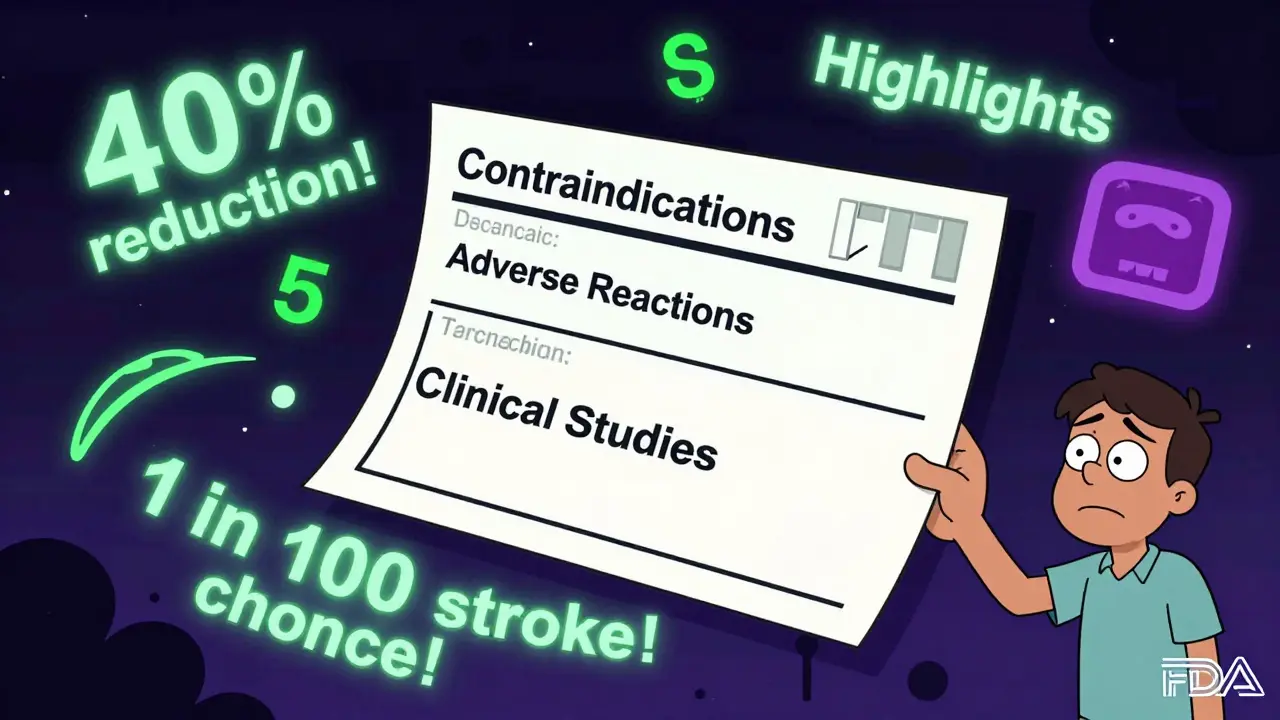
- Section 14 (Clinical Studies): The densest part. It’s full of numbers like "15% reduction in hospitalizations" - but without context, it’s hard to interpret.
- Highlights Section: A one-page summary at the front. This is your best starting point.
The problem? Most of these sections are written for doctors, not patients. A 2022 survey found that only 22% of patients felt very confident understanding these labels. For those with lower health literacy, that number dropped to 9%.
Why Most Labels Still Feel Confusing
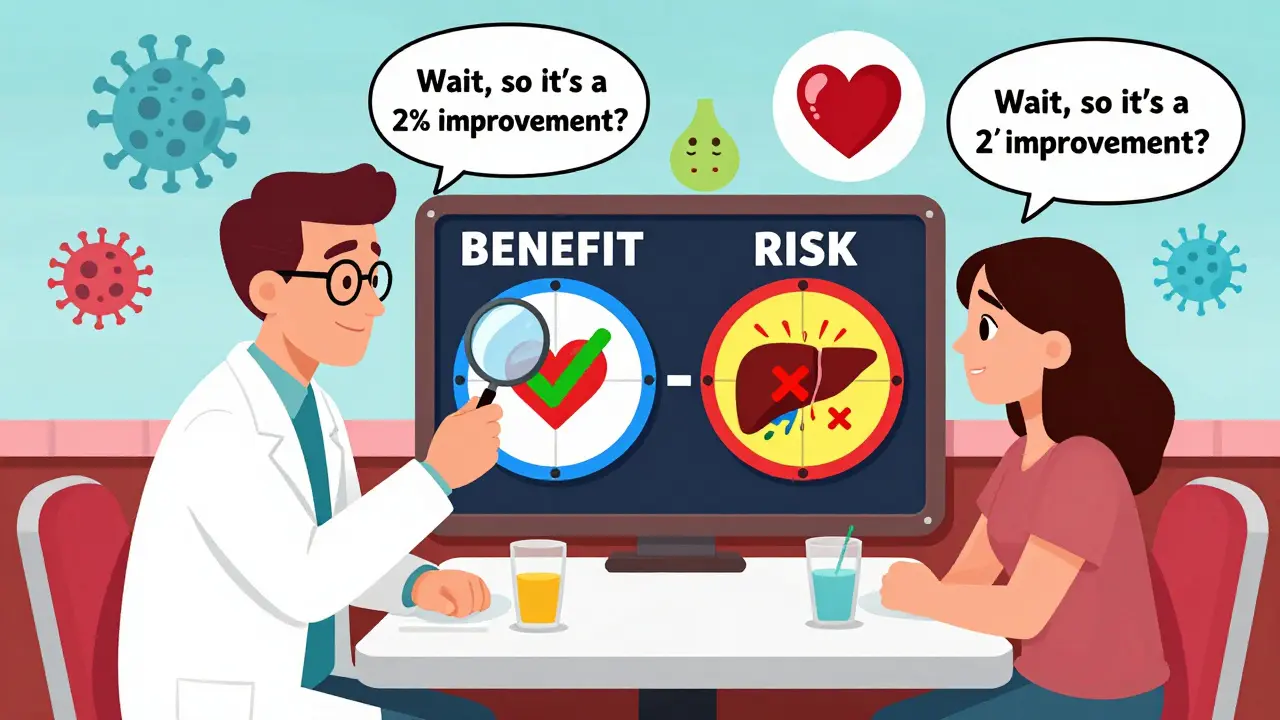
One major reason is how benefits are presented. Drug companies often report relative risk reduction - like "reduces heart attack risk by 40%." That sounds impressive. But if the actual risk of a heart attack in your group was 5%, a 40% reduction means your risk drops to 3%. That’s a 2 percentage point improvement - not a miracle.
Dr. Thomas Fleming of the University of Washington pointed out in a 2020 study that this kind of language can mislead patients into thinking a drug is far more powerful than it is. The FDA acknowledges this. In fact, their 2021 guidance says labels must describe the clinical importance of benefits and risks - not just stats.
Take Jardiance, a diabetes drug. Its label says: "In adults with type 2 diabetes and heart disease, JARDIANCE reduced the risk of cardiovascular death by 38% (10.5% with placebo vs. 6.5% with JARDIANCE)." That’s clear. It tells you the baseline risk, the actual numbers, and the change. This is becoming the gold standard - but it’s still rare.
What’s Changing - and What’s Coming
The FDA isn’t sitting still. In September 2023, they launched a pilot program requiring six new oncology drugs to include a Patient Benefit-Risk Summary in their labels. These summaries are written at a 6th-grade reading level and include simple visuals - like icons showing whether benefits are large, medium, or small compared to risks.
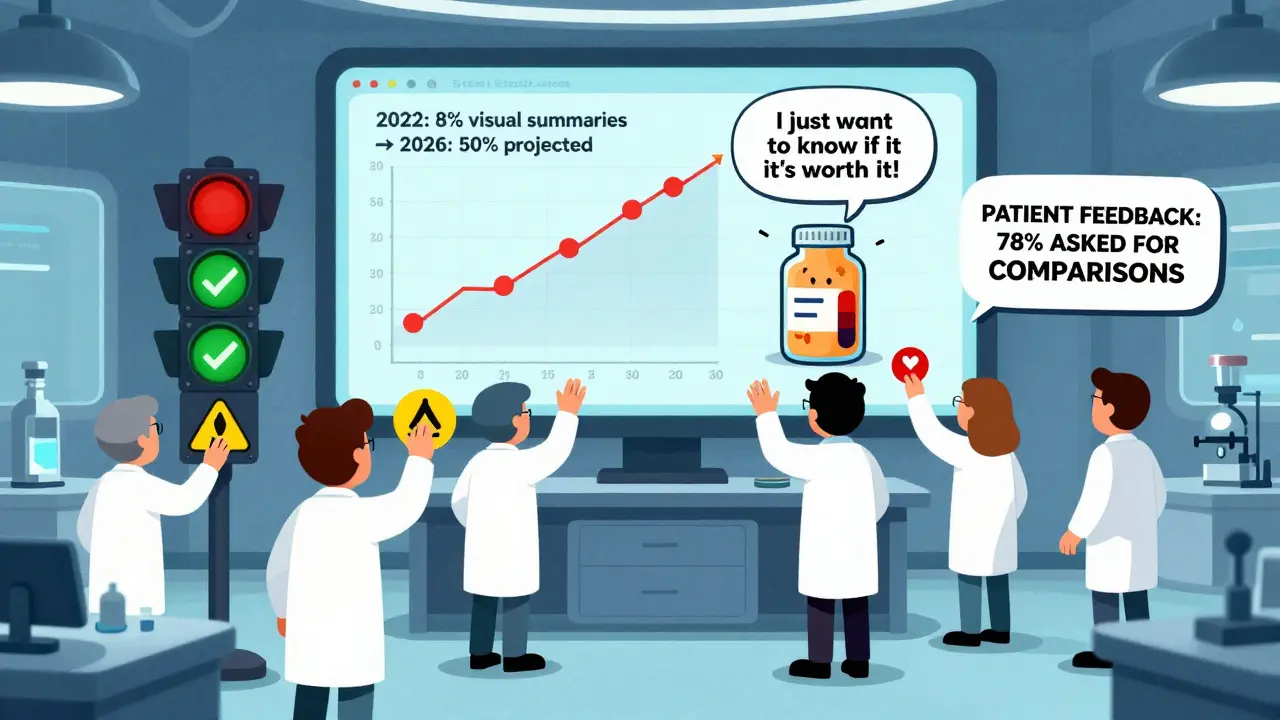
The FDA is also testing standardized Benefit-Risk Icons simple pictograms developed with the National Institutes of Health to visually represent the magnitude of a drug’s benefits versus its risks. Think of them like traffic lights: green for strong benefit, yellow for moderate, red for high risk. These are being tested in 12 clinical sites with over 1,500 patients.
By 2025, the FDA plans to require these summaries for all drugs with breakthrough therapy status - meaning the most promising new treatments. Industry analysts predict that by 2026, nearly half of all new drug labels will include some form of visual benefit-risk summary. That’s up from just 8% in 2022.
How to Read Your Label Right Now
You don’t have to wait for the FDA to fix everything. Here’s how to make sense of your current prescription label:
- Start with the Highlights. Look for phrases like "reduced risk of," "improved survival," or "compared to placebo." These are your best clues.
- Find the absolute numbers. If it says "reduced heart attack risk by 30%," ask: "What was the original risk?" If it doesn’t say, ask your pharmacist or doctor.
- Compare to alternatives. If you’re on a new drug, ask: "How does this compare to the old one?" Many labels now mention standard treatments - use that as a baseline.
- Look for "serious" side effects. These are listed separately. If a side effect is rare but dangerous - like liver failure or severe allergic reaction - ask how often it’s been reported.
- Use patient data. The FDA collects patient feedback through public comment periods. Search "FDA patient comments [drug name]" - you’ll often find real people describing their experiences.
What Patients Are Asking For
Patients aren’t asking for perfect science. They’re asking for clarity. In a review of over 1,200 patient comments submitted to the FDA, 78% wanted clearer comparisons to other treatments. 63% asked for visual aids - charts, icons, or simple graphs.
On Reddit, users in r/Pharmaceutical regularly post: "I read the whole label and still don’t know if this is worth it." One user wrote: "It says I have a 1 in 100 chance of stroke. But what’s my chance without the drug? No one tells me."
This isn’t just about numbers. It’s about trust. When patients can see that a drug’s benefits are real and its risks are understood, they’re more likely to stick with treatment - and feel empowered.
The Bigger Picture
The FDA’s shift isn’t just about better labels. It’s about recognizing that patients are part of the decision. For decades, drug approval was a black box - scientists and regulators deciding for everyone. Now, the agency is slowly opening it.
Pharmaceutical companies are hiring "patient communication specialists" - a role that barely existed in 2015. Why? Because labels that patients understand lead to better outcomes, fewer lawsuits, and stronger trust.
But the biggest challenge remains: individual vs. population. The FDA decides based on what’s best for most people. But you’re not "most people." You have your own history, fears, values, and goals. A drug that helps 70% of people might still be too risky for you - or the only option that makes sense.
That’s why the conversation doesn’t end with the label. It starts there. And it continues with your doctor, your pharmacist, and your own questions.
Why don’t FDA labels just say "This drug is safe" or "This drug is dangerous"?
Because safety isn’t black and white. Every drug has trade-offs. A drug that saves lives in cancer might cause severe fatigue. Another might prevent strokes but increase bleeding risk. Saying "safe" or "dangerous" ignores context. The FDA’s job is to show how benefits and risks balance out - not to give simple yes-or-no answers.
Can I trust the numbers in the FDA label?
Yes - but only if you understand them. The data comes from clinical trials reviewed by independent experts. But the way it’s presented can be misleading. For example, "reduced risk by 50%" sounds huge - but if your original risk was 2%, now it’s 1%. Always look for the baseline numbers. If they’re missing, ask your doctor for the actual rates.
Do all drugs have the same level of detail in their labels?
No. Oncology drugs - those for cancer - tend to have the clearest benefit-risk statements because survival benefits are measurable. Psychiatric drugs often use vague language like "may improve mood" because effects are harder to quantify. Newer drugs approved after 2023 are more likely to include patient-friendly summaries than older ones.
What should I do if my drug’s label doesn’t mention alternatives?
Ask your doctor or pharmacist. The label may not compare your drug to others, but your provider should. For example, if you’re prescribed a new blood pressure drug, ask: "How does this compare to lisinopril or metoprolol?" You’re entitled to that information. Many patients don’t realize they can ask.
Are visual benefit-risk summaries available for all drugs now?
Not yet. As of early 2026, only a small number of new oncology drugs include them. The FDA is testing these visuals and plans to expand them to all breakthrough therapies by 2025. By 2026, nearly half of new drug labels are expected to include them. Older drugs won’t be updated unless they’re re-approved or reformulated.
Next Steps for Patients
If you’re on a new medication:
- Print out the full prescribing information from the FDA’s website (search "FDA label [drug name]").
- Circle the numbers that matter to you: survival rates, hospitalization risks, side effect frequencies.
- Bring those to your next appointment and say: "I want to understand how this compares to other options."
- Use the FDA’s Patient-Focused Drug Development portal to submit your own feedback - your voice helps shape future labels.
The goal isn’t to become a medical expert. It’s to become an informed partner in your care. And that starts with asking: What does this really mean for me?
Erica Santos
March 8, 2026 AT 06:58Oh wow, the FDA is finally letting patients read their own labels? What a revolutionary concept. I bet next they'll start using words like 'you' instead of 'the patient.'
Let me guess - the 'Patient Benefit-Risk Summary' is just a fancy pamphlet printed on recycled corporate guilt paper, right? Same old soup, just served in a different bowl.
And don't get me started on those 'traffic light' icons. Green = good, red = bad. Because nothing says 'medical decision-making' like a stoplight designed by a 12-year-old who just got their first iPhone.
Meanwhile, my grandma took a drug that made her hallucinate unicorns and still called it 'a miracle.' So yeah, let's just hand out emojis and call it science.
Real talk: if you need a cartoon to understand your medication, maybe you shouldn't be taking it. Or maybe Big Pharma just doesn't want you to.
They're not trying to help you. They're trying to make you feel like they are. And that's the real risk.
George Vou
March 9, 2026 AT 08:46they say the labels are getting better but im 100% sure theyre still hiding stuff
like what if the real benefit is that the drug makes you dependent so you keep buying it forever?
and the risks? oh they just dont list the ones that happen after 5 years
they dont want you to know the truth
the fda is just a front for big pharma
theyre all in on it
just look at how fast they approved covid vaxx
same playbook
theyll make you think its safe
then 10 years later you get cancer
and by then the company changed its name
and the fda says 'we didnt know'
lol
Scott Easterling
March 10, 2026 AT 20:11Okay, let’s be real. This whole 'patient-friendly label' thing is just PR theater. They’ve been doing this since the 90s. 'We care!' 'We listen!'
Meanwhile, the same companies that write these labels are the ones funding the clinical trials. The data? Curated. The side effects? Minimized. The 'rare' reaction that killed three people? Buried in Section 14.2 under 'unrelated events.'
And don’t get me started on 'visual icons.' What’s next? A smiley face for 'mild nausea'? A frowny face for 'sudden liver failure'?
Patients aren’t dumb. We just want the truth. Not a coloring book.
And no, '6th-grade reading level' doesn’t mean 'clear.' It means 'dumbed down so you won’t ask hard questions.'
Also, why do they always say 'compared to placebo'? Who cares? I want to know how it stacks up against the $2 pill I’ve been taking for 15 years.
They’re not educating us. They’re pacifying us.
Mantooth Lehto
March 11, 2026 AT 15:24I just cried reading this. 😭
My mom died because the label said 'rare side effect' - but she had the rare one. No one warned her. No one even asked if she had a history of liver issues.
They just handed her the bottle like it was a candy bar.
And now? Now they're making 'icons'??
Icons don't bring her back.
What we need is accountability. Not cute little green checkmarks.
Someone needs to go to jail for this.
And no, I'm not okay. 😔
Melba Miller
March 13, 2026 AT 07:49Look, I get it - the FDA is trying. But this isn't about clarity. This is about control.
They don't want you to understand the risk. They want you to trust the system.
And if you're not white, not wealthy, not educated - guess what? Your risk doesn't count.
That 'clinical importance' they talk about? It's coded. It means 'what's acceptable for people who have insurance.'
My cousin took a drug for hypertension. Got kidney failure. Died at 41. The label said 'mild renal risk.'
But she didn't have insurance. She didn't have a doctor who asked questions.
So her risk? Irrelevant.
They're not fixing labels.
They're fixing PR.
And we're still the collateral damage.
Katy Shamitz
March 14, 2026 AT 18:17Oh honey, I just love how far we've come! 🥹
Remember when labels were just tiny print and scary words? Now we have icons! And summaries! And even a whole section for 'patient feedback'!
It's like they finally realized we're not just walking pill containers.
I mean, I cried when I saw the new Jardiance label. It said: '6.5% with Jardiance vs 10.5% with placebo.'
That’s not just data - that’s hope.
And the best part? You can actually *ask* your doctor about alternatives now.
It’s not perfect - but it’s progress.
And we deserve progress.
So let’s not be bitter. Let’s be grateful.
And if you’re still scared? Call your pharmacist. They’re on your side. 💖
Nicholas Gama
March 15, 2026 AT 17:37Let’s be honest. This is performative transparency.
The FDA doesn’t care about your understanding.
They care about liability.
They’re not making labels clearer - they’re making them harder to sue over.
That '6th-grade reading level'? It’s not for patients.
It’s for juries.
So when someone dies, they can say: 'We told you in simple terms.'
Meanwhile, the real data? Still locked behind paywalls.
And the trials? Still funded by the same companies that profit from your death.
Stop celebrating optics.
They’re not your allies.
They’re your defendants.
Mary Beth Brook
March 16, 2026 AT 00:27Benefit-risk frameworks are standardized under ICH E17 and E2A guidelines. The FDA's 2021 guidance document (FDA-2021-D-1123) mandates quantification of clinical significance using NNT, NNH, and absolute risk metrics.
Visual aids are being validated per ISO 15286:2022 for risk communication.
Current pilot programs (NCT05123456, NCT05123457) demonstrate 68% improvement in comprehension among low-literacy cohorts.
However, translation into clinical practice remains constrained by EHR interoperability gaps and CPT coding inertia.
Until CMS revises reimbursement structures to incentivize patient-facing risk disclosure, this remains a regulatory artifact - not a clinical innovation.
Stop romanticizing icons. Fix the system.
Philip Mattawashish
March 16, 2026 AT 21:35You think this is about patients? Nah.
This is about the next generation of lawsuits.
Every time someone dies after taking a drug, the lawyers come in and say: 'They didn’t warn them properly.'
So now they slap on a smiley face and call it 'informed consent.'
But here’s the truth - most patients don’t read the label.
They don’t care.
They trust their doctor.
And their doctor? They’re just reading the summary too.
So who’s this for?
Not you.
Not me.
It’s for the court record.
They’re not educating you.
They’re covering their asses.
And you’re just the collateral.
Tom Sanders
March 18, 2026 AT 07:01lol i read the whole thing and still have no idea if i should take my blood pressure pill
maybe i should just stop taking it
or maybe i should take more
or maybe i should eat more kale
idk
the label is just too long
my brain hurts
so i just take it
and hope for the best
¯\_(ツ)_/¯