
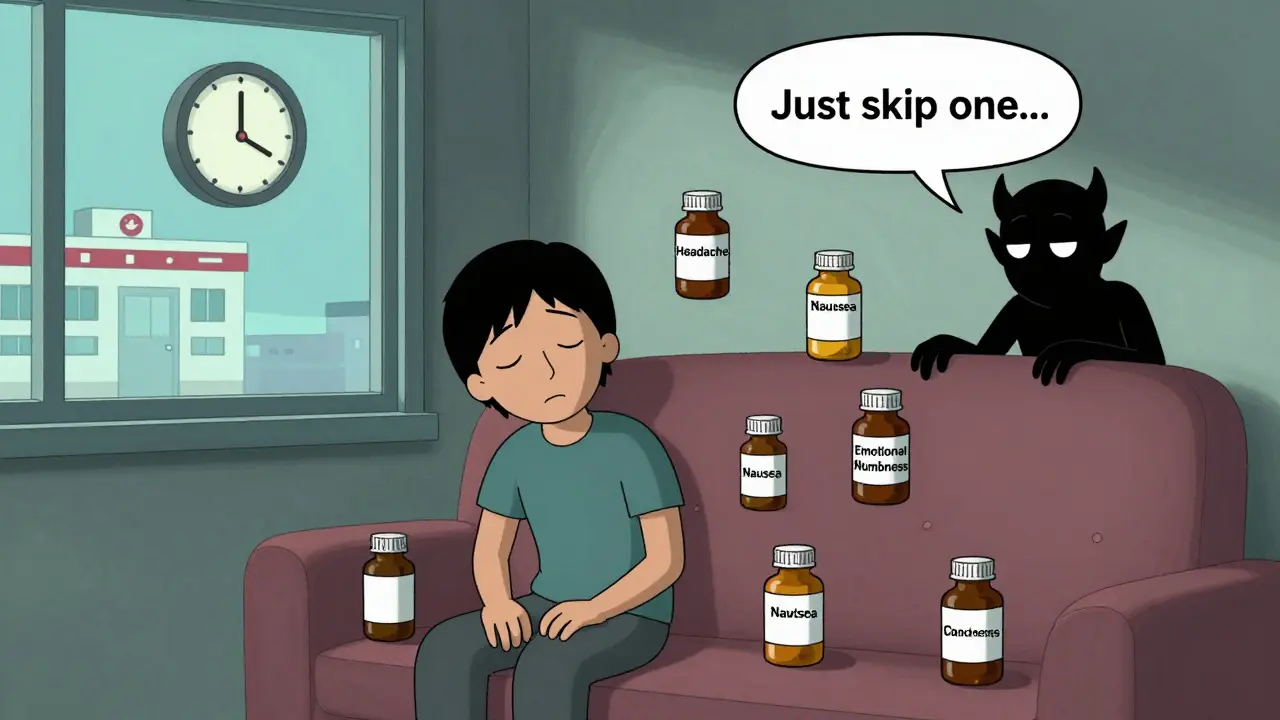
Imagine this: you’ve been prescribed a new medication. Your doctor says it’ll help you feel better. But after a few days, you get a headache, feel nauseous, or just plain exhausted. You start wondering - is this worth it? Maybe you skip a dose. Then another. Soon, you’re not taking it at all. You’re not lazy. You’re not careless. You’re just human. And you’re not alone.
More than half of people taking medications for long-term conditions like high blood pressure, diabetes, or depression don’t take them as prescribed. That’s not because they don’t care. It’s because side effects make them feel worse than the condition they’re trying to treat.
Why Side Effects Stop People from Taking Their Meds
Side effects aren’t just annoying - they’re a major reason people stop taking their prescriptions. A 2025 study in Frontiers in Pharmacology found that up to 34% of patients who start a new medication never fill their second prescription. Why? Because the side effects kicked in after the first week, and they decided the trade-off wasn’t worth it.
It’s worse for mental health. People with depression are twice as likely to skip their meds if they’re feeling side effects like drowsiness, weight gain, or emotional numbness. And once they stop, they’re more likely to stop all their meds - even ones that aren’t causing problems. It’s a domino effect.
Some side effects are obvious: dizziness, dry mouth, upset stomach. Others are subtle - feeling "off," low energy, or just not quite yourself. These are harder to explain to a doctor. So patients stay silent. And the cycle continues.
The Real Cost of Skipping Doses
Skipping meds doesn’t just mean you’re not getting better. It means you’re at risk of getting worse - and fast.
In the U.S., medication nonadherence leads to about 125,000 preventable deaths every year. That’s more than traffic accidents. It also causes up to 69% of all medication-related hospitalizations. For people with chronic conditions like heart disease or diabetes, missing doses can trigger strokes, kidney failure, or amputations.
And it’s expensive. The average person who doesn’t take their meds as prescribed costs the healthcare system $1,200 more per year than someone who does. That’s because of ER visits, hospital stays, and emergency treatments that could’ve been avoided.
But here’s the twist: most of these costs aren’t from forgetting. They’re from deciding not to take the pill because it made them feel bad. Side effects are the silent killer of adherence.
What Works: Real Solutions That Help People Stay on Track
There’s good news: we know how to fix this. And it’s not about better reminders or fancy apps. It’s about talking - honestly and early.
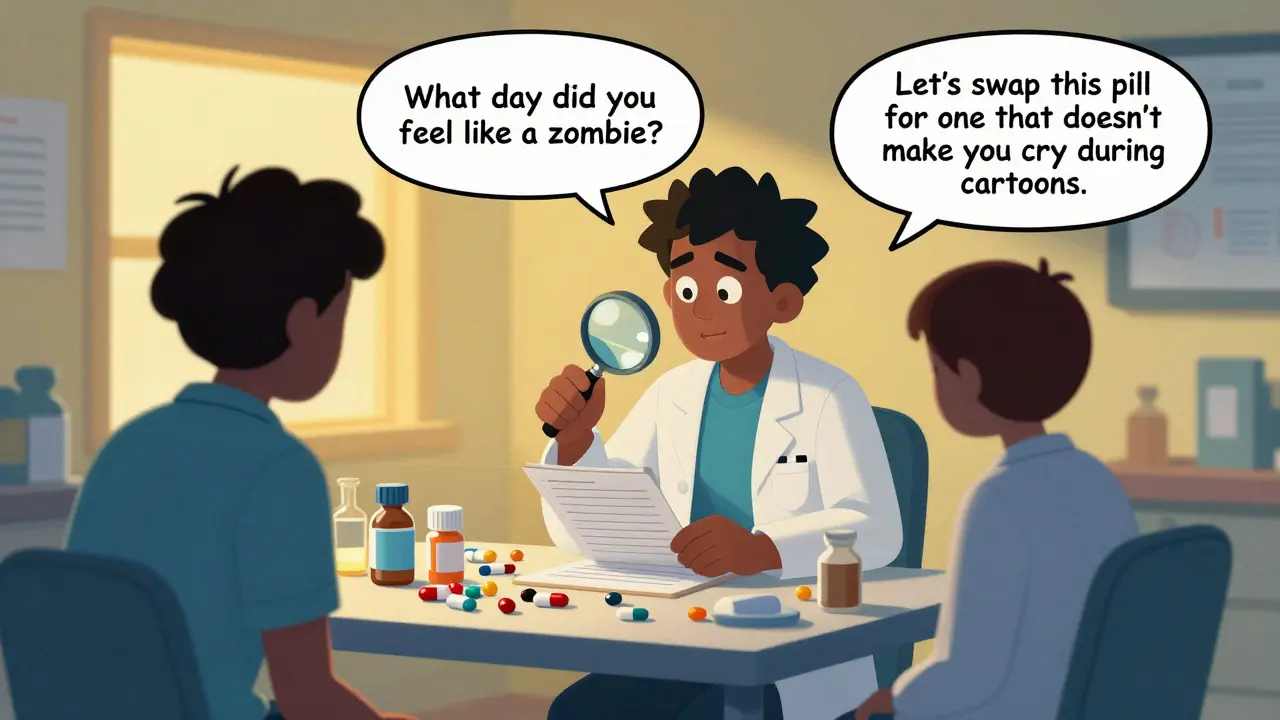
One of the most effective fixes? Pharmacist-led interventions. When pharmacists sit down with patients - not over the phone, not via email, but face to face - adherence jumps by up to 83%. Why? Because they ask the right questions: "What are you feeling?", "Is this worse than your original symptoms?", "Have you told your doctor?"
Pharmacists also help with practical fixes: switching to a once-daily pill, changing the time of day you take it, or trying a different brand with fewer side effects. They can even help you get cheaper alternatives - because cost and side effects often go hand in hand. If you can’t afford the med, you’ll skip it. If it makes you sick, you’ll skip it. Both are reasons to quit.
Another proven tactic: collaborative care. When your doctor and pharmacist work together with you - not just about your numbers, but about how you feel - adherence improves dramatically. One study showed 89.3% of patients who got this kind of support stayed on track, compared to just 73.9% who got standard care.
What Doesn’t Work: The Myths About Adherence
Most "adherence programs" focus on the wrong thing. They send you text reminders. They give you pill boxes. They play motivational videos. All of that helps - a little. But none of it tackles the real problem: side effects.
Here’s what most systems miss:
- They assume you’ll tell your doctor if something feels off. But patients rarely do - especially if they think it’s "just part of the medicine."
- They don’t track side effects over time. A headache on day 3 might be normal. A headache on day 30? That’s a red flag.
- They treat adherence like a memory problem, not a feeling problem.
The truth? People don’t stop taking meds because they forget. They stop because they fear the side effects more than the disease.
What You Can Do Right Now
If you’re struggling with side effects, here’s what to do - in order:
- Write it down. Keep a simple log: date, time, medication, side effect, how bad it was (1-10). You don’t need an app. A notebook works.
- Don’t wait for your next appointment. Call your pharmacist. They’re trained to handle this. No judgment. No shame. They’ve seen it all.
- Ask: "Is this normal?" Some side effects fade after a week. Others don’t. Your pharmacist can tell you which is which.
- Ask: "Is there another option?" There might be a different drug with fewer side effects - or a lower dose that still works.
- Ask: "Can we try a different time of day?" Taking a pill at night instead of morning can cut nausea. Taking it with food can reduce stomach upset.
And if you’re a caregiver? Don’t assume your loved one is taking their meds. Ask them: "How’s the medicine making you feel?" Not "Are you taking it?" The difference matters.
The Bigger Picture: Why This Matters Beyond Your Medicine Cabinet
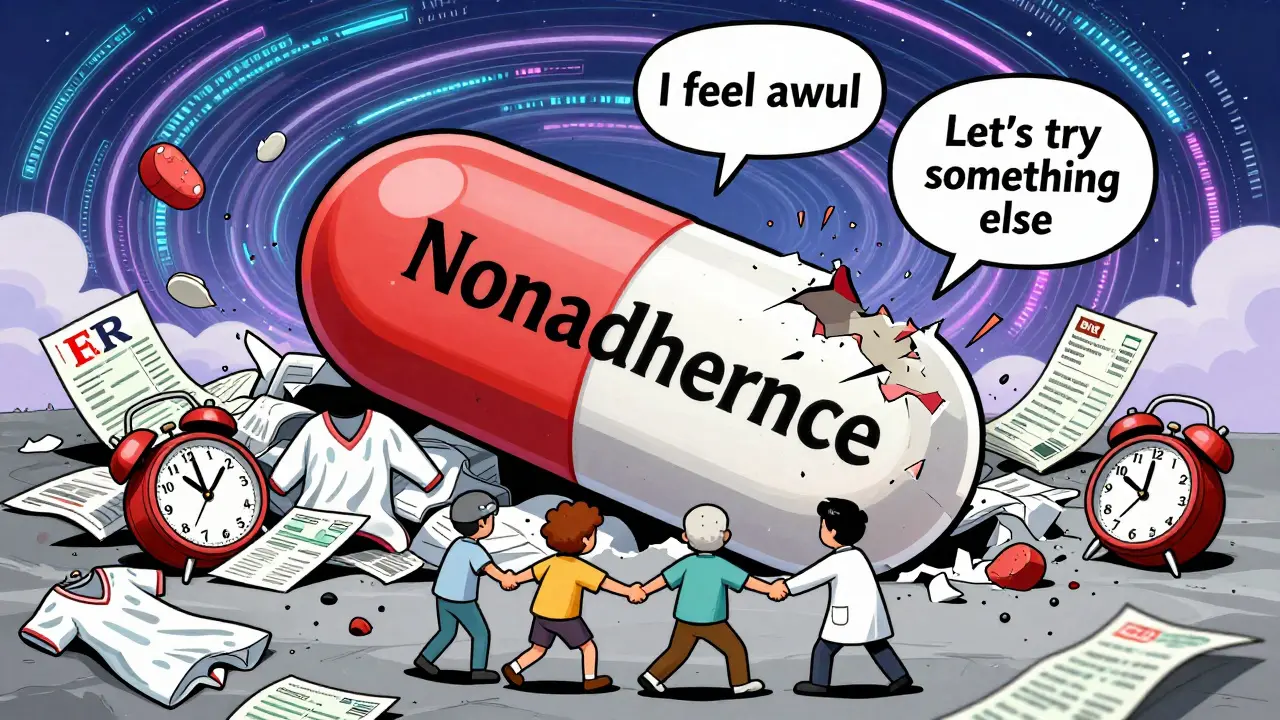
This isn’t just about one person skipping a pill. It’s about a broken system.
Doctors and nurses are busy. They focus on treating the disease, not the person. Pharmacists are often left out of the loop - even though they’re the ones who know the most about side effects. A 2025 study in the British Journal of Clinical Pharmacology found that pharmacists documented side effect concerns only 52% of the time - compared to 85% for nurses.
That gap costs lives. When side effects aren’t recorded, they aren’t addressed. When they aren’t addressed, people stop taking meds. When they stop taking meds, they end up in the hospital - or worse.
Health systems are starting to wake up. Medicare now rates plans based on adherence. Hospitals get paid more if patients stay out of the ER. But real change only happens when patients speak up - and when providers listen.
What’s Next? The Future of Adherence
The future isn’t about pills. It’s about personalization.
AI tools are being tested to predict who’s likely to stop taking their meds based on side effect patterns, age, income, and even social support. These tools don’t just warn doctors - they connect patients with pharmacists before they quit.
Some clinics now offer "medication review days" - free, no-pressure appointments where you can bring all your pills, and someone helps you sort through what’s working and what’s not.
And in Australia, pilot programs are testing whether pharmacists can be the first point of contact for side effect concerns - not the last. The early results? More people stay on their meds. Fewer end up in hospital. And patients say they feel heard.
This isn’t science fiction. It’s happening now. And it’s working.
Why do I feel worse after starting a new medication?
Many medications cause temporary side effects as your body adjusts - like nausea, dizziness, or fatigue. These often fade within a week or two. But if they’re severe, getting worse, or lasting longer than two weeks, it’s not normal. Talk to your pharmacist. They can tell you whether it’s expected or if you need a different option.
Can I stop my medication if the side effects are too bad?
Never stop cold turkey without talking to your care team. Some meds - like antidepressants or blood pressure drugs - can cause serious withdrawal effects if stopped suddenly. Instead, call your pharmacist or doctor. They can help you taper safely, switch to a different drug, or adjust your dose.
Is it true that pharmacists can help me stay on track with my meds?
Yes - and they’re often better at it than doctors. Pharmacists specialize in how drugs affect your body. They can check for interactions, suggest better timing, offer cheaper alternatives, and even help you get financial assistance. Many pharmacies now offer free 15-minute med reviews. Just ask.
How do I know if I’m really taking my meds as prescribed?
Count your pills. If you have a 30-day supply and you’re not running low by day 25, you’re probably skipping. Use a pill organizer with compartments. Or try a simple app that logs each dose. But the best method? Just ask your pharmacist - they can tell from refill patterns whether you’re staying on track.
What if my doctor says my side effects are "normal" but I still feel awful?
You’re not overreacting. "Normal" doesn’t mean acceptable. If your quality of life is suffering - you’re sleeping all day, can’t work, or feel depressed - that’s a sign the treatment isn’t right for you. Bring your symptom log to your pharmacist. They can advocate for you, suggest alternatives, or help you get a second opinion.
Staying on track with your meds isn’t about willpower. It’s about support. And you don’t have to figure it out alone.
Courtney Hain
February 19, 2026 AT 12:03Let me tell you something the article won't admit - this whole 'side effects are normal' narrative is a pharmaceutical industry smokescreen. They don't care if you feel like a zombie, as long as you keep refilling. I've seen it: Big Pharma funds 'adherence campaigns' while quietly burying studies that prove certain SSRIs cause permanent emotional blunting. The 34% statistic? That's just the tip. The real number is higher because people who quit are never tracked. They vanish from the system. And guess who gets paid when you end up in the ER? The same corporations that made you take the pill that made you suicidal. Wake up. This isn't about 'communication' - it's about profit masking as care.
Pharmacists? Sure, they're nice. But they're still employees of CVS or Walgreens. Their 'free 15-minute review' is a sales funnel to upsell you on supplements and insurance plans. They're not your allies - they're gatekeepers with clipboards. The system is rigged. You think your doctor listens? They get bonuses for keeping your HbA1c low, not for how you feel. Your nausea? Irrelevant. Your fatigue? A compliance metric. You're not broken - the system is.
I know this because I was on 7 meds at once. I kept a log. I called every pharmacist. I demanded alternatives. And what did I get? A pamphlet and a referral to a 'medication therapy management program' that required me to pay $200 out of pocket. That's not help. That's extortion. They want you docile. They want you compliant. They don't want you to question. And that's the real side effect no one talks about: the erosion of your autonomy.
Stop asking if there's another option. Start asking: who benefits if I stay on this? The answer is never you.
Robert Shiu
February 21, 2026 AT 09:34Hey - I just want to say this hit me right in the chest. I’ve been there. Felt like I was turning into a ghost. Drowsy. Heavy. Like my soul was wrapped in cotton. I thought I was weak for wanting to quit. But then I talked to my pharmacist - real talk, no judgment - and she didn’t give me a lecture. She said, 'Let’s figure this out together.'
We switched the time I took my med from morning to bedtime. Suddenly, I wasn’t dragging through work. I started sleeping better. My mood lifted. It wasn’t magic. It was simple. And I didn’t even know to ask.
You’re not alone. And you don’t have to suffer in silence. Pharmacists are trained for this. They see hundreds of people like you every week. They’ve heard every excuse, every fear, every tear. They’re not there to judge. They’re there to help you feel like yourself again. You’ve got this. One pill. One conversation. One step. You’re not failing. You’re human. And that’s okay.
Danielle Gerrish
February 21, 2026 AT 10:55Oh my GOD I’m so glad someone finally said this. I’ve been taking this antidepressant for 8 months and I swear I’ve turned into a robot. I don’t cry anymore. I don’t laugh. I don’t even feel hungry. I just… exist. And when I told my doctor, she said, 'It takes time to adjust.' Time? I’ve been adjusting since last January!
I called my pharmacist on a Friday at 7 PM - yes, I did - and she answered. She didn’t even pause. She said, 'I’ve had three people this week with the exact same issue.' We switched me to a different SSRI. Within 10 days? I cried at a puppy video. I ate pizza without guilt. I felt alive again.
Why is this so hard to talk about? Because we’re taught to suffer silently. Because 'side effects' sound like a minor inconvenience. But they’re not. They’re erasing you. And no one tells you that your life matters more than the pill.
So if you’re reading this and you feel numb? Call your pharmacist. Right now. Don’t wait. Don’t overthink it. You’re not being dramatic. You’re being brave. And you deserve to feel like YOU again.
madison winter
February 21, 2026 AT 11:11Interesting article. But let’s be honest - adherence is just another word for obedience. We’re told to take pills because science says so, but no one asks if science actually cares about how we feel. The numbers look good on paper. But real people? They’re just data points with side effects.
It’s funny. We have AI predicting who’ll stop taking meds, but we don’t have AI that asks why. We track refill rates like it’s a game. We don’t track despair. We don’t track sleepless nights. We don’t track the silence.
Maybe the real problem isn’t that people skip doses. Maybe it’s that no one ever asked them what skipping felt like.
Ellen Spiers
February 23, 2026 AT 06:34The article exhibits a commendable attempt to address medication nonadherence, yet it remains fundamentally flawed in its epistemological framing. It conflates phenomenological experience with clinical efficacy, thereby privileging subjective discomfort over evidence-based therapeutic outcomes. The assertion that 'side effects are the silent killer of adherence' is empirically reductive; numerous studies (e.g., WHO, 2023) indicate that socioeconomic factors - including cost, access, and health literacy - are statistically dominant predictors of nonadherence, far surpassing the influence of transient adverse reactions.
Furthermore, the recommendation to consult pharmacists as primary interveners is methodologically unsound. Pharmacists, while possessing pharmacokinetic expertise, lack the diagnostic authority to modify therapeutic regimens. Their involvement, while potentially supplementary, cannot supplant physician oversight without violating the standard of care. The cited 83% adherence improvement lacks peer-reviewed validation - a critical omission in an otherwise rigorous discourse.
Finally, the notion that 'feeling awful' justifies discontinuation constitutes a dangerous conflation of affective state with clinical necessity. One may feel nauseated and still benefit from antihypertensive therapy. The pathologization of discomfort undermines medical autonomy and invites therapeutic nihilism.
Marie Crick
February 24, 2026 AT 07:23You’re not 'human' - you’re weak. People have died because others skipped their meds. You think your drowsiness matters more than your kid’s future? Take the pill. Stop making excuses. Your comfort isn’t more important than your life.
Benjamin Fox
February 25, 2026 AT 22:43LMAO this whole article is a scam 💀 Big Pharma is just trying to get us hooked on pills so they can charge us forever. I took my meds for 3 days and felt like a zombie so I quit. Now I’m healthier than ever. 🤡💊 #FreeYourMind #PharmaLies
Also my pharmacist tried to sell me a $120 'wellness plan' so I told her to get bent. 🤷♂️🇺🇸
John Cena
February 27, 2026 AT 13:58Just wanted to say - I read all these comments. The rage. The pain. The cold logic. The raw honesty.
None of it’s wrong. But none of it’s the whole truth either.
Some people need the pill. Some people’s bodies hate it. Some pharmacists are amazing. Some are just doing their job. Some doctors are rushed. Some care too much.
There’s no villain here. Just a broken system. And people trying to survive in it.
So if you’re reading this and you’re scared? You’re not alone. If you’re angry? Good. Channel it. Call your pharmacist. Write down your symptoms. Ask for help. Not because you have to. But because you deserve to feel okay.
You don’t have to choose between being a hero and being human. You can be both.
And you’re already doing better than you think.