
If you've ever wondered why your prescription costs $50 one month and $15 the next, you're not alone. The answer often lies in whether your medication is single-source or multi-source drugs-a distinction that can save you hundreds each year.
What Are Single-source Drugs?
Single-source drugs are medications made by only one company with no generic alternatives available. These drugs are marked with an 'N' code in the Medi-Span MONY classification system. They're often newer treatments still under patent protection. For example, before 2023, Humira was a single-source drug for 14 years-no generics existed. During that time, its list price climbed steadily, with rebates and list prices moving dollar-for-dollar. This means when the manufacturer raised prices, the net cost to insurers and patients also went up. Single-source drugs make up just 10% of prescriptions filled in the US but account for a large chunk of drug spending because they're expensive.
What Are Multi-source Drugs?
Multi-source drugs are available as both the original brand and generic versions from multiple manufacturers. They're marked with 'O' (brand with generics) or 'Y' (generic) in the MONY system. The FDA requires these generics to meet strict bioequivalence standards-meaning they must work the same as the brand in your body. For instance, generic lisinopril for high blood pressure has dozens of manufacturers. Because of competition, these drugs are usually 80-85% cheaper than brand names. In fact, 86% of all medications sold in the US are multi-source drugs, but they only account for 23% of total drug spending. That's a huge savings for patients and the healthcare system.
Why Pricing Is So Different
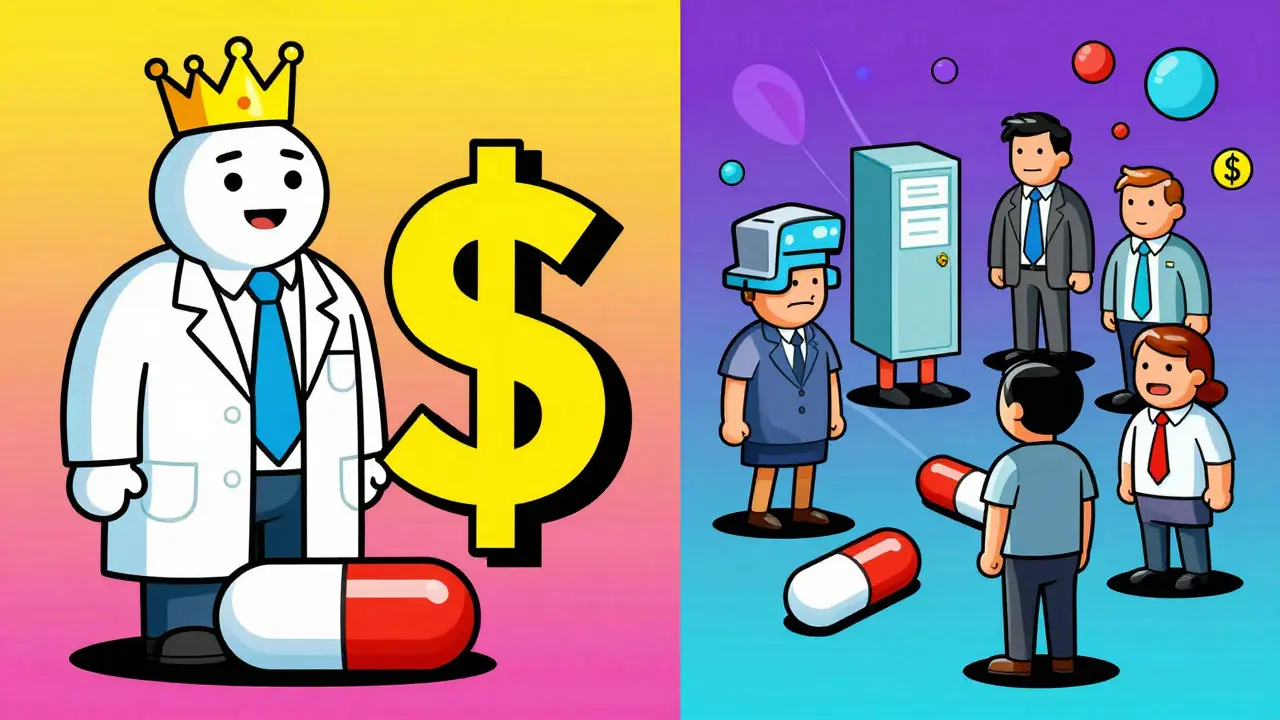
Here's where it gets practical. Single-source drugs have higher list prices with less competition. The USC Schaeffer Center found that for these drugs, a $1 increase in rebates leads to a $1 increase in list price. But for multi-source drugs? A $1 rebate increase only leads to a less-than-$1 list price rise. Why? Because multiple companies are fighting for market share. This competition drives net prices down over time. In 2023, single-source drugs saw a $958 average price increase, while multi-source drugs only went up by $69. Yet multi-source drugs had a higher percentage increase (26% vs 7.4%)-but their starting prices were much lower. So even with a 26% jump, a $100 drug becomes $126, while a single-source drug jumping $958 from $1,000 becomes $1,958. That's why patients often see bigger dollar savings with multi-source drugs.
How the FDA Ensures Safety
The FDA's Orange Book is a critical tool. It lists therapeutic equivalence codes for multi-source drugs. An 'A' code means the generic is fully equivalent to the brand. But if you see 'BX' or 'C', that's a warning. For example, some drugs have 'BX' codes because their effectiveness varies between manufacturers. The FDA says these are still safe, but your pharmacist should explain why. However, the FDA's position is clear: all approved generics must meet the same standards as brand names. A 2022 Kaiser Family Foundation survey found 41% of patients on single-source drugs skipped doses due to cost, compared to 22% for multi-source drugs. Why? The average monthly cost for single-source drugs is $587, while multi-source drugs average just $132. That difference matters.
Common Patient Concerns
Many patients worry when their generic switches brands. A Reddit user shared, "I felt different after the switch." But FDA data shows these changes shouldn't affect effectiveness. Still, some people do report side effects with different generics. Why? Because inactive ingredients can vary. If you notice changes, talk to your pharmacist. They can check if your specific generic is approved and if there's a reason for the switch. Also, insurers often push multi-source drugs first. For example, step therapy requires trying a cheaper generic before covering a brand-name drug. This saves money but can be frustrating if it doesn't work for you. Know your rights-ask your doctor to specify 'no substitutions' on the prescription if needed.
What You Can Do Today
Here's how to take control. First, ask your pharmacist: 'Is this single-source or multi-source?' They can check the MONY code. Second, check your insurer's formulary online. Many have searchable lists showing which drugs are covered and at what tier. Third, use the FDA's 'Understanding Generic Drugs' page-it explains everything in plain language. Finally, if costs are high, ask about manufacturer coupons or patient assistance programs. For single-source drugs, these programs can cut costs by 50% or more. Remember, you're not alone. 63% of multi-source drug users experience unexpected generic switches due to PBM contracts. But with the right info, you can navigate these changes smoothly.
Are generic drugs really the same as brand-name drugs?
Yes. The FDA requires generics to have the same active ingredients, strength, dosage form, and route of administration as the brand. They must also meet strict bioequivalence standards-meaning they work the same in your body. While inactive ingredients might differ slightly, this doesn't affect safety or effectiveness for most people. The FDA monitors all generics for quality.
Why does my insurance only cover the generic version?
Insurers prefer multi-source drugs because they're cheaper. For example, a generic version of a drug might cost $132 a month versus $587 for the brand. This saves your insurer money, which helps keep premiums lower for everyone. If you need the brand for medical reasons, ask your doctor to write 'no substitutions' on your prescription. Your pharmacist can then get the brand if it's covered under your plan.
Can switching between generic manufacturers affect my treatment?
FDA rules require all generics to be bioequivalent, so switching shouldn't change how the drug works. However, some people report differences due to inactive ingredients or personal sensitivity. If you notice side effects after a switch, talk to your pharmacist. They can check if your pharmacy has changed the generic manufacturer and help you find a consistent option. In rare cases, your doctor might need to specify 'no substitutions' on your prescription.
How do I know if my drug is single-source or multi-source?
Ask your pharmacist directly. They can check the Medi-Span MONY code for your medication. You can also look up your drug in the FDA's Orange Book online. If it's listed with an 'A' code, it's multi-source. If it's not listed or has no therapeutic equivalence code, it's likely single-source. For example, Lantus insulin was single-source until generics entered the market in 2023.
What is Maximum Allowable Cost (MAC) pricing?
MAC is the highest price your insurer will pay for a generic drug. It's usually 50-60% below the brand's average wholesale price. For example, if a brand drug's wholesale price is $100, the MAC for its generic might be $40-$50. PBMs set MAC limits to control costs. If a pharmacy charges more than MAC, you might pay the difference out-of-pocket. Always ask your pharmacy if they're charging MAC pricing for your generic.
Do single-source drugs ever become multi-source?
Yes, when patents expire. For example, Humira was single-source for 14 years until 2023, when the first generics entered the market. The FDA's Generic Drug User Fee Amendments (GDUFA III) aim to speed up generic approvals, with new targets of 10 months for approval by 2025. This means more drugs will transition from single-source to multi-source status, saving patients billions.
Rene Krikhaar
February 5, 2026 AT 00:01Single-source drugs like Humira cost thousands before generics
Now generics are available and prices dropped
Check your meds MONY code with your pharmacist
It's a game-changer for saving money
Dr. Sara Harowitz
February 6, 2026 AT 17:14Oh please! Single-source drugs are essential for innovation! Without patents, companies wouldn't invest in new treatments! The government should stop pushing generics! America's leadership in medicine is at risk!
Georgeana Chantie
February 7, 2026 AT 15:20Single-source drugs are a scam! Generics work just as well! 😠
Big Pharma is just trying to keep prices high!
Carol Woulfe
February 9, 2026 AT 00:30I must question the FDA's approval process. It's clear that Big Pharma influences the system. Many generics have different inactive ingredients that can cause adverse effects. This is a serious concern for patient safety.
Kieran Griffiths
February 10, 2026 AT 02:32Don't worry! Always talk to your pharmacist.
They can help you find the right option.
It's okay to ask for specifics about your meds.
Knowledge is power!
Brendan Ferguson
February 10, 2026 AT 13:47Both single and multi-source drugs have their place.
The key is working with your doctor to find the best option for your situation.
Always check for therapeutic equivalence codes in the Orange Book.
Johanna Pan
February 10, 2026 AT 18:51I love how generics make healthcare accesible!
Even in my country, we use them all the time.
It's great that the FDA ensures safety.
Keep up the good work!
Elliot Alejo
February 12, 2026 AT 09:23Multi-source drugs save patients money without sacrificing quality.
The FDA's strict standards ensure they're safe.
Always ask your pharmacist about your options.
Pamela Power
February 13, 2026 AT 08:40Oh please! Multi-source drugs are just as good? Please!
The FDA's 'standards' are a joke.
Big Pharma controls everything.
This is all a scam to keep us sick!
Albert Lua
February 13, 2026 AT 11:59In my country, we have strict regulations for generics.
They work just fine!
It's all about education.
People need to know the facts!
Katharine Meiler
February 15, 2026 AT 04:39The therapeutic equivalence codes are critical.
BX-rated drugs require careful monitoring.
Always verify with your pharmacist for specific cases.
Joyce cuypers
February 15, 2026 AT 06:20I've had good experince with generics.
Always check with your doc.
It's okay to ask questions! 😊
Gregory Rodriguez
February 15, 2026 AT 15:38Oh sure, generics are great! 😂
Except when they're not.
But hey, at least they're cheaper!
Just don't blame me if you have side effects.
Bella Cullen
February 16, 2026 AT 21:22This is all overcomplicated.