
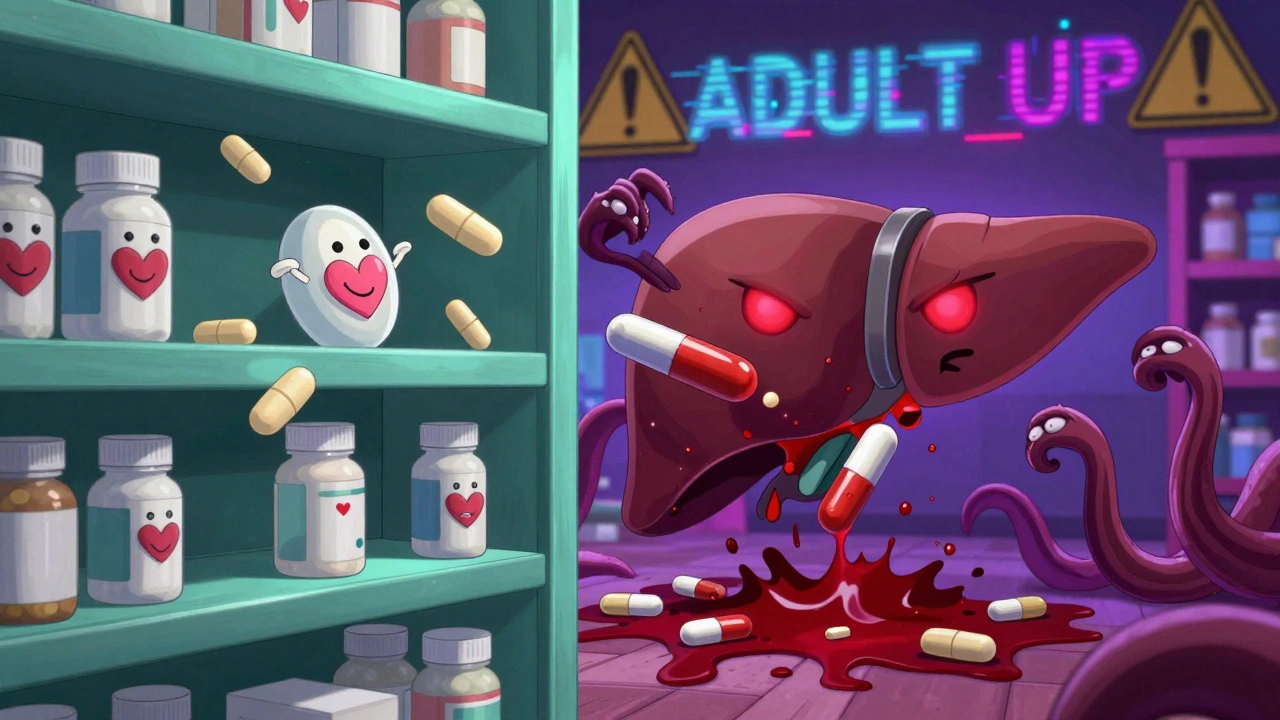
Many people take statins to lower their cholesterol and protect their heart. Others take antifungals to treat stubborn yeast infections, athlete’s foot, or nail fungus. What most don’t realize is that when these two types of drugs are taken together, they can cause serious, even life-threatening side effects. This isn’t a rare glitch - it’s a well-documented, dangerous interaction that happens more often than you think.
Why This Interaction Happens
Statins like simvastatin, atorvastatin, and lovastatin are broken down in your liver by an enzyme called CYP3A4. Azole antifungals - including itraconazole, ketoconazole, and voriconazole - block that same enzyme. When you take them together, your body can’t clear the statin properly. The result? Toxic levels build up in your muscles.This isn’t just theoretical. In one case reported in the BMJ Case Reports, a patient taking simvastatin and itraconazole saw their simvastatin blood levels spike by more than five times. That led to rhabdomyolysis - a condition where muscle tissue breaks down, releasing dangerous proteins into the bloodstream that can crash your kidneys.
It’s not just the strong inhibitors. Even fluconazole, often thought of as "mild," can interfere with fluvastatin by blocking CYP2C9. And while pravastatin and rosuvastatin are safer because they don’t rely heavily on liver enzymes, they’re not risk-free either. New research shows even these statins can interact with certain antifungals in ways we’re still learning about.
Which Combinations Are Most Dangerous?
Not all statins and antifungals are created equal. Some pairs are far riskier than others.- High risk: Simvastatin + itraconazole (up to 10x higher statin levels), Lovastatin + ketoconazole
- Medium risk: Atorvastatin + voriconazole, Fluvastatin + fluconazole
- Low risk: Pravastatin or rosuvastatin with any azole
The FDA explicitly warns against using simvastatin with itraconazole. In 2022, they updated the label to say it’s contraindicated - meaning you should never take them together. The European Medicines Agency followed suit in 2023.
Here’s what patients are reporting: On patient forums, people describe sudden, severe muscle pain after starting fluconazole for a yeast infection while already on simvastatin. One user, "CholesterolWarrior42," ended up in the ER with creatine kinase (CK) levels over 15,000 U/L - normal is under 200. That’s a clear sign of muscle breakdown.
What to Do If You Need Both Medications
If you’re prescribed an antifungal and you’re already on a statin, don’t panic. But do act. Here’s what works:- Ask if you can use a topical treatment. For athlete’s foot or vaginal yeast infections, creams, sprays, or suppositories often work just as well as pills - and they don’t enter your bloodstream the same way.
- Switch antifungals if possible. Terbinafine (Lamisil) doesn’t interfere with CYP3A4. It’s a great alternative for nail fungus and skin infections.
- Switch statins. If you’re on simvastatin or lovastatin, ask your doctor about switching to pravastatin or rosuvastatin. These are metabolized differently and are much safer with antifungals.
- Temporarily stop your statin. If switching isn’t possible, your doctor might recommend pausing your statin for a few days before and after the antifungal course. Studies show this reduces risk without causing cholesterol spikes.
One 2022 survey found that 87% of patients who followed this temporary pause protocol managed their cholesterol just fine. No major spikes. No rebound issues. Just safety.

The Hidden Benefit - And Why It Matters
Here’s something most doctors don’t tell you: Statins might actually help fight fungal infections.Lab studies show that certain statins - especially fluvastatin and atorvastatin - work together with azoles to kill Candida species more effectively. At low doses, they disrupt the fungus’s cell membrane in ways the antifungal alone can’t. In one study, combining fluconazole with atorvastatin reduced Candida auris growth by up to 70% compared to either drug alone.
This isn’t just lab magic. A 2023 study found that patients on statins had a 32% lower risk of complications from candidemia - a serious bloodstream yeast infection. The NIH is now funding a major trial (NCT05678912) to see if we can safely use statin-azole combos as a new treatment for drug-resistant fungal infections.
So while the interaction is dangerous, it’s also potentially powerful. The challenge is using it safely - not accidentally.
What You Should Ask Your Doctor
Don’t assume your doctor knows every interaction. A 2023 JAMA Internal Medicine study found only 42% of primary care doctors correctly identified high-risk statin-azole pairs in a simple test.Next time you’re prescribed an antifungal, ask:
- "Is this antifungal going to interact with my statin?"
- "Which statin do I have, and is it one of the ones that can cause muscle damage with antifungals?"
- "Can we use a topical version instead?"
- "Should I pause my statin while I’m on this?"
If your doctor says "It’s fine," ask them to check the FDA label or consult a pharmacist. Pharmacists are trained to catch these interactions - and many are now seeing 10 to 12 dangerous combinations a month.

What’s Changing in 2025
Electronic health records are finally catching up. Epic Systems rolled out new alerts in Q3 2024 that flag statin-azole interactions in real time. If your doctor uses Epic, they’ll now get a pop-up warning before prescribing itraconazole to someone on simvastatin.That’s progress. But it’s not foolproof. If you’re seeing a specialist who doesn’t use the same system, or if you’re getting a prescription from a clinic that hasn’t updated its software, you’re still at risk.
The bottom line? Don’t rely on technology alone. Know your meds. Know your risks. Speak up.
What to Watch For
If you’re taking both types of drugs - even if you were told it’s "safe" - watch for these signs:- Unexplained muscle pain, tenderness, or weakness - especially in your thighs or shoulders
- Dark, tea-colored urine
- Fatigue or nausea that doesn’t go away
- Feeling unusually weak or dizzy
If you notice any of these, stop the antifungal and statin, and call your doctor immediately. Rhabdomyolysis can escalate fast.
And remember: Just because you’ve taken both drugs before without issue doesn’t mean it’s safe. Your liver changes. Your dose changes. Your health changes. What was okay last year might be dangerous today.
Lola Bchoudi
December 8, 2025 AT 22:12Just had a patient on simvastatin prescribed fluconazole last week-caught it during med reconciliation. Thank God for clinical pharmacists. Always double-check CYP450 pathways, folks. Even 'mild' antifungals can trigger rhabdo. Pravastatin or rosuvastatin are the only safe bets here. Topical azoles? Even better. Don’t gamble with muscle breakdown.
Morgan Tait
December 10, 2025 AT 05:48Let me tell you something the FDA doesn’t want you to know… Big Pharma *wants* you to have rhabdomyolysis. It’s a cash cow. Statins are just a Trojan horse for kidney failure and dialysis. They don’t care if you live or die-only if you keep buying pills. And now they’re pushing ‘safer’ statins? Ha. Same poison, different packaging. I’ve been off all meds since 2018. Garlic, apple cider vinegar, and sunlight cured my cholesterol. The system is rigged.
Darcie Streeter-Oxland
December 11, 2025 AT 03:17While the article presents a reasonably comprehensive overview of the pharmacokinetic interactions between azole antifungals and statins, it lacks sufficient citation of primary literature regarding the 87% success rate of statin interruption. Furthermore, the assertion that ‘pravastatin and rosuvastatin are not risk-free’ is underdeveloped. A systematic review of adverse event databases would have strengthened the argument. As written, the piece leans toward alarmism without adequate nuance.
Sarah Gray
December 12, 2025 AT 12:31Oh, so now we’re pretending fluconazole is ‘mild’? Please. If you’re taking statins and you’re not a board-certified pharmacist, you’re playing Russian roulette with your myocytes. The fact that 42% of PCPs can’t identify high-risk combos isn’t surprising-it’s criminal. And don’t even get me started on ‘CholesterolWarrior42.’ That’s not a username, that’s a warning label.
Kathy Haverly
December 12, 2025 AT 20:25Everyone’s freaking out about statin-azole interactions like it’s new news. Meanwhile, the real danger is that people are being told to ‘pause’ their statins like they’re coffee. You think your LDL just sits there waiting? You think your plaque isn’t growing? This is fearmongering dressed as education. You want safety? Stop taking statins entirely. Then come back when your heart attack is already happening.
Andrea Petrov
December 14, 2025 AT 11:34Did you know the NIH trial NCT05678912? It’s not about ‘safe combos’-it’s a backdoor for Big Pharma to patent a new drug cocktail. They’ve been testing statin-azole synergy since 2016. The ‘danger’ is a distraction. They want you to think you’re being protected while they quietly rebrand the interaction as a ‘therapeutic synergy’ and charge $1,200/month for the combo pack. Wake up.
Steve Sullivan
December 15, 2025 AT 05:33bro i just took fluconazole for a yeast thing and i'm on atorvastatin and i'm fine lol 🤷♂️ but also i'm 27 and my liver is basically a tank 🏗️ maybe it's different if you're older or have fatty liver idk but this post is kinda scary. also i use coconut oil for athlete's foot now and it works better than cream lmao 🥥
George Taylor
December 17, 2025 AT 03:31...and yet... you still didn't mention... the fact... that... the FDA's 2022 update... was only a Class II recall... which means... it wasn't even mandatory... and... the European Medicines Agency... didn't ban it... they just... 'strongly recommended'... and... most pharmacies... still dispense it... without warning... and... you're telling people to 'ask their doctor'... but their doctor... doesn't know... and... the EHR alerts... are opt-in... and... only in Epic... and... most rural clinics... use Cerner... which... doesn't... flag... this... interaction... at all... and... you're just... giving... people... false... security...?
ian septian
December 18, 2025 AT 02:55Switch to pravastatin. Skip the pill. Use cream. Done.
Nikhil Pattni
December 18, 2025 AT 03:00Bro I'm from India and we have this problem all the time. People buy fluconazole from local chemist without prescription, and they're on rosuvastatin because it's cheap, and they think 'no problem'. But here's the thing: in India, many statins are generic and have different metabolites, and some antifungals are contaminated with other CYP inhibitors like clarithromycin. Also, many patients are diabetic or have liver issues, so the interaction is way worse than in US/EU. I saw a case last month: 68-year-old man, on simvastatin, took fluconazole for jock itch, ended up with CK 28,000. They didn't even know what statin he was on. Pharmacies here don't ask. Doctors don't follow up. This isn't just a Western problem-it's a global silent killer.
William Umstattd
December 18, 2025 AT 18:32Let me be clear: if you are taking a statin and you are prescribed an azole antifungal, and you do not immediately consult a pharmacist or request a drug interaction screen-you are not just negligent, you are morally irresponsible. Your body is not a laboratory for reckless experimentation. The fact that you’ve taken this combination before without incident does not make you lucky-it makes you a statistical anomaly on the path to a tragic headline. Shame on the medical system that lets this happen. And shame on you for not demanding better.
Simran Chettiar
December 19, 2025 AT 03:11It is fascinating to contemplate the ontological implications of pharmacological interaction as a metaphor for human vulnerability-our bodies as fragile vessels navigating an increasingly complex pharmacopeia, where even well-intentioned interventions become entangled in unseen metabolic webs. The statin-azole paradox-simultaneously lethal and therapeutic-mirrors the duality of modern medicine itself: a double-edged sword forged in reductionist science, yet wielded by beings who remain profoundly ignorant of their own biochemistry. Perhaps true healing lies not in avoiding interaction, but in cultivating humility before the intricate, unknowable symphony of our cellular existence.
Anna Roh
December 19, 2025 AT 19:11Okay but how many people actually die from this? Like, real numbers. Not case reports. Not ‘up to 10x higher levels.’ Actual mortality stats. I’m not saying it’s not serious-I’m just saying this post feels like fear porn. Also, I’ve been on simvastatin and fluconazole for 3 years. No issues. Maybe I’m just lucky? Or maybe the risk is way lower than they say?