
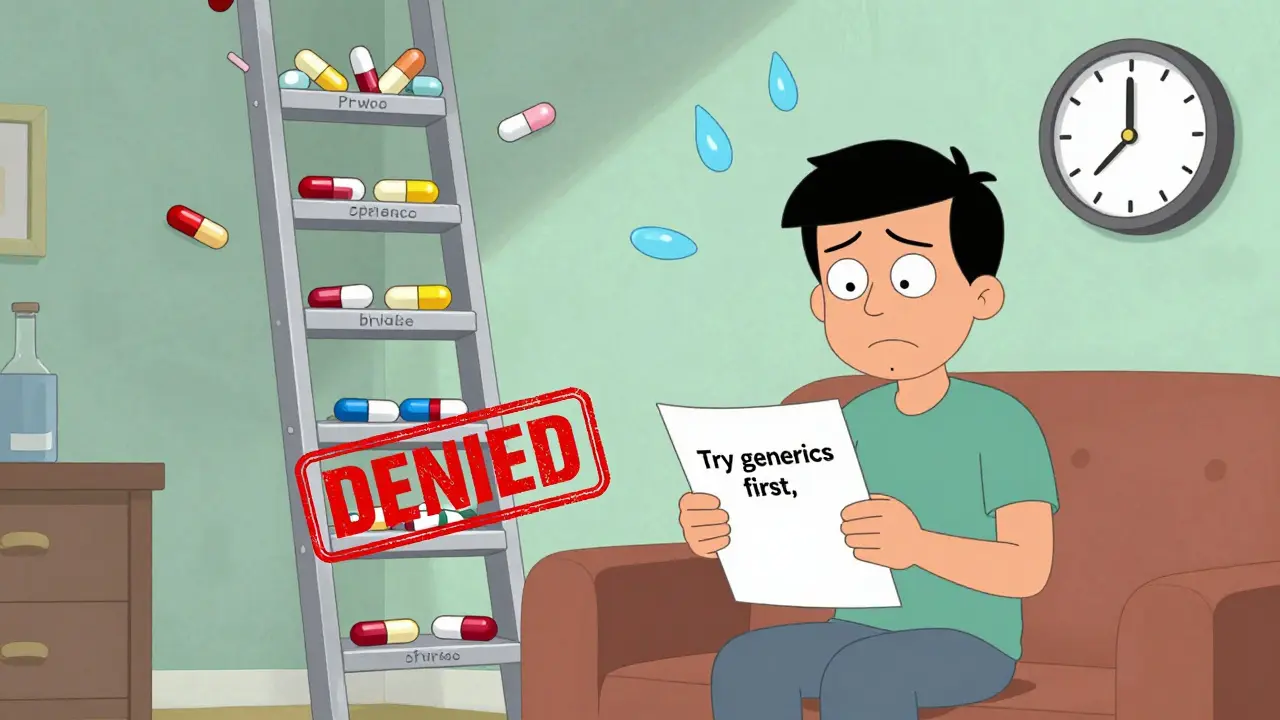
Imagine you’re on a medication that’s working fine - your pain is under control, your joints aren’t swelling, and you’ve got your life back. Then your insurance sends a letter: Stop taking this drug. Try three cheaper ones first. That’s step therapy. And it’s happening to millions of people right now, even if they don’t realize it.
What Exactly Is Step Therapy?
Step therapy, also called a "fail-first" policy, is when your health plan forces you to try one or more lower-cost drugs before they’ll pay for the one your doctor actually prescribed. Usually, those cheaper drugs are generics. If those don’t work - or if they cause side effects - you can then move to the next step: the brand-name drug your doctor originally wanted. It sounds simple. But here’s the catch: your doctor didn’t pick the first drug randomly. They picked it because they know your body, your history, your condition. Step therapy ignores that. It treats every patient the same, like a checklist. According to the National Institutes of Health, about 40% of U.S. health plans now use step therapy for prescription drugs. That number’s been climbing since 2018. And it’s not just for rare conditions - it’s used for arthritis, depression, diabetes, asthma, even migraines.Why Do Insurers Use It?
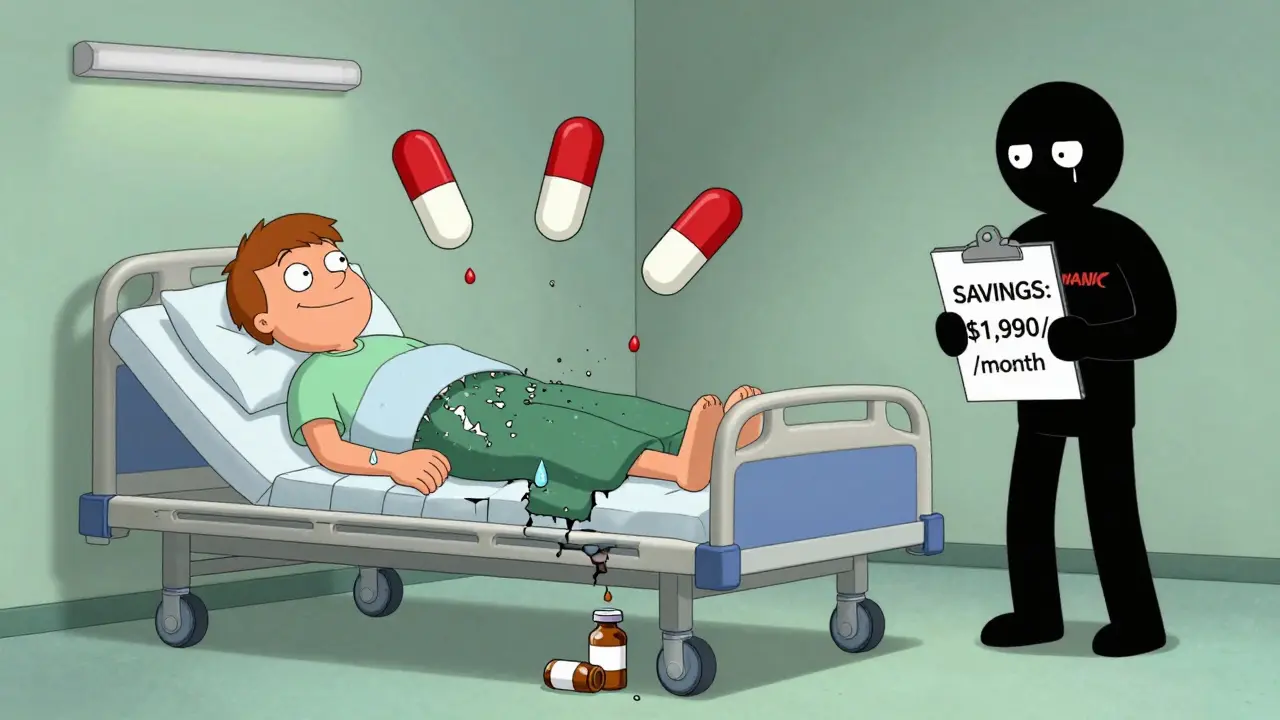
Insurers say step therapy saves money. And they’re not wrong. A 2021 Congressional Budget Office analysis found it can cut drug spending by 5% to 15%, depending on the condition. For example, a biologic drug for rheumatoid arthritis might cost $2,000 a month. A generic NSAID? Maybe $10. But here’s what insurers don’t always say: those savings come at a cost to your health. When you’re forced to try drugs that don’t work, your condition can get worse. Joint damage. Nerve damage. Hospital visits. All because you had to wait for approval. The American College of Rheumatology says step therapy puts patients at risk. In their 2022 report, they found that 42% of people with chronic conditions experienced disease progression while stuck in the step therapy loop. One Reddit user, "ChronicPainWarrior," described going through three different NSAIDs over six months before finally getting their biologic. By then, their joints were permanently damaged.How Does It Actually Work?
It’s not random. Insurers build a ladder. Step one is usually the cheapest generic. Step two might be another generic or an older brand-name drug. Step three is the one your doctor prescribed. For example:- Step 1: Generic ibuprofen for arthritis pain
- Step 2: Generic naproxen
- Step 3: Humira (brand-name biologic)
- Getting the first drug
- Taking it for weeks or months
- Going back to your doctor to prove it didn’t work
- Submitting paperwork to your insurer
- Waiting for approval - often 2 to 8 weeks
- Getting the next drug
- Repeating the process

When Can You Skip Step Therapy?
You’re not stuck. There are legal exceptions. The Safe Step Act - introduced in Congress multiple times since 2017 - outlines five clear situations where insurers must bypass step therapy:- You’ve already tried the required drug and it didn’t work
- The required drug would cause serious harm or side effects
- The required drug is contraindicated for your condition
- Delaying your treatment could cause irreversible damage
- You’re already stable on your current drug and it was previously approved
What Can You Do?
If your doctor prescribes a drug and your insurer denies it because of step therapy, here’s what to do:- Ask your doctor to file a step therapy exception. They need to include: why the required drugs won’t work for you, your medical history, and proof of past treatment failures.
- Call your insurer. Ask for the exact form and process. Get the name of the person handling your case. Write it down.
- Track every date. When you submitted. When you followed up. When you got a response.
- If denied, appeal. Most insurers have a two-tier appeal process. Don’t give up after the first no.
- Ask about patient assistance programs. Many drug makers offer free or discounted meds if you’re stuck in step therapy.
Amy Vickberg
January 16, 2026 AT 01:24My rheumatoid arthritis doctor fought for months to get me off the step therapy ladder. I was on ibuprofen for 11 weeks while my knees turned to cement. By the time Humira was approved, I could barely walk to the bathroom. Now I’m stable, but I’ll never forget how the system treated me like a spreadsheet.
Insurance companies don’t live with the pain. They just crunch numbers and call it efficiency.
Ayush Pareek
January 17, 2026 AT 11:44As someone from India where even basic meds are hard to access, I’m shocked this happens in the US. Here, we fight for any drug at all. But forcing people to fail first? That’s not cost-saving-it’s cruelty wrapped in bureaucracy.
Doctors know their patients. Let them decide.
Nishant Garg
January 17, 2026 AT 18:11Let’s be real-the entire healthcare industrial complex is a Rube Goldberg machine designed to extract profit while pretending to care. Step therapy? It’s not about savings. It’s about shifting risk from corporations to patients.
They’ll cut your biologic because it’s $2,000 a month, but won’t blink at a $50,000 ER visit because you collapsed from uncontrolled inflammation. The math is broken. The morality? Nonexistent.
And don’t get me started on how self-insured plans operate outside state laws. That’s corporate sovereignty with a side of human suffering.
Meanwhile, CEOs take bonuses while patients wait for approval letters like they’re waiting for a visa to another country. The system isn’t broken-it’s working exactly as intended.
Nicholas Urmaza
January 17, 2026 AT 19:46If you can't afford the brand name then you shouldn't be on it in the first place
Step therapy is common sense. People get lazy and want the expensive stuff because it's easier. The system is there to make sure you're not gaming it
Doctors should follow protocol not push their personal preferences
And if you're too sick to wait then you're already in the ER stop complaining about paperwork
Nilesh Khedekar
January 19, 2026 AT 09:18Ohhh, so now we’re supposed to feel bad for people who want the expensive drug because… their doctor said so? Wow. What a tragedy.
Let me guess-your doctor also thinks your cat should be on disability? Or that your chronic pain is caused by unresolved childhood trauma?
Step therapy exists because people like you keep demanding the $2000-a-month miracle drug when the $10 generic does the same damn thing for 70% of patients.
And don’t even get me started on how you all scream ‘unfair!’ when you’re told to try the drug your insurance actually pays for. Like you’re being tortured. Newsflash: you’re not dying. You’re inconvenienced. Get over it.
Nat Young
January 20, 2026 AT 11:28Here’s the real issue nobody’s talking about: step therapy doesn’t save money. It just delays costs.
People get worse. They end up in the ER. They need surgeries. They lose jobs. The system pays more later.
Also, the 17% who succeed on generics? They’re the lucky ones. The rest? They’re the invisible statistics.
And the Safe Step Act? It’s dead on arrival. Congress won’t touch it because Big Pharma and insurers both fund both parties.
So yes, you’re on your own. And no, your doctor can’t fix it. They’re just a middleman with a pen and a prayer.
Jan Hess
January 21, 2026 AT 04:44I’ve been through this with my son’s asthma meds. Took 6 weeks to get the inhaler the allergist prescribed. He ended up in the ER twice during that time.
Don’t let them make you feel guilty for wanting to stay healthy. Fight. Document. Call every single day. They get tired of you faster than you think.
And if your pharmacist offers to help? Take it. They’ve seen this a hundred times. They’re your secret weapon.
Iona Jane
January 23, 2026 AT 03:36They’re testing us. All of this. The step therapy. The delays. The paperwork. It’s a test to see who’s still willing to suffer quietly.
They’re weeding out the weak. The ones who won’t fight. The ones who don’t know their rights.
And when you finally get your drug… they’ll raise the deductible next year.
This isn’t healthcare. It’s a psychological experiment in compliance.
Jaspreet Kaur Chana
January 24, 2026 AT 04:17Back home in Punjab, my uncle took insulin for 30 years without insurance. He paid out of pocket, sometimes skipping doses to make it last. I never thought I’d see Americans complaining about having to wait for a drug.
But then again-you’ve got lawyers and patient advocates and pharmacies that will fight for you. In India, we just pray and keep going.
So yeah, fight. Use the system. Write the letters. Call the insurer. You’ve got tools we only dream of. Don’t waste them.
And if you get approved? Pay it forward. Help someone else navigate the mess. We’re all in this together.
Diane Hendriks
January 24, 2026 AT 05:37Step therapy is not only legal-it is economically rational, medically defensible, and ethically neutral when applied correctly.
Those who claim it endangers lives are conflating inconvenience with catastrophe. The data shows no statistically significant increase in mortality associated with step therapy protocols when exceptions are properly adjudicated.
Furthermore, the notion that physicians possess infallible knowledge of individual patient biology is a romantic delusion rooted in pre-evidence-based medicine.
Insurance companies operate under fiduciary duty. Patients do not have a moral right to premium drugs simply because they prefer them.
Let the market, not the medical ego, determine value.
And if you cannot tolerate the system? Move to a country with socialized medicine. But do not demand others subsidize your preference for branded pharmaceuticals.