

Imagine waking up with your skin covered in raised, red, itchy welts that seem to move around your body. One moment they’re on your arm, the next they’re on your neck. They burn, they throb, and no matter how much you scratch, they won’t go away. This isn’t just a bad rash-it’s urticaria, commonly called hives. It’s not rare. About 1 in 5 people will get hives at least once in their life. For some, it’s a one-time annoyance. For others, it becomes a daily battle that disrupts sleep, work, and even relationships.
What Exactly Are Hives?
Hives are more than just a skin reaction. They’re your body’s alarm system going off. When something triggers your immune system-like food, stress, heat, or even an unknown cause-special cells in your skin called mast cells release histamine. That chemical causes tiny blood vessels to leak fluid into the surrounding tissue, creating those swollen, itchy welts. They can be as small as a pinhead or as big as a dinner plate. They come and go, sometimes within hours, and often leave no trace behind.
Acute hives last less than six weeks. Chronic hives last longer-six weeks or more. About 70-80% of chronic cases have no clear trigger. These are called chronic spontaneous urticaria. You wake up with them. You go to bed with them. And no matter how hard you try, you can’t pinpoint why they keep coming back.
What Triggers Hives?
Not all hives are the same. Some are clearly linked to something you ate, touched, or were exposed to. Common triggers include:
- Shellfish, nuts, eggs, and dairy
- Medications like penicillin or NSAIDs (ibuprofen, aspirin)
- Insect stings or bites
- Latex or certain cosmetics
- Physical factors: heat, cold, pressure, sunlight, or sweat
But here’s the twist: in chronic cases, triggers are often invisible. Up to 80% of people with long-term hives never find a clear cause. That doesn’t mean nothing’s triggering them-it just means the trigger is internal. Autoimmune reactions, where your body accidentally attacks its own skin cells, are behind many of these cases. Studies show 30-40% of chronic spontaneous urticaria patients have antibodies targeting their own mast cells.
Physical urticarias-like pressure hives from tight clothes or cold hives from an AC blast-are real and underdiagnosed. They make up 20-30% of chronic cases. If you get hives every time you take a cold shower or wear a bra strap too tight, that’s not just coincidence. It’s a specific type of reaction.
Antihistamines: The First Line of Defense
If you’ve ever had hives, you’ve probably reached for an antihistamine. And for good reason-they’re the most effective first step. These drugs block histamine from binding to receptors in your skin, which stops the swelling and itching.
There are two main types:
- First-generation: Diphenhydramine (Benadryl), chlorpheniramine. They work fast but make most people drowsy-up to 70% of users feel sleepy. Not ideal for daytime use.
- Second-generation: Cetirizine (Zyrtec), loratadine (Claritin), fexofenadine (Allegra). These are non-sedating for most people and last 24 hours. They’re the go-to for daily management.
Doctors now recommend starting with a standard dose-10mg of cetirizine or fexofenadine once a day. But here’s what most people don’t know: if that doesn’t work after a week, you don’t just wait. You up the dose. The latest international guidelines say it’s safe to take up to four times the standard dose. For example, 40mg of cetirizine daily. Studies show this boosts control rates from 50% to over 70% in chronic cases.
Many patients report that loratadine only lasts 4-6 hours, forcing them to take it twice a day. Cetirizine, on the other hand, gives 8-10 hours of relief for most. Fexofenadine is less likely to cause drowsiness but can be less effective for some.

When Antihistamines Aren’t Enough
One in two people with chronic hives don’t get full relief from even high-dose antihistamines. That’s when things get more complex.
For those cases, biologics like omalizumab (Xolair) are used. It’s an injection given every four weeks. Approved since 2014, it targets the immune molecule IgE, which plays a role in triggering hives. Clinical trials show it works for 65% of patients who didn’t respond to antihistamines. People report complete symptom control within 4 weeks. But it’s expensive-around $1,500 per dose in the U.S.-and not everyone has access.
In September 2023, the FDA approved dupilumab (Dupixent) for chronic hives. Originally used for eczema and asthma, it showed 55% of patients had complete symptom relief in trials, compared to just 15% on placebo.
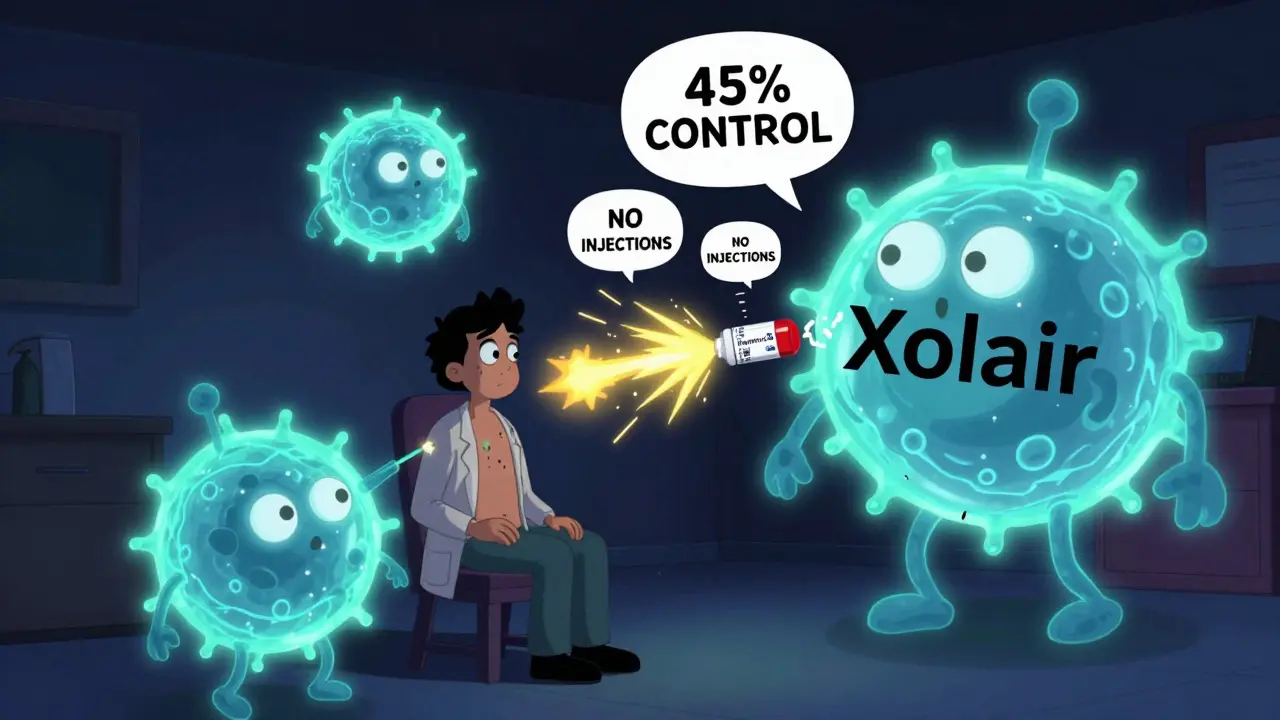
The newest option? Remibrutinib. Approved in January 2024, it’s the first oral tyrosine kinase inhibitor for hives. No injections. Just a pill, taken twice daily. In trials, 45% of patients had complete symptom control. Patient adherence is better than with injections-85% stick with it versus 70% for omalizumab.
Corticosteroids like prednisone give fast relief, but they’re not a long-term fix. Taking them for more than 3-5 days can cause high blood sugar, insomnia, mood swings, and weight gain. One patient on NHS.uk wrote: “After three days of prednisone, I couldn’t sleep, felt like I was losing my mind, and gained 5 pounds.” That’s why doctors avoid them unless it’s an emergency.
What Doesn’t Work (and Why)
Many people try home remedies: cold baths, aloe vera, vitamin C, or herbal teas. Some help with temporary comfort, but none stop the underlying reaction. Antihistamines are the only treatment proven to block the core mechanism.
Also, don’t assume your hives are “just stress.” While stress doesn’t cause hives, it can make them worse. If you’re having daily outbreaks, it’s not “in your head.” It’s a real immune response. Misdiagnosis is common. One in five chronic hives patients sees three or more doctors before getting the right diagnosis.
Managing Hives in Daily Life
Getting control isn’t just about pills. It’s about tracking. Start a simple symptom diary. Note:
- When hives appear
- What you ate or drank
- Any new products (soap, detergent, lotion)
- Stress levels, sleep quality, weather changes
Many people find patterns after 2-4 weeks. Maybe your hives flare after red wine. Or every time you exercise. Or during your period. That’s valuable info for your doctor.
If you’re on high-dose antihistamines and still struggling, talk to your doctor about combining therapies. Some patients use a non-sedating antihistamine during the day and a low-dose sedating one at night to help with sleep and itching. Studies show this improves control by 30%.
Apps like Urticaria Tracker (rated 4.3 on the App Store) help log triggers and share data with your doctor. Over 10,000 people use them. The Urticaria Patients Association offers global support groups-15,000+ members share tips, meds, and emotional support.
The Bigger Picture
Hives are more than a skin issue. They’re a quality-of-life issue. On Reddit’s chronic hives community, 68% of 1,245 respondents said hives disrupted their sleep-many waking up 2-3 times a night. One in five chronic hives patients develops anxiety or depression because of the constant itch, unpredictability, and lack of control.
The global market for hives treatments is growing fast-projected to hit nearly $3 billion by 2028. New drugs are coming. Genetic testing may soon help doctors pick the best antihistamine for your body, based on your DNA. But for now, the best tools are still simple: know your triggers, take the right dose of antihistamines, and don’t give up if the first one doesn’t work.
Chronic hives are not a life sentence. With the right approach, most people find control. It might take time. It might take trying a few things. But relief is possible.
Erik J
December 16, 2025 AT 13:49Interesting breakdown on the histamine mechanism. I’ve had chronic hives for 3 years and never realized autoimmune antibodies could be targeting mast cells. The 30-40% stat was new to me. I’ve been on 20mg cetirizine for 18 months-still not fully controlled. Wonder if I should push to 40mg like the guidelines say.
Naomi Lopez
December 17, 2025 AT 13:18As someone who’s read every paper on urticaria since 2020, I’m glad to see the guidelines finally acknowledge dose escalation. Most GPs still act like doubling antihistamines is dangerous. It’s not. The EAACI/GA²LEN/EDF/WAO guidelines explicitly endorse up to 4x standard dose. And yet, patients are left guessing. This post is one of the few that actually gets it right.
BETH VON KAUFFMANN
December 18, 2025 AT 00:23Let’s be real-most of these ‘trigger diaries’ are useless. I kept one for 14 months. Turned out my hives spiked every time I was stressed. Shocking. No kidding. Meanwhile, my dermatologist prescribed me a $1,200/month biologic because I ‘didn’t find a trigger.’ Meanwhile, I was sleeping 4 hours a night, drinking 3 espressos, and wearing a wool sweater. The trigger? Life. And your doctor doesn’t care. They just want to bill for omalizumab.
Martin Spedding
December 18, 2025 AT 10:11antihistamines dont work for me. i tried everything. even the 40mg thing. nothing. then i tried cbd oil. it helped a bit. but then i read online that it might interact with the new drugs. so now im scared to take anything. also i think big pharma is hiding the real cause. its the 5g. i know it sounds crazy but look at the rise in cases since 2018.
Kaylee Esdale
December 19, 2025 AT 00:53you’re not alone. i used to cry in the shower because the water made me break out. now i use a fan to cool down before bed and wear cotton shirts. it’s not glamorous but it keeps me from screaming all night. if you’re reading this and you’re tired-keep going. you’re stronger than the itch.
Donna Packard
December 20, 2025 AT 11:13Thank you for sharing this. I’ve been on fexofenadine for 8 months and just increased to 180mg daily last week. Still no breakthrough, but I’m not giving up. I just started the Urticaria Tracker app. Logging my sleep and stress levels already helped me notice a pattern with my menstrual cycle. Small wins.
Jody Patrick
December 21, 2025 AT 09:55Why are we letting Big Pharma sell us $1500 shots when we have cheap pills? This is a scam. America spends more on hives than any country. We need real solutions, not fancy biologics. Just ban the food dyes already.
Raven C
December 22, 2025 AT 04:31I must say, while your clinical overview is technically accurate, the casual tone undermines the gravity of this condition. Chronic urticaria is not merely a ‘skin issue’-it is a systemic, neuroimmunological dysregulation that profoundly impacts psychosocial well-being. One must approach this with the rigor it deserves, not with bullet points and app recommendations. The emotional toll is underreported, and your phrasing risks minimizing it.
Marie Mee
December 23, 2025 AT 02:17you think its bad wait till you find out the real reason they dont want you to know about remibrutinib its because the government is in bed with the pharma companies and they want you to stay sick so they can keep selling you the expensive stuff i heard they are even putting something in the water to make it worse i know its crazy but i saw it on a video